
"Air Pollution in Delhi: Breathing Amidst a Crisis"
"Exploring the Causes, Impacts, and Solutions for a Cleaner, Healthier Future in India's Capital"
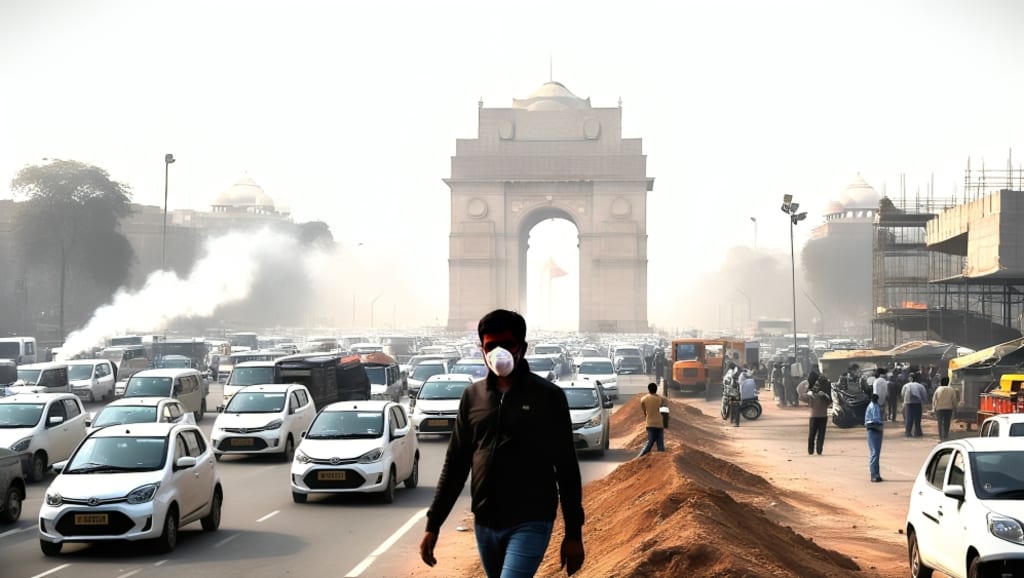
Air Pollution in Delhi: A Problem We Need to Tackle
Delhi is India's seat of power, housing over 20 million people and thousands of dreams. However, as a part of its vibrant culture and history, the city of Delhi suffers from a growing menace-air pollution. The air is so toxic that it poses serious health challenges for everybody, including infants and the elderly. This crisis has reached alarming levels, making it one of the most polluted cities in the world. But what's causing this, and what can we do about it?
Understanding Air Pollution
Air pollution occurs when harmful particles and gases, dust, smoke, and chemicals, mix up with the air. Many of them are very small and even invisible to the human naked eye, yet they have a great effect on human health and the environment at large. The case worsens in Delhi, during winters specifically, as a phenomenon called temperature inversion causes the air to trap close to the ground; it then gives rise to the famous smog: a thick mixture of smoke and fog.
What Makes Delhi’s Air So Polluted?
Several factors contribute to Delhi’s poor air quality:
Vehicle Emissions:
With millions of vehicles on the roads, Delhi's traffic is a major source of pollution. Cars, buses, and motorcycles release large amounts of harmful gases like carbon monoxide and nitrogen dioxide, which degrade air quality.
Industrial Activity:
All factories and industrial plants in and around Delhi throw smoke and poisonous chemicals into the atmosphere. Such emissions account for a large percentage of the pollution in the city.
Construction Dust:
The city is constantly under construction-roads, bridges, apartments, or offices. Though this is a must-do, it throws tons of dust into the atmosphere, causing pollution.
Crop Burning of neighboring states:
For four months of the year, Punjab, Haryana, and Uttar Pradesh clear their fields for the next planting season by burning leftover crop stubble. The smoke makes its way to Delhi, exacerbating already dismal air quality.
Fireworks at Festivals:
Festivals like Diwali are a source of joy but are also contributors to pollution through the ample usage of firecrackers, which release harmful chemicals in the atmosphere.
Effect of Air Pollution
The effects of air pollution in Delhi are widespread and devastating:
Health Issues:
Polluted air is like a slow poison. It causes respiratory problems like asthma, bronchitis, and lung infections. The long-run exposure has the possibility of fetching severe diseases like lung cancer and heart conditions. In particular, risks are even greater for children, whose lungs are still under development, and the aged, who possess weaker immune systems.
Poor Visibility:
During winters, dense smog-like conditions in Delhi can reduce road visibility, which leads to accidents. It's also responsible for flight delay and disrupts the regular routine of people.
Environmental Damage:
Pollution harms not just humans but also plants, animals, and water bodies. It can damage crops, affect biodiversity, and cause climate change.
What Can Be Done?
Delhi's air pollution crisis is not an unsolvable problem. Such a situation demands a concerted effort from the administration, industries, and citizens. Now, here is what we can do:
Start Using Public Transport:
The number of vehicles on the roads can reduce quite drastically if not many vehicles are on the streets. The metro and buses in Delhi are excellent alternatives to private cars.
Promote Green Energy:
Switch to electric cars and solar and wind power will give an impetus in reducing fossil fuel dependency.
Improving Waste Management:
It is essential to put a stop to burning of wastage including crop stubble. Farmers should be provided with alternatives. Government incentives are also needed for the farmers to refrain from burning their fields.
Stringent Laws:
Stringent laws for pollution control at factories and vehicles. Penalties should be hiked for violation.
Every citizen can make a difference. Planting trees, reducing energy consumption, and avoiding firecrackers might make little difference individually, but collectively it makes a big difference.
The Future
The air pollution in Delhi serves as a reminder of rapid urbanization without employing sustainable practices. The government has also initiated schemes such as the Odd-Even scheme and the employment of smog towers; these should be part of a long-term, comprehensive planning.
Clean air isn't only a matter of cleaner air; it's a matter of saving lives and having a healthy future for generations to come. Each one of us has his role, and now is the time to take action. We can transform Delhi into a city where we enjoy clean and life-giving air with each breath.
About the Creator
Keep reading
More stories from ANKIT SHARMA and writers in Critique and other communities.
Celebrating Constitution Day: Honoring the Foundation of India's Democracy
India, on each November 26, celebrates Constitution Day, also known as Samvidhan Divas, as the country pays homage to the adoption day of the Indian Constitution. However, this day is also a reminder to most people regarding the values, principles, and rights that happen to be the bedrock of the world's largest democracy. Whether you're a history fan, a curious student, or someone eager to understand the spirit of our nation, let's explore why this day is so significant.
By ANKIT SHARMAabout a year ago in Education
Cassie and Johnny
I’m the kind of dame you notice. I’m no femme fatale, but you can’t ignore me, at least not until I warn you about what’s coming, then everybody ignores me. Hell, they usually blame me afterwards and give Johnny all the credit for saving the day, but my Johnny couldn’t save a seat at the movies without my help. Sure, he’s brawny, but brainy? Not so much. Like that time I asked him to spot me five bucks, and he said he didn’t see it anywhere on me, and believe you me, he looked but good.
By Harper Lewis17 days ago in Critique
Movie Review: "I Heard the Bells"
"I Heard the Bells," produced by Sight & Sound Films (which shares the same parent company that operates the popular Broadway-style theaters in Lancaster, Pennsylvania and Branson, Missouri), is a treat to watch every Christmas. It depicts the true story behind the Christmas carol "I Heard the Bells on Christmas Day," written by poet Henry Wadsworth Longfellow.
By Heather Clark2 days ago in Critique
Top tipple tricks
Been thinking a lot about drinking, lately. Not least because of a recent episode of over-indulgence and the inevitable after effects. Some readers may recall the earlier articles I wrote about beating the booze. Here I set out an experiment in techniques for cutting down on my alcohol intake. The experiment was successful, the techniques worked, and I have armed myself with an arsenal of weapons in the war against the demon drink. I have yet to fire the first round however. It's all a question of timing (perhaps procrastination).
By Raymond G. Taylor7 days ago in Psyche



Comments (1)
It’s very bad in India the polutionwell written thank yo7 for sharing