
Why Don’t We Know More About D.C.’s First Serial Killer?
He has never been caught

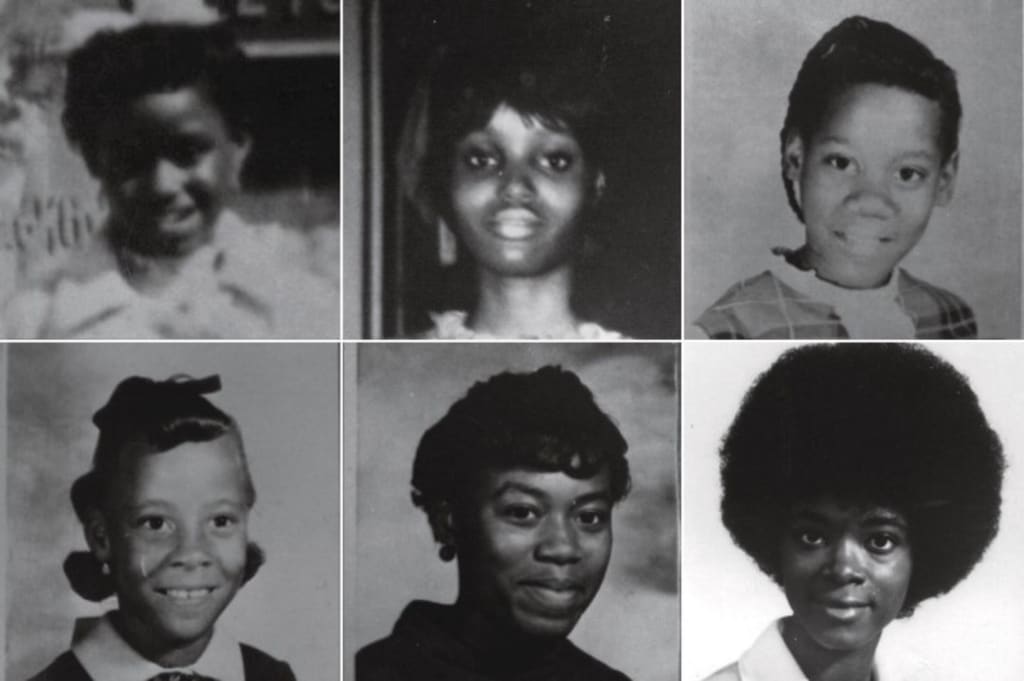
The Freeway Phantom was a moniker given to a serial killer who operated from April 1971 to October 1972. The Freeway Phantom was Washington D.C.’s first serial killer who murdered six young girls during his spree. What was a key commonality all of those girls had? They were black.
Carol Spinks was just 13 years old when she became the Freeway Phantom’s first victim. She left her house one night to go to a 7-Eleven and was never seen alive again. Six days later, Carol’s body was found next to the I-295. She had been raped and strangled by her killer.
He would then target Darlenia Johnson. The 16-year-old worked a summer job at Oxon Hill Recreation Center. That was until she failed to arrive for work one morning in July. Her body was found in the same area as Carol’s body. Seven days later, Brenda Crockett — who was just 10 years old — was missing after seeing a movie. Nenomoshia Yates was 12 years old. She disappeared after going to the supermarket for groceries.
Number 5 on the Phantoms victim list was Brenda Woodard. She was an 18-year-old woman who was last seen taking the bus home from dinner at a restaurant. The last known victim was 17-year-old Diane Williams. Diane was on her way home from spending time with her boyfriend.
All of the Phantom’s victims were found raped, strangled, and 5 of them had their shoes removed. According to the police, Brenda Woodard was more brutally attacked than the rest of the victims. That fact gave them early insight into the serial killer they were looking for. One of the key differences with Brenda’s murder was that her killer left a note on her body. Interestingly, the note was in Brenda’s handwriting The note read:
“This is tantamount to my insensititivity [sic] to people especially women. I will admit the others when you catch me if you can! Free-way Phantom!” the message read.
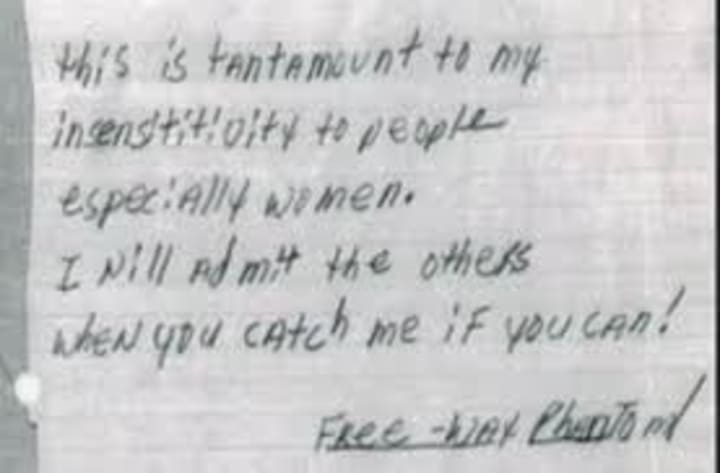
According to former D.C. Police detective Romaine Jenkins, an analysis of the handwriting showed that Brenda did not write it while under duress. This led him to believe that Brenda knew her killer and willingly went along with writing the letter, all the while being unaware of what her killer was planning. Brenda did become aware of what was happening at some point, though. She had defensive wounds and was the only victim who was stabbed. She also was the only victim to be found with her shoes still on.
And then there was Brenda Crockett.
Detective Jenkins believes that Brenda’s mother spotted her with the Phantom. On the night that she was taken, Brenda called her house two times. The first phone call was to tell her sister that a white man kidnapped her and had taken her to Virginia. The police believe that Brenda was fed this story by the Phantom in order to keep him off of their radar.
Jenkins also believes that 10-year-old Brenda Crockett’s mother might have seen the killer in action. Brenda had called her home twice on the night she was abducted. The first call was to tell her sister that she had been kidnapped by a white man and had been driven to Virginia — a story police believe was fabricated to throw them off the scent.
When Brenda called a second time, she asked a very telling question. “Did my mom see me?”. Brenda was asking this question to her mother’s boyfriend. He immediately asked her how her mother could have spotted her if her abductor had taken her to Virginia. At that moment, he told Brenda to put whoever took her on the phone. Then the line went dead. Detective Jenkins was sure that this was proof of the Phantom being local. He believes that Brenda was told to make that phone call out of fear that the Phantom had been spotted by her mother as she was canvassing the neighborhood.
“Why would you let her call home, not once, but twice?” Jenkins said. “He had to make sure that the mother didn’t see her.”
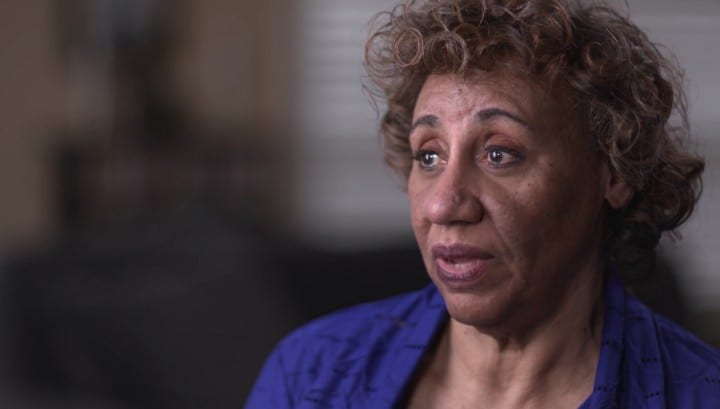
As the police worked to find answers, they came across a major clue. It appeared that he used St. Elizabeth’s Hospital as an anchor point for their victim choices. St. Elizabeth’s was a mental asylum in Washington D.C. It is believed that the killer may have been someone familiar with the facility — perhaps a patient or a worker who knew the area. The Phantom also kept trophies. He would take textbooks, curlers, shoelaces, and other items from the girls he attacked. The hope is that someone may come across those items one day.
As far as suspects go, the police haven’t had many strong leads. After ruling out a group known as the “Green Vega Rapists”, the police focused on a man named Robert Askins. Askins was a known kidnapper and rapist who had previously been charged with homicide on three occasions. He had also spent time as a patient at St. Elizabeth’s Hospital. When the police searched his home, they found documents with diction similar to the letter he forced Brenda Woodard to write. The police, however, were not able to find any hard evidence to link Askins to the murders. He denied any and all involvement in the killing spree. Askins died in April 2010 while serving time in prison.
While the Phantom was forensically aware enough to keep evidence away from the police (he knew enough to wash the bodies, leave little DNA behind, and dump the bodies in different states), there is another factor believed to have been on his side: Race.
“Those Black girls didn’t mean anything to anybody — I’m talking about on the police department,” said Tommy Musgrove, head of the D.C. police homicide unit. “If those girls had been white, they would have put more manpower on it, there’s no doubt about that,” he added.
About the Creator
True Crime Black
The True Crime genre doesn’t always include equity in its storytelling. WE need to shine a light on our victims of color.
Keep reading
More stories from True Crime Black and writers in Criminal and other communities.
Will Jayson Artis Ever Get Justice?
This case centers around 22-year-old Jayson Artis. Jayson had just made the move from his home in Virginia to Los Angeles so that he could attend college there. Before starting his classes, Jayson decided to enjoy his new home. In July of 1998, he brought his brother Steven to Los Angeles for a visit. The two took a trip to Tijuana, Mexico for some partying. On August 1st, Jayson’s friend Michael met them at Avienda Revolucion. Jayson supposedly had a reputation for being a more rowdy person when he would drink, which made this night of partying a potentially bad combination. That was starting to show itself when Jayson became upset with a bartender. He was annoyed that the tequila he was drinking was $6 a shot and he initially didn’t want to pay for it. Michael was able to convince him to pay it and leave — which is exactly what happened.
By True Crime Black3 years ago in Criminal
The $23,000-a-Day Question: Ephrata spends $8.5 million a year for police. What are we actually buying?
The Invoice Arrives Every year, Ephrata property owners receive a tax bill. A massive chunk of that bill goes to one place: The Police Department. We are told this is the price of safety. We are told that we have a "Gold Standard" department that warrants premium funding.
By Sunshine Firecrackera day ago in Criminal


Comments
There are no comments for this story
Be the first to respond and start the conversation.