
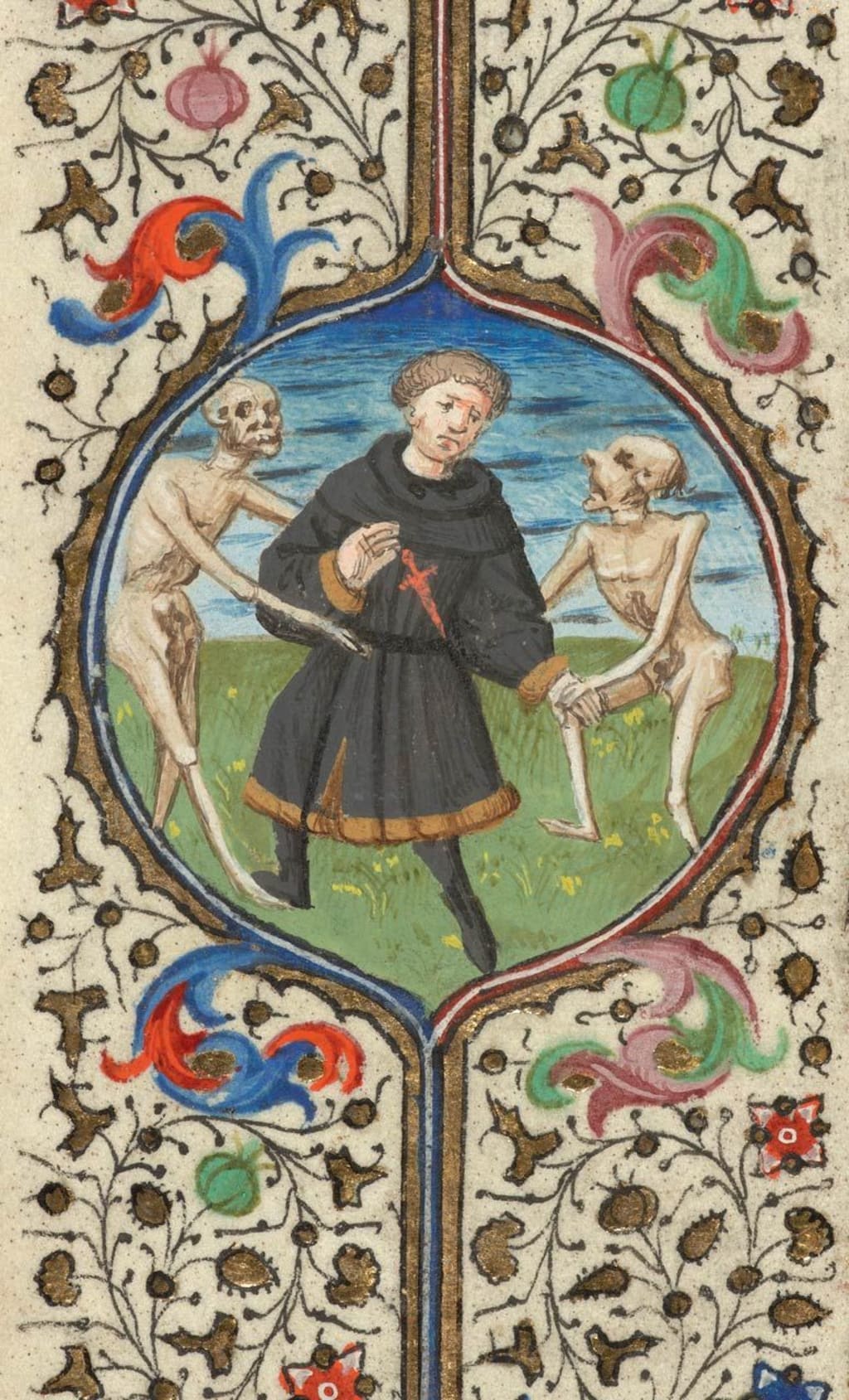
The Reverend Theo Littleworth had never been threatened with a pistol by a nun before, and so he was naturally at a loss as to how to react. The awkwardness of the situation was not helped by the fact that he was kneeling in an antique store over a prostrate man who appeared to be dead. That is to say, blood was flowing liberally from his chest and he had no pulse. His glanced around the antiquaries, many of them of a religious character, and his eyes rested briefly on a resin statuette of Saint Christopher carrying the infant Christ on his shoulders. He half-hoped it might provide some guidance, but it bore the expression of someone saying ‘Sorry mate.’
The priest decided to say ‘Hello there.’
The figure he was looking at was trembling. She did not look like the sort of person who goes around shooting priests. She could not have been more than forty, with a small nose and features which Littleworth imagined were habitually cheerful. She wore a short, pale blue head veil and the casual but modest dress and shirt now worn by most women’s’ religious orders in Australia. Her view was of a slightly-built, unshaven young man with a furrowed brow and jet black hair. He wore a full Roman collar with a black shirt, and despite the fact it was the height of summer wore a brown coat and purple waistcoat. His attire appeared worn, a little frayed and too big for his body. He also had a rather battered grey trilby, which he had taken off to examine the body.
‘What are you doing here?’ she demanded in a shrill voice. ‘Did you do kill him?’
Littleworth’s attention was already elsewhere. He had taken a long, thin length of purple cloth, embroidered with a yellow cross, out of his coat pocket and was placing it around his neck. Then, gazing intently into the face of the dead man and tracing a cross in the air above him, said
‘I absolve you from your sins, in the name of the Father, and of the Son, and of the Holy Spirit.’
Instinctively the woman answered ‘Amen’, placed the pistol on a table nearby, and knelt beside the priest. Littleworth regarded her curiously.
‘Are emergency services coming?’ he asked.
‘Yes,’ the woman said, and continued to kneel reverently while the priest administered the last rites.
A Detective Inspector Boyle was presently on the scene, accompanied by a young sergeant who seemed to find the sight of a priest and a religious in the company of a bloody corpse amusing. Littleworth wondered if he would at some point address him as ‘Father Brown.’ The detectives interviewed the two separately, and there appeared nothing contradictory in their accounts. It seemed that the deceased, Robert Badouin, antiquarian specialising in items of religious interest, had contacted both Father Littleworth and Sister Agatha Fitzgerald on separate occasions and asked them to come to him at the store. He said nothing about the purpose of their visit save that he needed to tell them something important. Both knew Badouin only by repute. He was a devout Catholic who attended Mass regularly and had given to a number of good causes. Littleworth was a priest at the city cathedral and Fitzgerald lived in a small religious community and managed a thrift store. Sister Agatha arrived at the appointed time – 2 pm – and found Badouin on the floor bleeding, non-responsive and not breathing. She rang for the police and paramedics. The priest, who had also been requested for 2 pm, came upon the scene several minutes later and Sister Agatha, momentarily believing him to be the man’s murderer, drew a pistol on him, which turned out to be a plastic replica she kept in her bag to frighten off potential attackers. The police pathologist ascertained that Mr Badouin had died from a bullet in the heart and that he had been dead at least an hour. A thorough inspection of the premises revealed nothing about his attacker.
The Reverend Theo Littleworth and Sister Agatha Fitzgerald learned nothing more of the investigation, except that it was ongoing, and attempted to return to their lives, which was of course difficult. Both were curious to know, for example, what Mr Badouin had wanted to tell them and whether it might be connected to his murder. Yet not two weeks later they found themselves in each other’s company again, this time in the offices of a solicitor named Ishana Patel.
‘I thought it best to settle this business with you both present,’ Ms Patel was saying. She went on to tell her puzzled audience that Robert Badouin had bequeathed a piece of medieval art to each of them.
‘He meant to give them in his lifetime, but made a provision in his will if for whatever reason he did not.’
She then indicated two plain wooden boxes with latched lids and invited the priest to open one and Sister Agatha the other. They discovered to their amazement two large, leather-bound books, the pages of which were richly and delicately adorned with Latin calligraphy and the most exquisite medieval illuminations. The solicitor explained that the book Littleworth marvelled at was a book of hours dated 1475, and that Sister Agatha’s treasure was a missal probably made about thirty years later. She also handed over letters of authentication and evaluation. It seemed that the book of hours would sell for twenty thousand dollars – US –and probably more at auction, while the missal was valued at three times that amount.
‘Good heavens,’ was all Littleworth could bring himself to say, and these sentiments were echoed by Sister Agatha with a short gasp. They of course asked why someone they did not know should bequeath such wondrous gifts, to which Ms Patel replied
‘I really couldn’t say, sorry. I honestly have nothing more to tell you.’
Sister Agatha and Father Littleworth had both taken a bus to the offices of Ishana Patel, and given the value of their new possessions they thought it wiser to share a taxi home. Besides, they both wanted to analyse their good fortune.
‘So it’s safe to say Robert Badouin called us to give us these,’ Sister Agatha was saying.
‘Which suggests the possibility that whoever killed him knew what he was going to do and that he was going to meet us that day,’ the priest added. ‘Someone who didn’t want us to have them.’
‘But he couldn’t have known about the will. Why would he – or she – kill him if he knew we would get the books anyway?’
The furrow in Littleworth’s brow deepened. ‘And why kill on the day he was to meet us? The murderer could have done it anytime. Then again, the murder and the meeting with us could be entirely unrelated.’
‘The first question we have to answer is why these medieval manuscripts were given to us,’ Sister Agatha said. ‘Surely that’s the key.’
Littleworth regarded the woman quizzically. ‘What do you mean, ‘we’? These are questions for the police, surely.’
‘Well, we can help them,’ Agatha replied. ‘We owe that much to Robert Badouin, at least.’ She grinned. ‘Come on, Father-‘
‘No,’ Theo Littleworth interrupted sardonically. ‘Do not call me Father Brown.’
Nun and priest spent several hours over the course of a week or so in a secluded and dimmed section of the city library – one of the best in the country - thumbing through catalogues of medieval collections and peering at microfiche. They were trying to find records of the medieval manuscripts using details supplied by the authentication papers. Research regarding the missal bore fruit first and yielded surprising results, and when the provenance of the book of hours was revealed it was decided that a visit to the genealogy section might be beneficial. When they had finished their researches Littleworth leaned back in his chair, removed his reading glasses and remarked to no-one in particular
‘Well, I’ll be buggered.’
A few readers nearby glanced casually at him and Sister Agatha answered
‘Indeed.’
The two duly called upon Inspector Boyle and presented their findings in the pages of a small black-covered notebook. It seemed that both the missal and the book of hours once belonged to the Abbey of Baylesend in the time of King Henry VIII, which, like all the monasteries in England, was despoiled by that disagreeable prince. Some treasures however were spirited away before the monarch’s commissioners could seize them. One of these was the missal, which was conveyed into the custody of one Edmund Fitzgerald, Earl of Baylesend. The book of hours was another, and this was preserved by the earls’ sister Anne, who was married to Sir Thomas Littleworth. The items remained in the keeping of their families until 1746 when the then Earl of Baylesend, Oswald Fitzgerald and Lord David Littleworth, descendant of Sir Thomas, were arrested for their support of the pretender to the British throne, James Stuart. The missal and book of hours were confiscated, along with other treasures, by a Captain Reginald Dunbar, who did not turn them over to the crown. Since then their whereabouts were unknown until 2018, when they appeared at an auction house in Austria and were purchased by one Robert Badouin.
Suppose, Littleworth and Fitzgerald suggested, that Robert Badouin had discovered the manuscripts in his professional travels, learned of their provenance and decided that they should be returned to descendants of their original custodians. Suppose also that he had discovered that two individuals both living in the same city as he were in fact direct descendants. If he were a man of means, as his occupation would seem to indicate, he might very well decide to make this altruistic gesture, especially as he was a man of faith and knew the missal and book of hours would return to the Church. Consider also, they continued, the possibility that someone who stood to gain a share in Badouin’s business and knew about the manuscripts was told by him what he intended to do on the day he died and shortly before the intended meeting. So the murderer, who obviously knew nothing about the provision of Badouin’s will, believed he had to murder him there and then.
Boyle listened patiently but with the enthusiasm of Jack’s mother receiving magic beans. Their theory seemed fanciful though it did seem to fit some of the facts. They were certainly not the first to present themselves as amateur sleuths. He thanked them and politely bade them farewell.
Father Theo Littleworth and Sister Agatha Fitzgerald never learned if their theory had been correct. But a few months later they were sharing tea in a cafe and noticed a small item in the paper informing the world that Robert Badouin’s nephew and heir, Peter Badouin, was ‘helping the police with their inquiries’.
The two smiled at each other.
‘We might very well have done justice for Robert Badouin,’ said Sister Agatha. ‘Well done, Father Brown.’
Theo Littleworth frowned and replied ‘Well done, Sister Christie.’ And he rose to pay the bill.
.
About the Creator
Gary Campbell
Hi. I'm an Australian writer, specialising in kids' stories and history, but quite happy turning my pen to crime, drama and Sci-fi. I think reading should be fun and I hope you enjoy my stuff.
Keep reading
More stories from Gary Campbell and writers in Criminal and other communities.
When angels tread in blood
The Reverend Theo Littleworth had never been threatened with a pistol by a nun before, and so he was naturally at a loss as to how to react. The awkwardness of the situation was not helped by the fact that he was kneeling in an antique store over a prostrate man who appeared to be dead. That is to say, blood was flowing liberally from his chest and he had no pulse. His glanced around the antiquaries, many of them of a religious character, and his eyes rested briefly on a resin statuette of Saint Christopher carrying the infant Christ on his shoulders. He half-hoped it might provide some guidance, but it bore the expression of someone saying ‘Sorry mate.’
By Gary Campbell5 years ago in Criminal
The Mayor’s Silence: Thomas Reinhold, Jonathan Gerlach, and Ephrata's 'House of Skulls'
The Promotion to Failure Thomas G. Reinhold isn’t a newcomer to Ephrata’s power structure; he is its architect. After spending over a decade (2012–2025) as Council President—rubber-stamping police budgets and prioritizing quick, unanimous meetings over deep scrutiny—Reinhold finally ascended to the Mayor’s office in January 2026.
By Sunshine Firecracker6 days ago in Criminal
Rachel Reviews: The Spiral Archive by Pieter Hendrik
It's difficult for me to know where to start with a review of this book as it was, for me, an entirely unique experience and one that I'll probably never have again. I don't want that to be interpreted as unenjoyable but it has left me scratching my head a little and ruminating on its content, its themes and its characters.
By Rachel Deeming4 days ago in BookClub



Comments
There are no comments for this story
Be the first to respond and start the conversation.