
What Constitutes The Crime of Stalking
Elements of the Crime of Stalking
Conduct
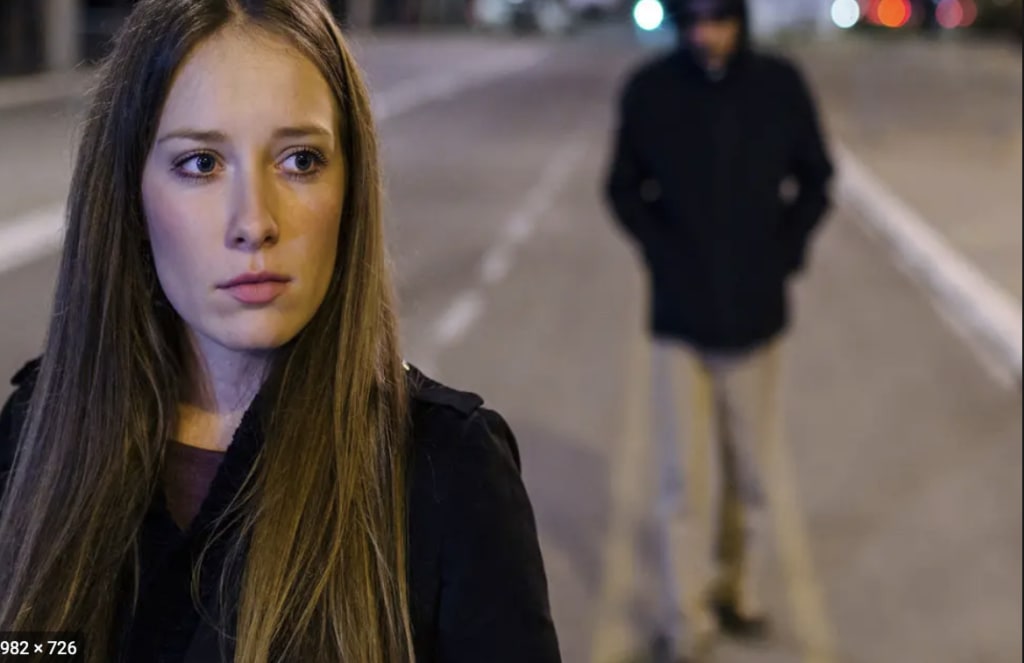
Any conduct or action done by an individual, directed to another with the knowledge that such a conduct would cause the other person to fear for themselves of bodily injury or death is one element of stalking. The injury feared may be in the possibility of happening to the person who is the direct recipient of such a conduct, their family members, their property or the property of such a family member. This conduct could be in the form of following someone or causing yourself to be where you know the other person will be too. Physical threats may also be included into the bracket of conduct as they form actions.
Result
It is required that to prove the crime of stalking, the person to whom the conduct is directed is made to fear. If the person themselves cannot be used to prove this, the test for a reasonable man is employed.
Timing
The time factor in hinted in the statute as discussed in the case can be construed to mean both the frequency of the conduct as well as the chain of events within which the conduct is done. The statute requires that the following or the action that causes fear in the other person has to be on more than one occasion. This is the frequency of the conduct. The statute talks of a scheme or course as regards the conduct. This means that until a given desired result is obtained by the stalker, they ae unlikely to stop. The conduct is, therefore, is just but a means towards achieving the end result which may be bodily injury or even death.
Unconstitutional Vagueness of the Stalking Statute
As much as the appellant tries to lean towards the vagueness of the statute in respect to the constitution, an in particular the First Amendment, the efforts are futile because the sought for vagueness is not there. The statute is clear and in a wording system to be understood by a person of ordinary intelligence as required in the receding Grayned case. The vague words in the previous statute having been removed and replaced with more clear words gives the effect that the new statute is not vague to an extent that it be unconstitutional (McCarthy 2007).
Evidence
The evidence in the case is enough, both factually and legally to support a conviction in stalking. In the case, Nathan’s conduct of following Jennifer, or availing himself where he knew Jennifer would be forms such a conduct that made Jennifer fear since one more than one occasion, he did it and, with the knowledge that she feared, Nathan did not stop. He knew that his actions or conduct made Jennifer to fear, so the element of knowledge of the result as envisaged in §§ 42.072 of the Texas Penal Code is properly met.
On the numerous occasions he came close to Jennifer, Nathan saw and obtained the knowledge that she got scared and would be crying. As if not enough, she called him sometimes to tell him she was afraid. Finally, in his response to the divorce so filed by Jennifer, Nathan acknowledged the fear in Jennifer. All this can mean the fear was beyond reasonable doubt.
Factual evidence on a reasonable person’s test would be on December 19th 1996 when he followed her and the distance between their cars was about an inch. He even hit Jennifer’s window at the police station. A reasonable person would only anticipate bodily injury would he have broken the window at the station or death would he have caused a crush with the cars (Hills & Taplin 1998)
About the Creator
Amanda Marie Bremer
As a storyteller, my goal is to connect people interested in world events. I love to share my opinions and reviews on matters based on research as well as personal experience.
Keep reading
More stories from Amanda Marie Bremer and writers in Criminal and other communities.
Biology Race and Racism
The study of genomes confirms an existing biological basis for the different races. As per the Mixed Marrow Registry, a black person has a 23% chance while a white person has 77% of finding a matching donor (Halagan et al., 2018). The probability of the different races is determined by the population representation in the Mixed Marrow Registry.
By Amanda Marie Bremer4 years ago in Humans
A Horror Movie Come to Life: Inside the Nightmare at 100 Washington Avenue
The Raid on Washington Avenue On the morning of January 6, 2026, the residents of Washington Avenue woke up to a swarm of law enforcement vehicles. But this wasn't a standard drug bust. The officers entering 100 Washington Avenue were wearing hazmat gear and respirators.
By Sunshine Firecracker3 days ago in Criminal
Crime Chronicles: Darya Nikolaevna Saltykova
A little while ago, we covered the story of Delphine LaLaurie (1787 - 1849), the New Orleans socialite who tortured and murdered her slaves. We also covered Erzsebet Bathory (1560 - 1614), who did the same thing in Hungary around 200 years before that; I didn't think I'd find another one, but I did - in Russia.
By Greg Seebregts3 days ago in Criminal




Comments
There are no comments for this story
Be the first to respond and start the conversation.