
What Bangladesh Stands to Lose in an India-Pakistan War
Though not a direct participant, Bangladesh could suffer serious humanitarian, economic, and political consequences if war breaks out between its two nuclear-armed neighbors.


Tensions between India and Pakistan have long loomed over South Asia, with both nations having fought multiple wars since their partition in 1947. In today’s volatile geopolitical climate, the potential for another military confrontation remains a persistent concern. While Bangladesh may not be a direct party to such a conflict, its geographic proximity, economic interdependence, and political positioning mean that it cannot remain unaffected. If India and Pakistan go to war, Bangladesh is poised to suffer serious humanitarian, economic, social, and diplomatic consequences.
Humanitarian Fallout: A Refugee Crisis on the Horizon
One of the most immediate effects of a war between India and Pakistan could be a sudden influx of refugees. Historically, Bangladesh has seen large-scale cross-border migration during conflict periods—most notably during the 1971 Bangladesh Liberation War, when millions fled to and from India. In a contemporary conflict, civilians from India's northeastern states or from regions near the Bangladesh-India border might flee into Bangladesh to escape violence. This would create an enormous burden on the country’s already strained infrastructure—especially in terms of shelter, food supply, sanitation, and medical services.
Economic Repercussions: A Fragile Balance at Risk
Bangladesh’s economy is intricately linked to regional stability. A war between two neighboring giants would disrupt this balance in several key ways:
• Trade Disruption: Both India and Pakistan are important regional trading partners. War would likely halt trade routes, delay shipments, and increase the cost of imports and exports. The ready-made garments (RMG) sector, which depends on a smooth supply chain, would face serious setbacks.
• Foreign Investment Deterioration: Investors typically flee unstable regions. A regional war could cause foreign direct investment (FDI) to plummet, particularly in a country like Bangladesh, which relies heavily on investor confidence for infrastructure and industrial growth.
• Currency and Inflation Risks: Global oil prices tend to spike during wartime. For an import-dependent country like Bangladesh, this would lead to inflation and increased production costs, affecting consumers and small businesses alike.
Diplomatic Dilemma: Balancing Two Giants
Bangladesh shares a complex relationship with both India a২nd Pakistan. In the event of war, it may face international pressure to take sides—a position that could alienate one or both powers. Remaining neutral might seem ideal, but it may not be diplomatically sustainable. India's proximity and historical role in Bangladesh’s independence make neutrality politically sensitive, while Pakistan’s ties with the Muslim world might influence internal public opinion in Bangladesh.
This diplomatic tightrope could affect Bangladesh’s standing in regional platforms like SAARC and may also influence its relationships with other global powers such as China, the U.S., or members of the OIC.
Social Instability and Communal Tensions
In times of international conflict, domestic tensions often rise. In Bangladesh, a war between India and Pakistan could ignite communal sentiments, fuel conspiracy theories, and lead to violence or unrest. Social media—an amplifier of misinformation—may exacerbate the situation, making it difficult for the government to maintain law and order. Political groups could also exploit the war narrative to advance their own agendas, further polarizing the population.
Environmental and Health Threats
Modern warfare is not confined to guns and soldiers. Should nuclear threats escalate—as both India and Pakistan are nuclear-armed—the risk of environmental contamination, radiation, or air and water pollution becomes real. Even if such extreme scenarios are avoided, war will likely disrupt river flows and shared water bodies. The Ganges and Brahmaputra rivers, both of which pass through India before entering Bangladesh, could be affected by Indian military strategies or infrastructure damages, causing agricultural disruption and water shortages in Bangladesh.
Security Challenges and Border Vulnerabilities
Although not directly involved, Bangladesh’s border areas would be highly vulnerable to spillover violence. Stray missiles, bombings, or military aircraft trespassing airspace are all plausible scenarios in a high-intensity conflict. Moreover, militant groups may take advantage of the chaos to smuggle arms, provoke unrest, or recruit vulnerable populations. Border patrol and intelligence operations would need urgent strengthening.
Conclusion: The Price of Proximity
In any India-Pakistan war, Bangladesh stands as a silent victim—geographically close, politically entangled, and economically vulnerable. While the country may not be firing weapons, the war’s shockwaves will undoubtedly be felt within its borders. As such, Bangladesh must proactively invest in diplomatic neutrality, humanitarian preparedness, and regional peacebuilding efforts.
Now more than ever, Bangladesh’s voice must echo in regional and international forums as a proponent of peace—not just for its neighbors, but for its own survival.
About the Creator
Chowdhury Kabir
Meet Kabir — a Bangladeshi poet, journalist, and editor. His work blends lyrical depth with social insight, exploring themes of love, identity, and humanity across poetry and prose.
Keep reading
More stories from Chowdhury Kabir and writers in Criminal and other communities.
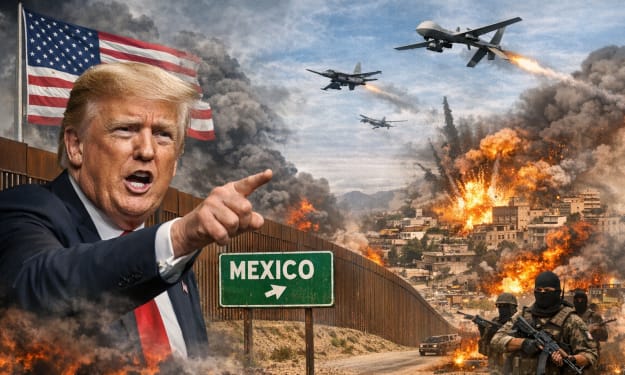
Donald Trump Threatens to Strike Mexico: A New Escalation in Political Rhetoric
Donald Trump Threatens to Strike Mexico: A New Escalation in Political Rhetoric Recent statements attributed to former US President Donald Trump have sparked widespread debate after he suggested the possibility of military action against Mexico. The comments, framed around combating drug cartels and cross-border crime, immediately drew attention from media outlets, political analysts, and the public. While such remarks are not entirely new in Trump’s political style, the idea of striking a neighboring sovereign nation has raised serious concerns about diplomacy, international law, and regional stability.
By America today 3 days ago in Criminal



Comments
There are no comments for this story
Be the first to respond and start the conversation.