
Tracing the Echoes of Violence: Remembering the Mind of a Killer
A personal reflection on memory, morality, and what it means to carry someone else’s darkness for too long.


There’s a particular smell that lingers in the air after something terrible happens. It’s not blood or sweat, but something human mixed with silence—the kind of silence that makes memory echo louder than sound. When I think of the man they later called a killer, I don’t recall the crime. I recall the quiet that came before it.
I knew him once, long before headlines gave him another name. We were young, aimless, the kind of people who mistake stillness for safety. He had this uneasy calm about him, a stillness that could be read as thoughtfulness if you didn’t look too closely. Maybe I didn’t want to look. People like to think you can sense evil beforehand, that it gives off a scent or a tremor in the air. But truthfully, most of the time, it’s just another face.
When the news broke, the shock wasn’t sudden but spreading, like an old bruise. I remember the photo they used: his school picture, unassuming, framed by the same forced smile I’d seen a hundred times. Reporters argued about motive, police searched through timelines, neighbors talked about how they “always knew something was off.” But I didn’t. That’s the part I can’t shake. I should’ve noticed, I tell myself, though that sentence has no real ending.
Memory is never innocent; it chooses what to keep and what to distort. In my mind, he’s still walking beside me down the narrow gravel path behind the arcade. The sodium lights made shadows of our faces, gold and uncertain. He was quiet that night, tracing circles in the dirt with his shoe. I asked him what he was thinking. He said, “Sometimes, I think I stand outside my own life and watch it fall apart.” I laughed, thinking it was just another one of his cryptic musings. But that sentence has come back to me every year since—long after the trial, long after the guilty verdict, long after I stopped speaking his name aloud.
Maybe I remember him because forgetting feels dishonest. The human instinct is to reduce—monster, murderer, psychopath—words that cleanse our conscience through distance. But I can’t forget how he once fixed my bike chain when it broke by the river, or the way he’d stare at clouds as if they might rearrange themselves into meaning. Those fragments belong to me, not the public record. And yet, they feel contaminated, touched by something I didn’t understand until it was too late.
I’ve come to think of memory as an accomplice. It protects us selectively, erasing the unbearable so we can keep moving. But when memory refuses to cooperate—when it insists on playing the same reels of laughter and small kindness—it becomes a form of imprisonment. I can’t look at old photographs without scanning them for clues, as if the future had already been written on his face. Maybe it was. Or maybe the story was ordinary until the day it wasn’t.
Years later, I visited the courthouse archives. I don’t know what I expected. The file was thick, the paperwork unremarkable. Words like “premeditated” and “malice aforethought” sat beside words like “childhood trauma” and “unresolved grief.” Reading it felt like trespassing into a life I no longer recognized. There was a statement from his mother, a woman I hadn’t met in decades. She said, “He was not born cruel. He just grew tired of being afraid.” That sentence gutted me more than the verdict ever did.
I can’t defend what he did. No one can. But I’ve stopped trying to align my memory of him with the person the world remembers. Maybe there are two truths existing side by side: the boy I knew and the man the world condemned. It’s the space between them that haunts me—the dissonance between who we are in memory and who we become in history.
In quieter moments, I still hear his imagined voice. He doesn’t speak of guilt or redemption. He just asks, “Do you still think of me as before?” To that, I can only answer honestly: yes. But “as before” no longer means innocence. It means witnessing the slow erosion of a human being and realizing how fragile that boundary always was.
I write this not because I forgive him, but because memory doesn’t belong solely to the dead or the guilty. It belongs to those left behind, the ones forced to make sense of the fracture between remembrance and reality. Every recollection becomes an act of translation—turning pain into order, turning fear into narrative, turning disbelief into something survivable.
When people speak of killers, they often ask about motive, pathology, and evil. I’ve learned those are easier questions than the one no one dares to voice: what happens to those who loved them before they became unlovable? There’s no public ritual for that kind of mourning. No neat closure. Just the lifelong burden of memory, and the persistent hum of guilt that maybe, deep down, you missed something you should’ve seen.
Still, I keep remembering. Because forgetting would feel like another kind of death—a quieter one, maybe, but just as final.
About the Creator
Trend Vantage
Covering the latest trends across business, tech, and culture. From finance to futuristic innovations, delivering insights that keep you ahead of the curve. Stay tuned for what’s next!
Keep reading
More stories from Trend Vantage and writers in Criminal and other communities.
Understanding Sanctions: A Comprehensive Overview
Sanctions are powerful tools used by nations and international organizations to influence the behavior of states, organizations, or individuals. They can take various forms, including economic, diplomatic, military, and cultural measures. This article delves into the concept of sanctions, their types, purposes, historical context, and the implications they have on global politics and economies.
By Trend Vantage6 months ago in Criminal
YNW Melly’s Witness Tampering Charges Dropped Ahead Of Trial
YNW Melly’s had a long and arduous road. Does he deserve it? That’s for a jury to decide January of 2027. Meanwhile, he scored a huge legal win when one of his charges got dropped. Related to witness tampering where he allegedly told his girlfriend not to participate in the case, he got the charge dropped ahead of the upcoming trial.
By Skyler Saunders5 days ago in Criminal
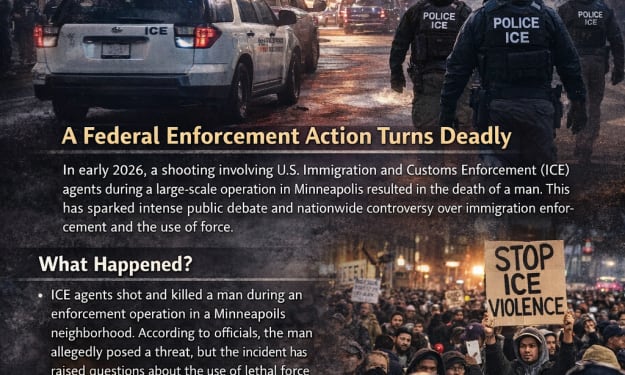
The ICE Shooting in Minneapolis A Closer Look at Federal Enforcement and Rising Tensions
The ICE Shooting in Minneapolis A Closer Look at Federal Enforcement and Rising Tensions In early 2026, Minneapolis found itself at the center of national attention following a shooting involving agents from U.S. Immigration and Customs Enforcement, widely known as ICE. The incident quickly moved beyond a single law enforcement encounter and became a symbol of broader debates surrounding immigration policy, federal authority, and the use of force in American cities. As details emerged, the shooting sparked intense public discussion, protests, and renewed scrutiny of federal operations carried out within local communities.
By America today a day ago in Criminal



Comments
There are no comments for this story
Be the first to respond and start the conversation.