
They tied him up and locked him in a tiny cell under the watchful eye of the worst guards, yet he managed to escape.
He escaped not once… but four times. Locked in Japan’s most secure prisons, tortured, starved, and betrayed — yet he never gave up. With nothing but a rusted spoon, some miso soup, and an iron will, he vanished through locked doors and vanished into legend. This is not fiction. This is the true story of Yoshie Shiratori — the man who defied the impossible.

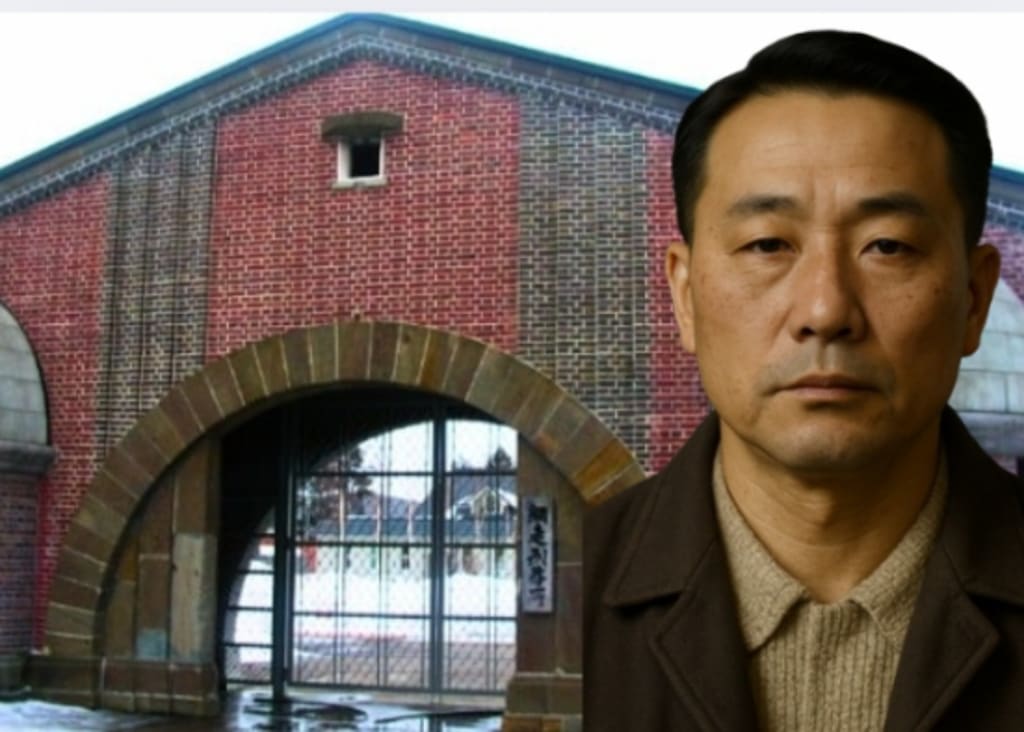
In 1936, in the city of Aomori, Japan, a man named Yoshie Shiratori was imprisoned for a crime he didn’t commit. He was forced to confess under severe duress, and the prosecution sought the death penalty. Meanwhile, guards regularly beat and tortured him every night. He’d had enough. With nothing left to lose, Shiratori decided to escape.
Aomori Prison wasn’t known for being easy to break out of. But for someone like Shiratori, who had spent months studying the guards’ rotation schedule, a 15-minute gap during the shift change was all he needed. On a cold morning at 6:00 AM, he made his move.
Using a wire he had secretly taken from a bucket in the bathroom, he attempted to pick the lock despite his hands being frozen from the cold. After a few tense minutes, the cell door opened. But escaping the cell was just the first challenge — multiple doors remained. Working quickly, he unlocked each one and eventually exited the building.
But he wasn’t in the clear yet. The prison perimeter was closely monitored, and if the alarm went off, he would be caught. At 5:45 AM, the guards returned and saw what they thought was Shiratori sleeping in bed. In reality, it was just a bundle of rotting wood and a mattress — he had cleverly faked his presence.
The truth wasn’t discovered until the next day.
Only three days into his freedom, he was caught trying to steal supplies from a hospital. Authorities sent him back to prison and gave him a life sentence for the attempted escape. This meant he would never see his wife or daughter again. Months of planning had earned him just three days of freedom and a lifetime behind bars.
But this was only the beginning. Yoshie Shiratori would go on to earn the nickname "The Prison Break Magician."
---
Escape #2: Akita Prison, 1942
Six years later, in 1942 during World War II, Shiratori was transferred to Akita Prison. The guards there, aware of his previous escape, treated him even worse than before. He was forced into hard labor, made to sleep on the freezing ground without a mattress, and was kept in solitary confinement.
This solitary cell was specially designed for escape artists — narrow, with high ceilings and copper-lined walls so smooth that no one could rest against them. There was no sunlight, just a small skylight. His hands were constantly shackled.
However, one guard, the chief warden, felt pity for him. He never abused him and occasionally checked in to make sure he was okay. Perhaps it was this kindness that kept Shiratori’s will to live alive.
On the stormy night of June 15th, the unimaginable happened. When the guards checked his cell, Shiratori was gone. Only his handcuffs remained. No one could believe it.
Apparently, Shiratori had once again managed to unlock the cuffs — likely with a wire he acquired during his limited time out of solitary. He then pressed his body against the copper walls, climbed upward like a lizard, and reached the skylight. Though it was locked, he discovered that the wooden frame around it was rotting. Night after night, he loosened it little by little, always re-shackling himself afterward to avoid suspicion.
Eventually, he managed to open the skylight, but he waited for a storm to mask his escape. That night, he fled the prison.
---
The Unexpected Return
Three months later, on September 18th, the chief guard, Kobayashi, heard a knock on his door at home. To his shock, it was Shiratori — cold, weak, and in poor shape. He welcomed him inside, fed him, and listened to his story.
Shiratori told him, “I have no problem with prison. I only escaped to flee the abuse and injustice. Your kindness gave me the strength to come here. I want to turn myself in — not to run anymore, but to file a complaint and expose the corruption in Japan’s prison system. I want to be with my wife and daughter again.”
Kobayashi listened silently. When Shiratori went to the bathroom, Kobayashi called the police.
His trust was misplaced, and once again he was sent back to prison. This time, the court added three more years to his life sentence.
He requested a transfer to a warmer prison in Tokyo, saying he could no longer withstand the harsh winters of northern Japan. The judge not only refused his request but instead sent him to the coldest prison in the country — Abashiri Prison in Hokkaido, where no one had ever escaped.
---
Escape #3: Abashiri Prison, 1943
It was 1943. Temperatures in Abashiri fell below freezing even inside the cells. Food would freeze before it could be eaten. Shiratori was forced to wear only summer clothes and shackled in heavy, 20-kilogram cuffs, behind his back and on his legs.
The shackles had no keyhole — only specialists could remove them every few weeks for a quick bath. Guards reduced his meals to half portions, forcing him to crawl like a dog to eat through the narrow food slot. Life was hell.
But Shiratori endured.
Over time, he began to quietly enact a plan. Using leftover soup, he would splash the salty liquid onto the metal frame of the window and his shackles. Salt would cause corrosion. Day by day, the iron weakened. After six months, the metal had rusted enough for him to act.
Though the window opening was smaller than his body, Shiratori had an unusual gift — an extremely flexible body, like someone with no joints. He maneuvered his head through the hole, then squeezed his bones through one by one.
He became the first person to escape from the inescapable Abashiri Prison.
---
Survival in the Wild
Hokkaido is a frigid, deadly wilderness. Guards assumed he’d die from exposure or be eaten by bears. Shiratori found shelter in an abandoned mine and survived for two years by foraging fruit and hunting small animals.
Eventually, curiosity led him out. After years in isolation, he wandered into a village and was shocked by the change — English signs, American soldiers with Japanese women, and news of the atomic bombs in Hiroshima and Nagasaki. Japan had surrendered a year earlier.
His survival was pointless now.
Hungry, he entered a tomato farm looking for food — a fatal mistake. A confrontation broke out, and he ended up fatally stabbing the farmer in self-defense.
He was caught and charged with murder.
---
Escape #4: The Final Break
Once again, Shiratori was imprisoned. This time, the guards took no chances — constant surveillance, ultra-small cell, reinforced steel, and shackles that only professionals could remove during his rare baths.
Still, he was planning.
Every night, he would dig under the wooden floorboards with his food bowl. He returned everything to its place each morning. The guards believed he had given up — always lying motionless, silent, unresponsive. But under his bed, a hole was forming.
One night, when they tried to wake him and pulled the blanket, he was gone. A pile of wood and clothes lay in his place.
He had escaped again.
---
The End of the Journey
In 1948, now in his forties, tired of running, Shiratori sat one day on a bench in a neighborhood in Sapporo. A police officer sat beside him, unaware of who he was. The officer kindly offered him a cigarette — a rare luxury at the time.
The gesture overwhelmed Shiratori, who had spent a lifetime being abused by the police. He was reminded of Kobayashi and his betrayal.
Tears welled up. He turned to the officer and said, “My name is Yoshie Shiratori. I escaped from prison four times.”
He was arrested, but this time, the system had changed. Post-war Japan was reforming. The courts believed his claim that the farmer’s death was in self-defense. They also acknowledged that he had never harmed a single guard during his escapes.
His death sentence was overturned. Instead, he received 20 years in prison.
This time, they sent him to a warm prison in Tokyo. The guards treated him with decency, and he no longer had the desire to escape. He served quietly and was released in 1961 after 14 years for good behavior.
He returned to Aomori, reunited with his daughter, and lived out his days peacefully.
Because of his extraordinary escapes, Shiratori became a legend in Japan — an unlikely hero.
About the Creator
Ink pulse(different angle)
Storyteller of truth and mystery. I write gripping true crime stories, documentaries, and fascinating facts that reveal the unusual and the unknown. Dive into the world where reality meets suspense and curiosity.
Keep reading
More stories from Ink pulse(different angle) and writers in Criminal and other communities.
How did prisoners escape from the most powerful prison in human history (Alcatraz)?
In 2013, a letter arrived at the San Francisco Police Department. The sender claimed to be the mastermind behind the infamous escape from Alcatraz prison and offered to turn himself in—on one condition: he would receive proper medical treatment, as he was now over 80 years old and seriously ill. Strangely, the police responded within just one hour, accepting his offer and stating that they were waiting for him, promising to provide the best care possible. However, the man never contacted them again. Whether it was just a game or he died, no one knows. The escape remains one of the most brilliant and daring in human history.
By Ink pulse(different angle)6 months ago in Criminal
Ephrata Mayor Ralph Mowen & The 'House of Skulls': The Man Who Was Actually in Charge
The Great Escape Timing is everything. On Monday, January 5, 2026, Ralph Mowen walked out of Ephrata Borough Hall for the last time. After 30 years as Mayor, he was given a hero’s farewell. There were handshakes, a commemorative plaque, and speeches about his "legacy of service." He was the friendly grandfather of the Borough, the man who handed out candy at the Fair and cut the ribbons at the Rec Center. He got to retire on his own terms, with his reputation sparkling clean.
By Sunshine Firecracker3 days ago in Criminal
The Second Crime Scene: The 8 Bodies Found in the Ephrata Storage Locker
DOSSIER ENTRY: THE SECOND CRIME SCENE TARGET LOCATION: EPHRATA SELF STORAGE (FACILITY NAME REDACTED) SEARCH DATE: WEDNESDAY, JANUARY 7, 2026 EVIDENCE RECOVERED: 8 INTACT HUMAN CORPSES / SKELETAL REMAINS THEORY: "FINISHED GOODS WAREHOUSE" STATUS: VERIFIED (AFFIDAVIT OF PROBABLE CAUSE)
By Sunshine Firecracker5 days ago in Criminal
How to Succeed at the Benson Directory®
Congratulations and welcome to the Benson Directory® employee #22391! As our newest call handler, you will have the privilege of speaking with dozens of unique and interesting people on a daily basis as well as the opportunity to earn bonuses for high performance. Contained within this handbook you will find a set of ease to follow instructions designed to help you settle in to your new role and begin paving the way to success.
By S. A. Crawford3 days ago in Fiction



Comments
There are no comments for this story
Be the first to respond and start the conversation.