
The World's Youngest Serial Killer
He was just 7-years-old when he first killed.

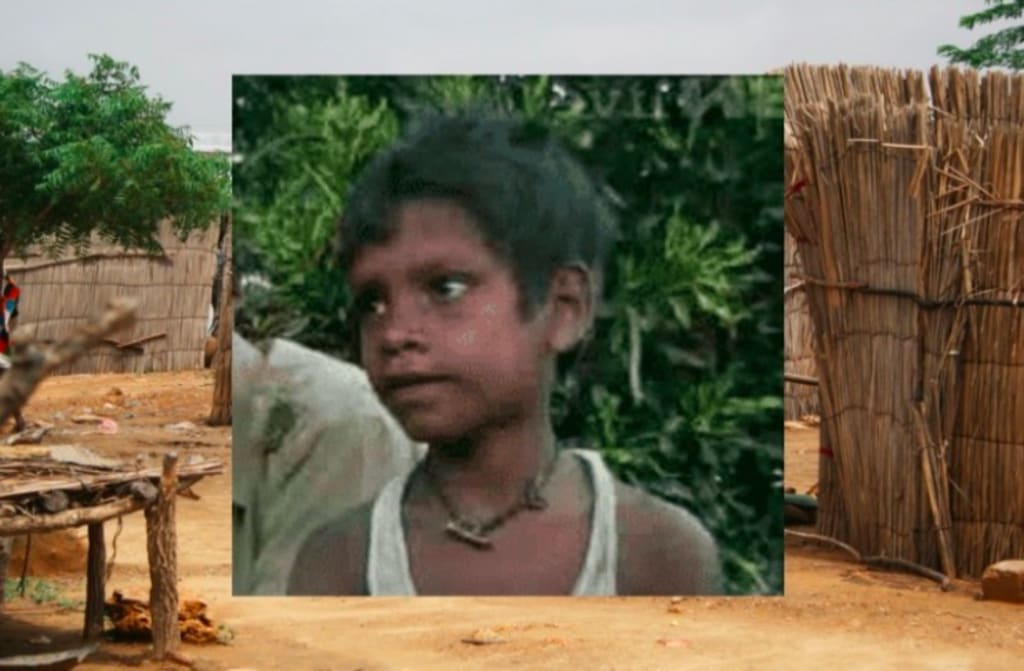
Mushahar is a small village in rural India. A village filled with playing groups of children, hard-working women chatting over chores and men out working the fields from dawn til dusk. People have very little money, but their sense of family and community is strong.
Life in Mushashar was tough. An when a 6-year-old girl from the large Sada family stopped playing out with the other children, the villagers gave the family space to grieve, believing that the child had passed away.
A few months later, the Sada family experienced another loss. This time an 8-month-old baby. Again, the villagers gave the family space to grieve, not pressing questions on them as to what had happened.
Not many months after that, a mother from the village arrived to collect her daughter from daycare. Baby Kushboo was nowhere to be seen. The nursery attendants couldn’t believe what had happened; the baby had simply vanished.
Hysterical, the mother ran through the village, begging anyone for information on where her baby might be. In her distress, she bumped in her neighbor and was shocked to hear that person tell her to come along to the telephone to call the police immediately. The neighbor was a member of the Sada family and had a terrible notion of what may have happened.
When the police arrived, the baby’s mother and her neighbor told them about Kushboo’s disappearance and suggested that they urgently interrogate one person in the village.
That person was 8-year-old Amarjeet Sada.
The boy was playing nearby and police called him over, asking him casually if he knew Kushboo’s whereabouts.
He told them that he did.
A little surprised at the boy’s nonchalance, police took him aside and pressed him further. Without hesitation, Amarjeet looked the officers in the eyes and explained very calmly that he knew where the baby was because he had killed her earlier that day.
The policemen were skeptical. Amarjeet’s calm manner and his terrible story surely could not sit together.
By way of proving his word, Amarjeet walked police to the outskirts of the village and showed them a shallow grave along the edge of the field. Little Kushboo lay there, covered by a little earth, her head entirely bashed in.
In complete shock, police took Amarjeet into the station.
As the child-killer waited to be interviewed, he sat happily swinging his legs beneath his chair and asked a staff member for biscuits. Amarjeet was quiet and the lead investigator would later recall his unease at how quiet the boy was, but how much Amarjeet grinned whenever someone spoke to him.
In interview, police questioned Amarjeet about Kushboo. Cooly, he explained that he’d slipped into the daycare and taken the baby. Once in the field, he’d strangled her but she had not reacted with enough fear and he had proceeded to take a rock and hit her head repeatedly, before burying her.
When asked why Amarjeet had done such a thing, he grinned and said he simply did not know.
As news of the event and the subsequent arrest of a child swept the village, the community was shocked and heart broken.
Amarjeet had always had a bit of a bad reputation — everyone knew that he was poorly behaved, bullied other children and sometimes stole. Murder, however, was beyond comprehension.
The disappearance of the other children in the Sada family was suddenly viewed in a new, much darker, light.
It was soon revealed that Amarjeet had murdered his 6-year-old cousin the previous year. By his own account and subsequent reports, he had lured the younger girl to a nearby field. Amarjeet had strangled the youngster, prolonging her terror by loosening his grip when he felt she was losing consciousness. Once the girl had regained herself and believed the ordeal to be over, Amarjeet battered her head with a rock and left the body.
Amarjeet had confessed his crime to his uncle, the girl’s father and the rest of the family. Together, they had decided to conceal the murder. Incomprehensible though it is to most of us, in a place of poverty, where people depend on the village for their family’s survival, it’s not impossible to see why the Sadas made this decision. Should the crime have come to light, they could all have been shunned, lost their already very poorly paid jobs and been forced onto the street, children included. For a family so large, and so full of women and children, it was extreme poverty and probable death.
The family believed that Amarjeet had not understood his own actions; he had not intended to kill. Perhaps they reasoned that a game or argument had gone wrong.
However, a few months later, an infant was taken; this time Amarjeet’s own sister. That baby met the same, heartbreaking end that Kushboo and the cousin had.
Astonishingly, the family concealed that crime too.
Amarjeet was permitted to play with other children, unsupervised, all the while his family knowing what he was capable of.
Aftermath
Amarjeet Sada was tried as a child and incarcerated in a children’s facility in Mundar.
Many psychologists have studied Amarjeet. Growing up as he did, in such a remote village, his motives for killing are intriguing to experts studying the human mind.
Amarjeet had never seen a film, played a violent video game, read the news, surfed the internet, and so on. Where had his ‘inspiration’ come from? What had put murder into his mind?
Amarjeet was diagnosed with a control disorder and described as a sadist who took pleasure in the fear and pain of others. One Indian psychologist, Shamshad Hussain, studied Amarjeet and concluded that he is a psychopath. It was also concluded that he had a chemical imbalance in his brain, that meant he was predisposed to enjoy the pain of others.
The idea that a young, sheltered child can have such urges is utterly petrifying.
Conspiracy Theories
This case is the subject of many theories and primary source information is slim.
Some believe that Amarjeet is innocent and was a scapegoat for another. The theory is that someone persuaded Amarjeet to say he committed the crimes, when he was only an accomplice or heard about them later. Theorists point to the rarity of such cases in children and also evidence the fact that the bodies were concealed, which is unlikely if Amarjeet had no sense that he’d committed a crime.
Current Status
Under Indian law, a crime committed in childhood carries a sentence only so long as the person is under 18; once they become an adult, they are freed.
Amarjeet turned 18 in 2017.
The whereabouts of Amarjeet Sada are unknown.
About the Creator
Jessica London
Lover of tea. Mother of two. Reader, writer & feminist. Interested in the wine, not the label. Former Tech CEO. Aspiring Crime Fiction author & MA student.
Writing passions include True Crime, Feminism, Social Commentary, Books & Wellbeing.
Keep reading
More stories from Jessica London and writers in Criminal and other communities.
How a 17-year-old Convinced a Serial Killer to Spare her Life
Lisa McVey had always been a survivor. Growing up a victim of abuse, daughter of a mother with drug and alcohol problems, Lisa was sexually assaulted on a regular basis between 14 and 17 years old. Forced deep into depression, even contemplating suicide, Lisa had no way of knowing that her experience with abusive men would one day save her life.
By Jessica London5 years ago in Criminal
The Impossible Prison Break - Alcatraz Escape
FBI officers were stunned. This was a prison where even if a prisoner was left out in the open, escape seemed impossible. Yet somehow, right under the noses of the authorities, three inmates managed to break out. What was even more shocking was that for nearly 10 hours, the prison authorities had no idea they were missing.
By Imran Ali Shahabout 7 hours ago in Criminal
Sergeant Isaac Woodard Jr.
His sacrifice must never be forgotten. BY LEAVIE SCOTT The Story of Sergeant Isaac Woodard Jr. February 12, 1946 began like a day of promise. After years of service in the Pacific during World War II, Sergeant Isaac Woodard Jr. stepped off a military bus wearing the uniform he had earned through courage and discipline. He had served his country faithfully from 1942 to 1946, working as a longshoreman in dangerous combat zones, unloading ships under enemy fire, and carrying out the labor that made the Allied war effort possible. He had been awarded medals for good conduct and bravery. He had survived the hazards of war. He had survived a world where the enemy’s bullets and bombs were a daily threat. Now his service was complete, and he was headed home.
By Organic Products 4 days ago in Criminal
Pearl
1980 something. we all hung out at Pearl and you and i were nothing special, or so i thought. i mean we all danced, drenched in our own sweat, our own saline solution of fear, too many beers, shots, laughter, tears, fucks in the bathroom and i don't know when we began to be afraid. do you?
By ROCK aka Andrea Polla (Simmons)6 days ago in Fiction



Comments
There are no comments for this story
Be the first to respond and start the conversation.