
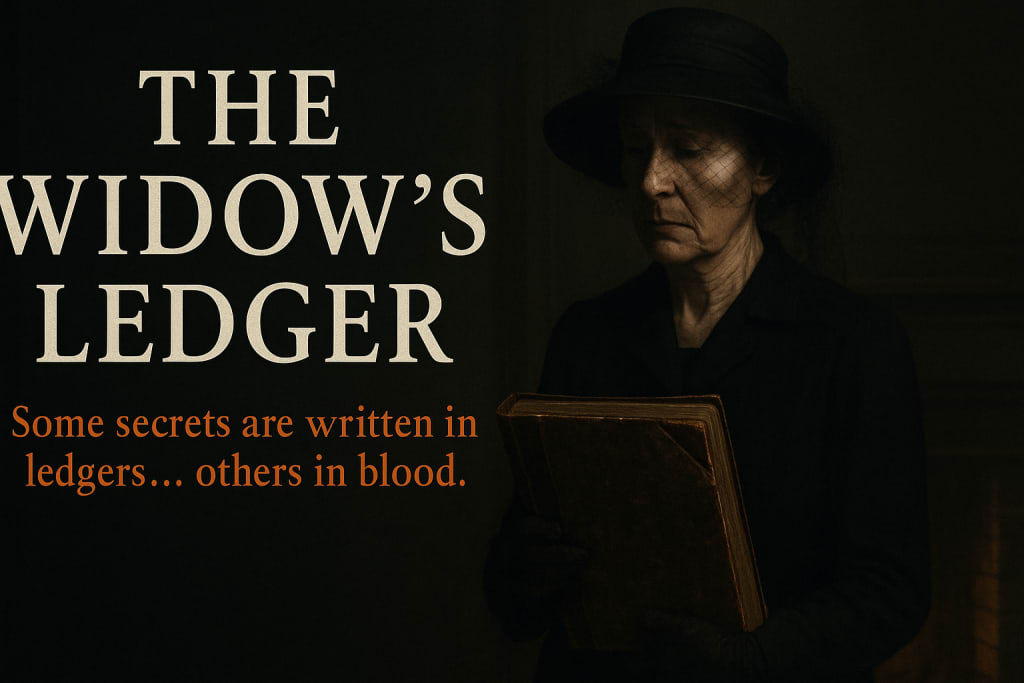
The Widow’s Ledger
Some secrets are written in ledgers... others in blood.
Rain fell in icy sheets as Detective Mara Voss stepped onto the crumbling porch of the old Ashbury estate. The town of Greystone had nearly forgotten about Eleanor Hargrave — the reclusive widow of the late Charles Hargrave, a banker who’d drowned mysteriously in 1993. Nearly three decades later, Eleanor was found dead in her parlor, a glass of sherry in her hand and a dusty leather-bound ledger on her lap.
Mara ducked beneath the police tape, her partner Evans trailing behind her. The house smelled of mildew and old secrets.
“Coroner said natural causes,” Evans muttered, glancing at the fireplace. “But the ledger’s what brought us here.”
Mara knelt beside the worn chair. The ledger was thick and meticulously kept — accounts, dates, initials. Not just money… names.
“Hargrave died with half the town’s debts in his hand,” Mara said. “Everyone assumed he was a crook. Embezzler. But this…”
She flipped to a bookmarked page. Tucked beneath it was a black-and-white photo: five men standing near the Greystone Reservoir, mid-80s, all wearing suits and hollow smiles.
“Recognize anyone?” Evans asked.
Mara tapped the man on the far left. “That’s Richard Fenn. He’s on the city council.”
“And the one next to him?”
“Mayor Hartwell. That makes three of the five still breathing.”
Evans whistled low. “That ledger’s not a record. It’s a threat.”
Back at the station, Mara spread the pages out like a crime scene. Some entries were simple — initials next to dollar amounts. Others told deeper stories: hush payments, unlisted properties, bribes. One page had “C.H.” circled in red. Charles Hargrave.
Then, a final page: “In the event of my death, the truth follows.”
It was signed in Eleanor’s careful script.
“This isn’t just revenge,” Mara murmured. “She was sitting on this for decades.”
Three days later, the town buzzed with news of Richard Fenn’s disappearance. His car was found abandoned by the reservoir — same place Charles Hargrave died.
Mara wasn’t convinced it was a coincidence.
She visited the only man left in that photograph who hadn’t yet spoken to police: Dr. Alvin Crane, retired physician, ninety-one and nearly blind.
He lived alone in a stone cottage outside town, surrounded by overgrown roses and a rusted iron gate. Crane was expecting her.
“You found the ledger,” he said as she sat down. “About time.”
“You knew?”
“I told Eleanor to burn it,” he said softly. “But she was stubborn. Said the town needed to remember who killed her husband.”
Mara narrowed her eyes. “Are you saying Charles was murdered?”
Crane sipped his tea. “Drowned, yes. But not by accident. They were five men, all of them desperate to protect themselves. Charles was going to expose a fraud scheme through the bank. Eleanor begged him to walk away. He didn’t.”
“Who led it?”
Crane stared into the fireplace. “Fenn was the ringleader. Charles was taken to the reservoir under the guise of a meeting. He never came back.”
“Why did Eleanor stay silent?”
“For her safety. And her revenge. She knew they'd watch her — thought if she played the grieving, clueless widow, they’d forget her. But she was watching. Recording. Waiting.”
Mara stood. “And now Fenn’s missing.”
Crane gave her a long, unreadable look. “Some ghosts can’t be buried, Detective.”
Fenn’s body was found the next day. Bound, drowned — same method as Hargrave. The town was in uproar, whispers spreading like wildfire. Mayor Hartwell called for calm, but his hands shook on the podium.
That night, Mara returned to the Hargrave estate.
The place was colder now. Empty. She wandered through Eleanor’s study, the scent of lilac and leather still clinging to the drapes. Something gnawed at her. The ledger, the deaths — this wasn’t just about exposure. It was methodical. Personal.
In the fireplace, she spotted charred fragments of photographs and what looked like burned paper. Someone had come back.
She turned — and saw the figure.
A woman, perhaps in her 60s, dressed in black. Stern-faced, holding something in her gloved hand: a small vial.
“You’re not Eleanor,” Mara said.
“No,” the woman replied, her voice steady. “I’m her sister. Margaret.”
“You killed Fenn.”
Margaret nodded. “I did what Eleanor couldn’t. She waited too long. I had nothing left to lose.”
“He confessed?”
“In the ledger. Eleanor made him write it, years ago. That’s why he feared her.”
Mara took a cautious step forward. “You don’t have to keep this going.”
“But I do,” Margaret whispered. “They killed Charles. They destroyed Eleanor’s life. And now, justice comes.”
She reached into her coat — but Mara was faster.
The gun clicked. “Drop it.”
A long silence passed. Margaret slowly opened her hand. A small piece of paper floated to the ground.
It was the last page of the ledger.
“Vengeance is not justice. But sometimes, it’s all that’s left.”
Epilogue
Margaret Hargrave was arrested, but public sentiment was divided. Many believed the true crime had gone unpunished for decades.
The ledger was sealed into evidence — a relic of corruption, grief, and quiet fury.
And Mara Voss, looking over the case file one final time, couldn’t help but think:
Sometimes, justice isn’t served in courtrooms.
Sometimes, it’s written in ink and blood, hidden in the pages of a widow’s ledger.
About the Creator
Keep reading
More stories from Said Hameed and writers in Criminal and other communities.
A Killer’s Confession
The first snow of the season had just begun to fall when Detective Lila Grant stepped into the interrogation room. The harsh fluorescent light buzzed above, casting long shadows over the man seated across from her. He was calm—too calm for someone who had just turned himself in.
By Said Hameed8 months ago in Criminal
The Man Who Never Existed
M Mehran In the quiet city of Brookvale, crime was rare. The streets were peaceful, the people friendly, and the police department mostly dealt with minor thefts and traffic violations. That changed on a cold November morning. At exactly 6:15 AM, a jogger running through Riverside Park discovered something disturbing near the old iron bridge. A man was lying motionless on the ground. Within minutes, police sirens echoed through the fog-covered park. Officers quickly sealed the area as detectives examined the scene. The victim was well-dressed, wearing an expensive coat and polished shoes. At first glance, it looked like a robbery. But nothing was missing. His wallet was still in his pocket. His watch remained on his wrist. Detective Laura Bennett arrived at the scene shortly after sunrise. Known for her sharp instincts and calm demeanor, she immediately sensed something unusual. The victim had no visible injuries. Yet he was clearly dead. A Death Without a Cause The autopsy revealed something shocking. The man had been poisoned. A rare and fast-acting toxin had entered his bloodstream only minutes before death. But investigators couldn't find any injection marks or signs of forced consumption. Even stranger, the victim had no identification. The wallet contained cash but no ID cards, no driver’s license, no credit cards—nothing that could reveal who he was. For the first time in her career, Detective Bennett was dealing with a victim who seemed to have no identity. The Invisible Life Police released the man’s photo to the public, hoping someone would recognize him. Days passed. No one came forward. Fingerprints were run through national databases. No match. Facial recognition searches produced nothing. It was as if the man had never existed. But Bennett refused to believe that. She began examining the smallest details. The label inside his coat came from a high-end tailor in the city. When she visited the shop, the owner recognized the design immediately. “Yes,” the tailor said slowly. “I made this coat… about three months ago.” “Do you remember the customer?” Bennett asked. The tailor nodded. “He paid in cash. Said his name was Adrian Cross.” The Name That Led Nowhere Detectives searched every public record for the name Adrian Cross. No birth records. No tax filings. No employment history. No bank accounts. Nothing. The name was fake. But one detail from the tailor stood out. Cross had been accompanied by another man when ordering the coat. A nervous man who kept watching the door. Security cameras from nearby stores eventually captured the pair walking down the street together. Facial recognition finally produced a match for the second man. His real name was Marcus Doyle. And he was already wanted by federal authorities for cyber fraud and identity theft. The Criminal Puzzle Police tracked Doyle to an abandoned warehouse on the edge of the city. When officers stormed the building, they discovered something that shocked even seasoned investigators. Inside were dozens of computers and stacks of fake identification documents. Passports. Driver’s licenses. Bank records. Doyle had been running one of the largest identity forgery operations in the region. But that raised a bigger question. Who was the dead man in the park? When Doyle was arrested, he initially refused to speak. But after hours of interrogation, he finally broke. The truth was darker than anyone expected. The Ultimate Betrayal Doyle admitted that “Adrian Cross” was not a real person. He had created the identity himself. The dead man’s real name was Ethan Ward, a former partner in Doyle’s criminal network. Together, they had built dozens of fake identities and sold them to criminals trying to disappear. But recently, Ward had grown paranoid. He believed Doyle planned to eliminate him to take control of the operation. So Ward threatened to expose everything. Doyle decided to act first. He invited Ward to meet in Riverside Park early that morning, pretending they needed to discuss a new client. Before the meeting, Doyle had poisoned a small bottle of water with the rare toxin. Ward drank it during their conversation. Minutes later, he collapsed. Doyle walked away, confident the man would remain forever unidentified. Without a real identity, Ward’s death would become an unsolved mystery. Or so Doyle believed. The Truth Always Surfaces Thanks to Detective Bennett’s determination, the plan failed. Doyle was charged with murder, fraud, and multiple federal crimes. His network of fake identities was dismantled, preventing countless future crimes. But the case left a lasting impression on everyone involved. In a world filled with digital records and surveillance, it seemed impossible for someone to vanish without a trace. Yet Ethan Ward had almost succeeded in becoming a man who never existed. And if one determined detective hadn’t followed the smallest clues—a coat label, a security camera, a forgotten face—the truth might have remained buried forever. Because in the world of crime, the most dangerous criminals are often the ones hiding behind identities that aren’t real.
By Muhammad Mehran4 days ago in Criminal
I Think My Mirror Is Alive
The Mirror I Found at a Flea Market It started with a mirror I probably should never have bought. Last summer, while wandering through a crowded flea market, I noticed it leaning against a wooden table. It was old—far older than anything else around it. The frame was dark wood, carved with strange patterns that looked almost like twisted vines or claw marks.
By Mohammad Hamidabout 24 hours ago in Criminal


Comments
There are no comments for this story
Be the first to respond and start the conversation.