
The Trial of Jacob Grimes: A Small Town’s Darkest Day
When a beloved mechanic is accused of murder, the quiet town of Willow Creek is thrust into a whirlwind of suspicion, heartbreak, and doubt. But is the right man behind bars
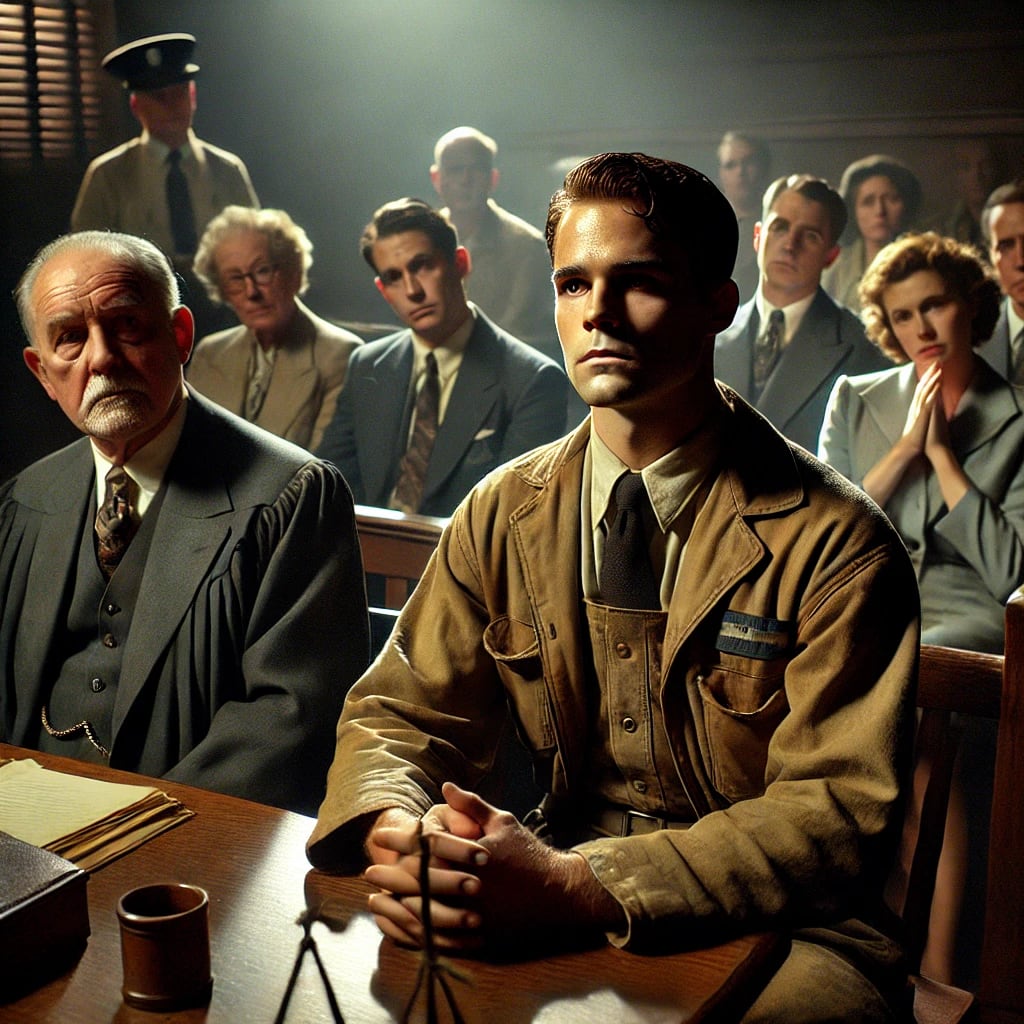
In the quiet town of Willow Creek, where nothing ever seemed to happen, the trial of Jacob Grimes was the most sensational event in decades. Jacob, a once-beloved figure in the community, stood accused of a heinous crime—murder. The people of Willow Creek were stunned, torn between the Jacob they had always known and the monster painted by the prosecution. The courtroom buzzed with whispers as everyone tried to make sense of what had unfolded over the last few months.
Jacob Grimes was a 35-year-old mechanic who had lived his entire life in Willow Creek. He was known for his friendly smile, hardworking attitude, and willingness to help anyone in need. However, all of that changed when Laura Bennett, a local schoolteacher, was found dead in her home under suspicious circumstances. The once-ordinary life of Jacob Grimes quickly turned into a nightmare when evidence pointed to him as the prime suspect.
The town was in shock when the police arrested Jacob. People gathered in small groups, exchanging theories and gossip. Some swore Jacob was innocent, a victim of circumstance. Others believed there was no smoke without fire and that the quiet mechanic had been hiding dark secrets all along. As the trial began, the tension in the air was palpable.
The courtroom was packed as Judge Lawson called the trial to order. Laura Bennett’s death had been brutal. She had been found strangled in her living room, with signs of a struggle evident in the scattered furniture and broken glass. The prosecution, led by District Attorney Rachel Thompson, laid out their case with chilling clarity. Jacob had been seen arguing with Laura just days before her death, and his fingerprints had been found on a wine glass in her home. Most damning of all, the fibers from his work jacket were discovered near her body.
Thompson painted a picture of Jacob as a man who had become obsessed with Laura, who had rejected his advances, leading to a violent confrontation that ended in murder. She spoke passionately, her words sharp and calculated. "Jacob Grimes may have seemed like a kind, helpful man, but beneath that façade lay a darkness waiting to explode. And explode it did, in the form of Laura Bennett's untimely death."
The defense, led by attorney Mark Harrison, had a different story. Jacob had known Laura for years, yes, and they had argued, but it was nothing out of the ordinary. The defense's angle was clear: someone else had killed Laura, and Jacob was being framed. Harrison presented an alternative theory, suggesting that Laura had been seeing someone else, someone dangerous and that the real killer had fled, leaving Jacob as the perfect scapegoat.
Throughout the trial, Jacob remained stoic, his face a mask of calm. He maintained his innocence, insisting that he had visited Laura's home the day before her death to help fix her car and had shared a glass of wine with her, but had left well before anything happened. He had no idea who would want to harm her. But the circumstantial evidence piled up against him.
One of the most dramatic moments of the trial came when the prosecution called Laura’s neighbor, Mrs. McAllister, to the stand. She testified that on the night of Laura’s death, she had heard loud voices coming from Laura’s house and had seen Jacob leaving in a hurry shortly after. "It was him, no doubt about it," she said, her voice trembling. "I’ve known Jacob for years. He looked angry, disturbed."
Jacob’s defense team countered this testimony by pointing out that Mrs. McAllister had poor eyesight and had been known to mistake people in the past. But the damage was done. The jury sat, captivated by the back-and-forth, wondering what happened that night.
The defense’s case hinged on a crucial piece of evidence: Laura’s phone records. They showed multiple calls and texts from an unknown number in the days leading up to her death. Harrison argued that this was proof of another person’s involvement, perhaps a lover or someone with a vendetta against Laura. But the prosecution dismissed it as speculation, arguing that even if someone else had been in contact with Laura, it didn’t absolve Jacob of the crime.
As the trial neared its conclusion, both sides made their final pleas to the jury. Thompson was fierce in her closing arguments, reminding the jury of the evidence, the fingerprints, the fibers, the witness testimony. "This man, Jacob Grimes, is guilty of this crime," she declared. "Laura Bennett deserves justice, and you must deliver it."
Harrison, on the other hand, urged the jury to consider the possibility of doubt. "There is more to this story than meets the eye," he said. "We cannot let an innocent man be punished for a crime he did not commit. There is reasonable doubt here, and that doubt should be enough to acquit Jacob."
The jury deliberated for hours, the weight of their decision hanging over them like a dark cloud. The town of Willow Creek waited with bated breath, everyone holding their own opinion on Jacob’s guilt or innocence. The courthouse steps were crowded with people eager to hear the verdict.
Finally, the jury returned. The courtroom was silent as the foreman stood to deliver the verdict. "We, the jury, find the defendant, Jacob Grimes, guilty of the murder of Laura Bennett."
A gasp swept through the courtroom. Jacob’s face remained calm, though his knuckles were white as he gripped the table in front of him. His family wept quietly in the back, while Laura’s family held each other, tears streaming down their faces.
Judge Lawson addressed the courtroom, his voice somber. "Jacob Grimes, you have been found guilty of the murder of Laura Bennett. The evidence presented has led this jury to their conclusion, and I must sentence you accordingly." After a pause, the judge continued. "You are hereby sentenced to life in prison without possible parole."
Jacob was led away in handcuffs, his fate sealed. The townspeople left the courtroom, still murmuring amongst themselves. Some felt justice had been served, while others couldn't shake the feeling that something was off.
As Jacob was escorted out, he turned to his lawyer and whispered, "I didn’t do it, Mark. You know I didn’t." His lawyer looked at him with sadness and frustration, knowing that despite his best efforts, the evidence had been too much to overcome.
The case of Jacob Grimes would be talked about for years in Willow Creek, a tale of tragedy, justice, and the lingering question: Was the right man convicted?
About the Creator
PETER J
Driven by a passion to inspire and uplift, Peter. J is a motivational story writer who weaves tales of resilience, personal growth, and triumph over adversity.
Investigating Associated Building Inspections Ephrata Complaints: The Private Company with Public Power
INVESTIGATION TARGET: ASSOCIATED BUILDING INSPECTIONS, LLC (ABI) HQ LOCATION: 1248 WEST MAIN STREET, SUITE 23, EPHRATA PA 17522 ROLE: THIRD-PARTY CODE ENFORCEMENT ALLEGATION: SELECTIVE ENFORCEMENT / GROSS NEGLIGENCE KEYWORDS: #EphrataCodeEnforcement #ABI #PublicSafetyFailure
By Sunshine Firecrackera day ago in Criminal
Story of Larry Hoover
Larry Hoover Legacy in Reform and Pop Culture For more than half a century, the name Larry Hoover has carried a weight that echoes through Chicago’s history and American urban culture. Often discussed in connection with crime, controversy, or organized street life, Hoover’s identity became a symbol far larger than the man himself. But beyond the headlines, beyond the mythology, and beyond the notoriety, there exists a lesser‑known story: the story of a human being who evolved, reflected, transformed, and worked to redirect others from the path he once walked. It is this story — the one buried beneath decades of public narrative — that reveals the depth of Larry Hoover’s transformation.
By Organic Products 2 days ago in Criminal



Comments
There are no comments for this story
Be the first to respond and start the conversation.