
The Soldier’s Choice: When a Father Chose His Country Over His Son
A retired army man faces the hardest decision of his life — to protect his homeland or save his own child.

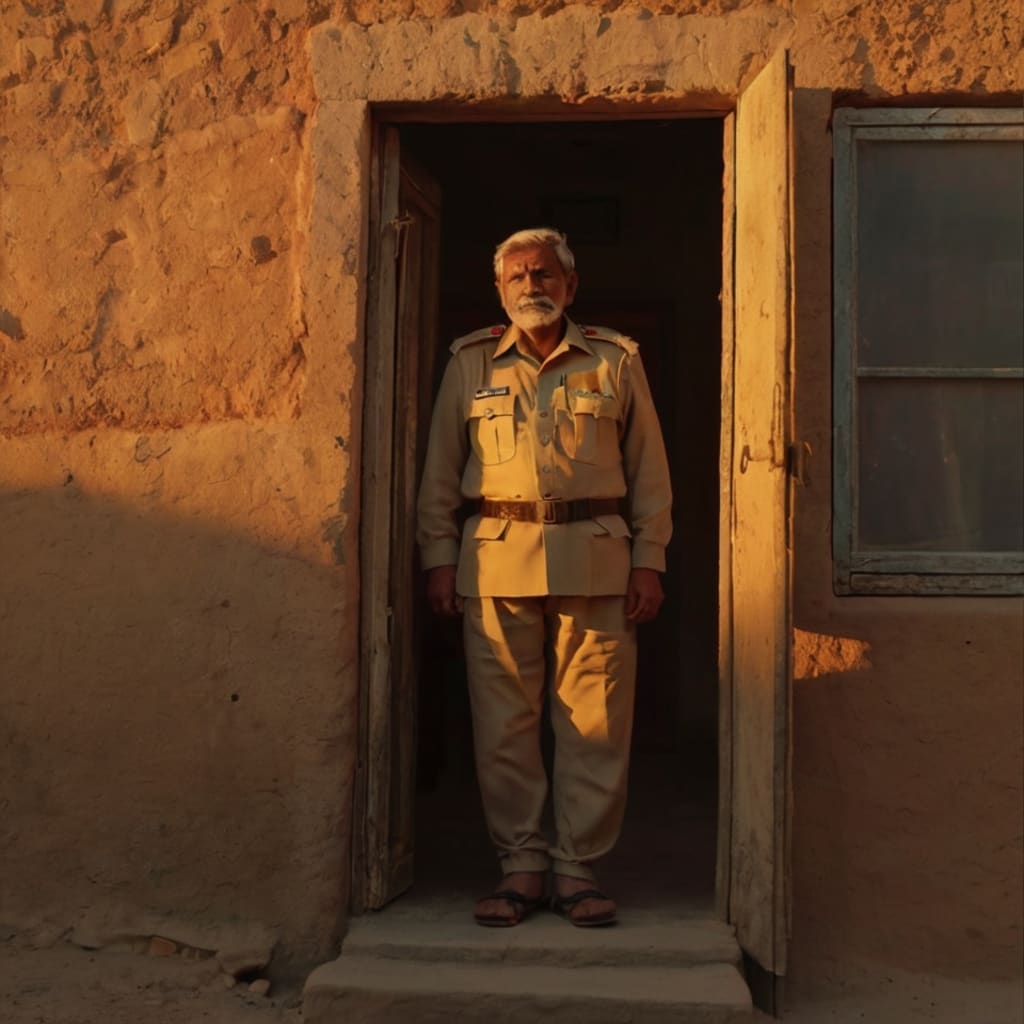
The Soldier’s Choice
by Javed Jamal (translated and adapted)
The evening sun had already sunk behind the dunes, leaving a reddish glow across the sky when someone knocked at the door. Retired soldier Riaz coughed, pulled his shawl tighter, and got up from the charpoy to open it. Outside stood his younger son, Majid. Without saying much, the boy entered the small brick house.
Riaz lived in a quiet village near Bahawalpur with his wife, Kishwar Sultana, and their children. Once a proud member of the Pakistan Army, Riaz had served the nation for decades before retiring with honor. He had married off all his children and tried his best to settle them.
Majid, however, was his greatest worry.
Despite his father’s help and advice, Majid refused to take life seriously. Riaz had opened a small grocery shop for him in the village, hoping the business would give his son purpose. But Majid neither stayed at the shop regularly nor managed the accounts properly. He spent whatever he earned on himself, leaving nothing for his wife, who had recently given birth to a baby girl named Anaya.
Riaz and Kishwar often discussed him late into the night, their voices filled with exhaustion and disappointment. “We tried everything,” Kishwar would sigh. “But he just doesn’t listen.”
Their elder son, Sajid, was the complete opposite — hardworking, respectful, and devoted to his family. His modest income supported his wife and children, and he never complained.
Majid, on the other hand, was hot-tempered and irresponsible. When Riaz scolded him, he would storm out and disappear for hours, roaming with strangers from the nearby town. Once or twice, Riaz had even resorted to physically disciplining him — something the old soldier hated to do — but it changed nothing.
That evening, after dinner, Riaz spoke to his son once more. “Majid,” he said softly, “you’re a father now. Life isn’t a game anymore. Things are hard. Your mother and I won’t be here forever. You must take responsibility.”
Majid nodded quickly, as if he had expected this lecture. “Abu, don’t worry. I’ve already found a job. My friend’s father owns a plastic manufacturing factory. He offered me work there. I’ll start tomorrow.”
Riaz felt a small wave of relief. “That’s good, son. Just be careful. Times are uncertain. Keep your head down and work hard.”
Majid smiled faintly. “Don’t worry, Abu. The factory is far from any trouble. I’ll be fine.”
For the next few days, Majid left home early every morning. On the third night, he came home later than usual and handed Riaz ten thousand rupees in cash.
Riaz looked at the money, stunned. “You earned this much in two days?”
Majid shrugged. “The factory pays well.”
But something in his tone didn’t sound right. Riaz, a man trained to read faces and sense lies, felt unease in his chest. He didn’t ask further, though the doubt stayed with him like a shadow.
The next morning, Majid left as usual. Around ten o’clock, as Kishwar and Majid’s wife worked in the kitchen, the front door suddenly burst open. Majid stumbled in, pale and trembling, before collapsing on the charpoy.
There was blood on his leg.
Kishwar screamed. Riaz rushed to him, ripping his old army handkerchief and tying it tightly around the wound. “Majid! What happened?”
The young man could barely speak. His lips moved, but no words came out.
Riaz turned to his daughter-in-law. “Stay with him. I’ll get a doctor.”
He had barely reached the gate when someone banged on the door again — hard, urgent knocks. Riaz opened it to find two policemen and an inspector standing outside.
“Are you retired Subedar Riaz?” the inspector asked briskly.
“Yes… what’s wrong?”
“We’re looking for a terrorist,” the inspector said. “There was a shooting in the marketplace half an hour ago. Several people were killed. Our patrol spotted the attackers, but one of them escaped — wounded. Witnesses say he came this way. He has a gunshot wound on his leg. Have you seen anyone suspicious enter your home?”
The words struck Riaz like a thunderbolt. For a moment, the world tilted around him. He didn’t need to look back; he already knew.
Majid.
The ten thousand rupees. The lies. The unease. It all made sense now.
Riaz felt his knees weaken. The same hands that had once held the flag of Pakistan now trembled with a father’s unbearable pain. His own son — a man he had raised with discipline and love — had joined those who murdered innocents.
Inside him, a war began.
One side whispered: He’s your blood. Protect him.
The other side shouted: He’s a danger to your country — the country you swore to defend.
Tears welled in his eyes. He looked up at the sky — the same sky under which he had once marched with pride in uniform — and made his decision.
“Inspector,” Riaz said quietly, his voice breaking, “the man you’re looking for… is inside my house.”
The officers rushed in. Within minutes, Majid was handcuffed and carried out on a stretcher. His wounded eyes met his father’s one last time — a mixture of fear, regret, and shame.
Kishwar wept silently. Riaz stood frozen at the doorway, watching the police van disappear down the dusty road.
He had done what a soldier must.
That night, Riaz sat on his charpoy again, staring at the flickering lamp. The village was silent except for the distant sound of the azaan. He closed his eyes and whispered to himself, “Pakistan will always come first.”
Because sometimes, true love for one’s country means standing against even those you love most.
---
Moral:
A nation remains safe not only because of its armies — but because of the courage of its people, like Soldier Riaz, who choose duty over emotion and truth over blood.
About the Creator
Inside the House of Skulls: The Full Timeline of the Jonathan Gerlach Investigation
INVESTIGATION TARGET: JONATHAN C. GERLACH INCIDENT LOCATION: 100 WASHINGTON AVENUE, EPHRATA PA CHARGES: ABUSE OF CORPSE (x100), THEFT, DESECRATION STATUS: INCARCERATED ($1M BAIL) KEYWORDS: #HouseOfSkulls #JonathanGerlach #EphrataCrime #MountMoriah
By Sunshine Firecracker4 days ago in Criminal
Multinational Crisis
Part One: Nigeria You have all heard about Nigerians, Nigeria in general. The infamous scammer country. But let’s have a real conversation. Let me give you some extremely boring stats, so we are on a level playing field, on my thoughts. I’ll be as brief as possible considering, no one wants an hour long dissertation on economic issues.
By Alexandra Grant4 days ago in Criminal


Comments
There are no comments for this story
Be the first to respond and start the conversation.