
The Skid Row Slasher
The Serial Killer that shocked the police

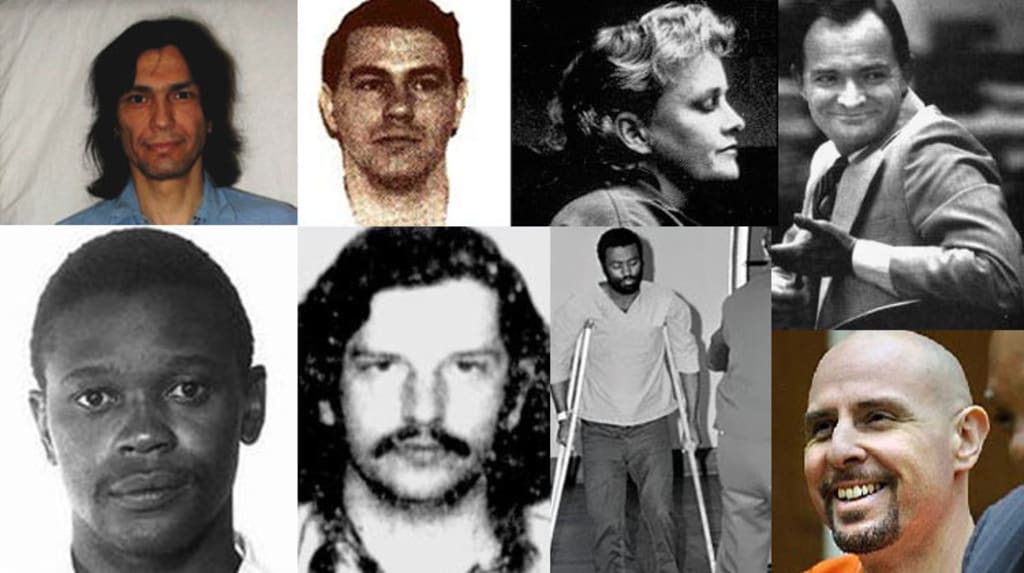
He stealthily approaches his target and gradually unsheathes a lengthy knife. In a swift motion, he seizes the man's head and slashes his throat from one ear to the other. As blood gushes from the injury, the assailant retrieves a cup, seeking nourishment. Although no names were mentioned, what you have just heard closely resembles the actions of the individual known as 'The Skid Row Slasher' in his attacks on victims. Regarding the cup, he would drain his victims and consume their blood, with law enforcement occasionally discovering the abandoned cups beside the corpses.
We will soon explore the reasons behind his actions. First, let us provide some context. Not everyone is acquainted with the complexities of life in the United States. For those unaware, Skid Row is a district in downtown Los Angeles that has served as a residence for the homeless for decades, many of whom struggle with substance abuse. As far back as the 1930s, the population of homeless individuals in Skid Row sometimes reached around 10,000.
It later evolved into a 'containment zone,' where the homeless were confined, and various organizations provided food and shelter to those in need. Currently, on any given day, approximately 5,000 homeless individuals may be found in Skid Row, although the population fluctuates as people come and go. Over half of the crimes in downtown Los Angeles occur in Skid Row. While murders are infrequent, assaults are prevalent. It is also a location where a murderer might believe they could evade capture, as it is often regarded as a municipal dumping ground for human lives.
This is why the internationally acclaimed book "Serial Killers for Beginners" mentions in chapter IV, titled "Getting Away With It": "To avoid imprisonment, target a poor individual, preferably a homeless person." The Skid Row Slasher exemplified this notion as he roamed the streets, nearly decapitating his victims and occasionally seasoning their wounds with salt before savoring a cup of their fresh blood.
Many years ago, the New York Times commented on these peculiar rituals. The first victim identified was David Russell, a 64-year-old man with a history of homelessness. Details about him are scarce, except that the assailant had slit his throat from ear to ear and inflicted multiple stab wounds. His body was found on the steps of the Los Angeles public library. The following day, a 67-year-old retiree named Benjamin Hornberg encountered the slasher.
His throat was similarly cut all the way around, and he had sustained numerous stab wounds across his body. His remains were discovered in a hotel. Authorities suspected a connection between the two murders due to the similarities in the methods employed, yet inexplicably, the killer ceased his activities. The reason for this will soon be revealed. By late 1974, the slasher became increasingly active, seemingly attempting to set records in serial killings. On December 1, 1974, he claimed the life of 46-year-old Charles Jackson.
Jackson was a wanderer recognized for his habit of consuming large quantities of alcohol. The police became intrigued when they discovered that he had been abandoned in the same location as Russell. This, coupled with the fact that the victim had suffered a slashed throat and multiple stab wounds, raised alarms. Although Jackson was often labeled a 'hobo,' he had a passion for reading, which explained his presence at the library.
For reasons unknown, he had left his family in Louisiana, ultimately finding himself on Skid Row, where he survived primarily on inexpensive bottles of Santa Fe red port and whatever remnants he could salvage from trash bins. The return of the slasher posed a challenge, as locating a criminal in the chaotic environment of Skid Row proved difficult. Many residents had negative encounters with law enforcement, complicating the process of gathering information.
Following the discovery of Jackson, the police began to suspect they were dealing with a potential psychopath. This was not an ordinary murder; after his death, Jackson's shoes had been removed, and his body had been arranged in a specific manner. Additionally, salt had been scattered around the corpse, and a nearly empty cup of blood was found nearby. At the time, criminal profiling was still in its infancy, prompting the police to seek advice from psychiatrists. They were informed that they were likely facing a sexual sadist who derived pleasure from manipulating the deceased body and engaging in ritualistic blood consumption.
Before investigators could delve deeper into the concept of vampirism, another body was discovered. This victim had also been posed, and it appeared that his blood had been consumed. He was identified as Moses Yakanac, a 47-year-old native Alaskan. His body was located in an alley just a week after Jackson's discovery, found by another transient who cried out, 'Murder! Murder! God help us!' Like Jackson, Yakanac was homeless and struggled with alcohol addiction.
After accumulating a significant amount of savings from his work in salmon canneries, he lost everything in a single night due to gambling. Arthur Dahlstedt, aged 54, was the next victim, occurring merely three days after the previous murder. Like the other victims, he had received assistance from the Christian Union Rescue Mission, although the message displayed on the mission's wall, 'JESUS SAVES,' may have been lost on him at the time of his demise.
Throughout his childhood, he had frequently moved in and out of foster homes, which ultimately led him to a path of despair. On Skid Row, he had rekindled his faith in Jesus, making it all the more shocking for the mission when they learned of his brutal murder, found slashed to death next to the Montana Hotel on Fifth Street. This incident instilled fear among the community. The homeless individuals were increasingly hesitant to close their eyes as they settled down for the night beneath makeshift coverings of rags and boxes.
Although conflicts were common among the residents, serious crime was relatively rare on Skid Row. However, with a maniac on the loose, many residents felt defenseless. As Rolling Stone described at the time, 'The men of Skid Row are vulnerable... They carry no weapons. Their bodies are pitiful specimens; tattered clothing conceals undernourished stomachs, weak muscles, and scarred skin from the hardships endured on the streets.' Robert Perez was among them.
He had come to Skid Row with the expectation of finding a place to sleep without being disturbed by the police. Unfortunately, he received the most horrific welcome imaginable, encountering the slasher's knife just days after his arrival. This tragedy occurred just over a week after Dahlstedt's body was discovered, with Perez's bloodied remains found near some eugenia bushes, a mere 50 feet from where Jackson had been found.
The police could not definitively confirm that all the murders were committed by a single individual; however, based on the timing, method of killing, and the associated rituals, they were quite convinced that there was indeed one perpetrator. They had gathered some information as well. The assailant had to possess considerable strength, as he had attacked the men with great violence and had evidently restrained them. This was not the act of a frail individual; rather, he was likely a large and imposing figure. In Skid Row, this eliminated approximately 80 percent of the male population.
The officers speculated that they were searching for a misfit from the hippie generation, perhaps a surfer who had lost his sanity after excessive use of LSD. They envisioned someone in their thirties, well-built, with long, unkempt hair, likely addicted to speed. Although they were a minority on Skid Row, such individuals did exist. The atmosphere was now charged with tension. The homeless individuals moved about with vigilant eyes, contemplating whether this person or that might be the murderer.
They shared embellished tales of how he first mutilated a victim's manhood before proceeding to the rest of the body. As if being homeless was not already challenging enough, they now found themselves in the midst of their own horror story. They continued to avoid the police at all costs, as past encounters often led to incarceration, which in turn meant sobriety, and sobriety brought about the torment of delirium tremens.
One resident of Skid Row recounted, 'On one occasion, I witnessed an altercation between a man and a woman in an alley, and the police were aware that I had seen it. They asked me to inform on the other man, but I refused, and they arrested me for being a vagrant.' They could only hope that the killer would cease his actions. Unfortunately, he did not. A few weeks later, he claimed the life of 58-year-old Casimir Strawinski.
This individual was precariously navigating the harsh realities of existence. He faced homelessness and was gravely ill, suffering from cancer and covered in open sores. Aware of his inability to fight against his circumstances, he endeavored, like many others, to secure a place to sleep indoors. When he was unable to find shelter at the Christian mission, he resorted to sleeping in a group, with one person keeping watch while the others rested. Strawinski was resolute in his determination to avoid becoming a victim of violence.
However, it appeared that his luck changed when he received a government check, which he used to rent a room at the Pickwick Hotel, distancing himself from the dangers of the streets. On January 8, a maid entered his room only to be met with a foul odor. There lay Mr. Strawinski, his throat brutally slashed. Just over a week later, 46-year-old Robert “Tex” Shannahan was found.
He was not a timid man and had the capability to defend himself. In a previous life, he had served as a paratrooper during the Korean War, worked on a Texas oil rig, and held various jobs before succumbing to the depths of despair in America. After earning some money from part-time work, he often spent it at the well-known Jake’s Bar. One evening, while there, he began to feel extremely unwell, sensing something was amiss with his stomach. He remarked to his friends, “If this worsens, I might have to miss the Super Bowl,” an event he would never dream of missing, regardless of his condition.
Yet, he failed to appear at Jake’s to witness the Pittsburgh Steelers claim victory. He was absent the following nights as well, leading his friends to assume he had taken a temporary job out of town. Eventually, Shannahan was discovered in his room, already in a state of advanced decomposition, his mutilated body positioned near a wall adorned with a Confederate flag. A bayonet from his wartime service, which had once hung on that wall, was now embedded in his lifeless form.
In contrast to the other victims, the assailant had to first stab Shannahan before proceeding to his throat, likely due to Shannahan's resistance as a fighter. Shortly thereafter, 49-year-old Samuel Suarez was discovered in a similar condition at the Barclay Hotel. One would expect a significant media and public outcry at this point, yet it seemed as though the incidents went unnoticed.
Had such events occurred in an affluent area like Hollywood Heights, films would already be in development. The plight of mutilated homeless individuals garnered little attention. The murders of three white men, one black man, and two Chicanos, all struggling in life, were deemed as trivial as a cat stranded in a tree in Orange County.
No one approached the police to inquire about the lack of progress in apprehending the perpetrator, nor did any newspaper amplify the sensationalism typically associated with the murders of so-called respectable individuals. However, a shift occurred when, about a week later, 45-year-old George Frias was discovered with his throat slashed.
Unlike the previous victims, Frias was employed full-time as a clerk at the L.A. Hilton Hotel and had mingled with affluent individuals, establishing a link to the general populace. Subsequently, the police created a sketch of the suspect believed to be responsible for these gruesome acts. The depiction was of a white male, approximately 30 years old, with long hair, standing at least six feet tall and possessing considerable strength, reminiscent of a surfer.
Psychological profilers informed the police that this individual likely harbored deep-seated issues related to his father, having been a loner who experienced childhood abuse, and appeared to be seeking vengeance against middle-aged men, whom he viewed as representations of his father.
In contrast to the other victims, the assailant had to first stab Shannahan before proceeding to his throat, likely due to Shannahan's resistance as a fighter. Shortly thereafter, 49-year-old Samuel Suarez was discovered in a similar condition at the Barclay Hotel. One would expect a significant media and public outcry at this point, yet it seemed as though the incidents went unnoticed. Had such events occurred in an affluent area like Hollywood Heights, films would already be in development.
The plight of mutilated homeless individuals garnered little attention. The murders of three white men, one black man, and two Chicanos, all struggling in life, were deemed as trivial as a cat stranded in a tree in Orange County. No one approached the police to inquire about the lack of progress in apprehending the perpetrator, nor did any newspaper amplify the sensationalism typically associated with the murders of so-called respectable individuals. However, a shift occurred when, about a week later, 45-year-old George Frias was discovered with his throat slashed.
Unlike the previous victims, Frias was employed full-time as a clerk at the L.A. Hilton Hotel and had mingled with affluent individuals, establishing a link to the general populace. Subsequently, the police created a sketch of the suspect believed to be responsible for these gruesome acts. The depiction was of a white male, approximately 30 years old, with long hair, standing at least six feet tall and possessing considerable strength, reminiscent of a surfer.
Psychological profilers informed the police that this individual likely harbored deep-seated issues related to his father, having been a loner who experienced childhood abuse, and appeared to be seeking vengeance against middle-aged men, whom he viewed as representations of his father.
The profilers indicated that he spent the majority of his time in solitude, except for instances when he would emerge from his hiding place to perpetrate these atrocious acts. They characterized him as a 'sexually impotent coward' who projected his own feelings of inadequacy onto vulnerable individuals and those down on their luck
. It was also believed that he possessed a talent for making others feel comfortable, which is when he would strike with his sharpened weapon. They were essentially searching for a charismatic figure akin to Patrick Swayze's character in the film Point Break, released years later. The police, however, were gravely mistaken.
Two days after the discovery of Frias, the body of 34-year-old Clyde Hays was found. This killer was truly outsmarting the authorities, seemingly desiring to be apprehended. He was acutely aware that he was far from being a washed-up surfer. Meanwhile, public discourse was rife with speculation regarding this horrific murderer, particularly since Hays was a white-collar worker whose affluent lifestyle starkly contrasted with the existence of the forsaken individuals on Skid Row.
Hays was killed in his Hollywood residence, but the gruesome nature of the mutilations and the blood fetish suggested the involvement of the Skid Row slasher. It was at this juncture that the police established a 'Slasher Task Force.' The lead detective informed the media, 'We are deploying every resource at our disposal to resolve this case.'
Three days later, a man named William Graham reported seeing someone lurking outside his Hollywood home. Initially dismissing it, he was soon confronted when a man burst into his living room and attacked him with a hatchet. Fortunately, his friend intervened, engaging in a struggle with the assailant, which resulted in both of them crashing through a window. The attacker fled the scene but inadvertently left behind a letter addressed to himself near the residence of actor Burt Reynolds.
The individual identified in the letter was Vaughn Greenwood, a 31-year-old man. Greenwood was apprehended for assault and burglary, and notably, no murders occurred during his incarceration. Law enforcement considered him a potential suspect in the killings, although he did not fit the typical profile, being a Black man with short hair, in stark contrast to the expected image of a white male with long, unkempt hair.
He had left school at a young age and faced difficulties with authority figures, having fled a foster home in Pennsylvania during his early teenage years. Subsequently, he wandered across the United States, engaging in agricultural labor before settling in California. Regarding the ten-year gap previously mentioned, he had committed a robbery against a 70-year-old man named Mance Porter, resulting in severe injuries, including a throat slash and stabbing.
For this crime, Greenwood received a significant prison sentence for aggravated battery. However, questions remain about his alleged blood-drinking and body-posing behaviors, leaving many to speculate about his psychological state, which may never be fully understood. He passed away in a California prison in 2020.
To comprehend his actions, one might need to delve deeper into his background, as little information is available regarding his motivations. While the notorious Charles Manson from the same era receives extensive coverage, the life and crimes of the Skid Row Slasher have garnered minimal attention, often overshadowed by more sensational cases.
Some theorized that Greenwood was involved in a Satanic cult, though such claims may be unfounded. Despite his bizarre actions, his crimes remain largely forgotten in the annals of serial killer history. A friend of Tex, who frequently socialized with him at Jake's Bar, later shared insights with Rolling Stone.
Although Tex may have been largely unknown to the general public, he was a valued friend to those who truly knew him. One of his friends expressed, 'I genuinely miss old Tex. I have been contemplating a trip to Texas to visit his family and share with them what an exceptional person he was.
I suppose I would like to escape from this place for a while.' Even law enforcement officers were reluctant to patrol Skid Row, as it served as a stark reminder of the numerous issues plaguing the United States. A detective assigned to the Skid Row Slasher case once reflected, 'That was likely the most unpopular assignment within the department. Working in Skid Row serves as a constant reminder of the more somber aspects of humanity.'
About the Creator
ADIR SEGAL
The realms of creation and the unknown have always interested me, and I tend to incorporate the fictional aspects and their findings into my works.
Keep reading
More stories from ADIR SEGAL and writers in Criminal and other communities.
The Red Slipper Murder Case
Like most kids, I went on plenty of field trips. One that always stood out to me was a visit to the Wyandotte County Historical Society Museum. It’s a charming old Second Empire-style house, filled with artifacts that tell the story of the community’s history spanning hundreds of years. As a child, I was obsessed with The Wizard of Oz, so when I saw a display case holding a pair of red ballet slippers, I was instantly drawn to it. Little did I know, these beautiful slippers hid a dark, blood-stained history, as they are directly tied to a chilling murder case.
By ADIR SEGAL10 months ago in Criminal
Elon Musk
I was born in South Africa, in a household where strictness and violence were the norm. While other kids played, I hid. I was beaten at school, ignored during recess, and once thrown down the stairs, ending up in a hospital bed. But these challenges didn't crush me. They made me stronger.
By Tariq Pathan 5 days ago in Criminal
Convicted Murderer Escaped Prison 50 Years Ago
It is shocking to know that prison inmates had such freedom in the old days. Lester Eubanks should be in prison right now. He, instead, walked away from an inmate program 50 years ago and hasn't been seen since. By all appearances, he lived a normal life during this time. He worked, dated women, and hung out with friends. He maintained contact with his dad, Mose, until his death. He even attended his funeral. Why did Eubanks go to prison, and how did he elude authorities for so long?
By Criminal Matters7 days ago in Criminal



Comments
There are no comments for this story
Be the first to respond and start the conversation.