
The Quiet Code of Broken Men
Inside a community that survives by silence, loyalty, and crime

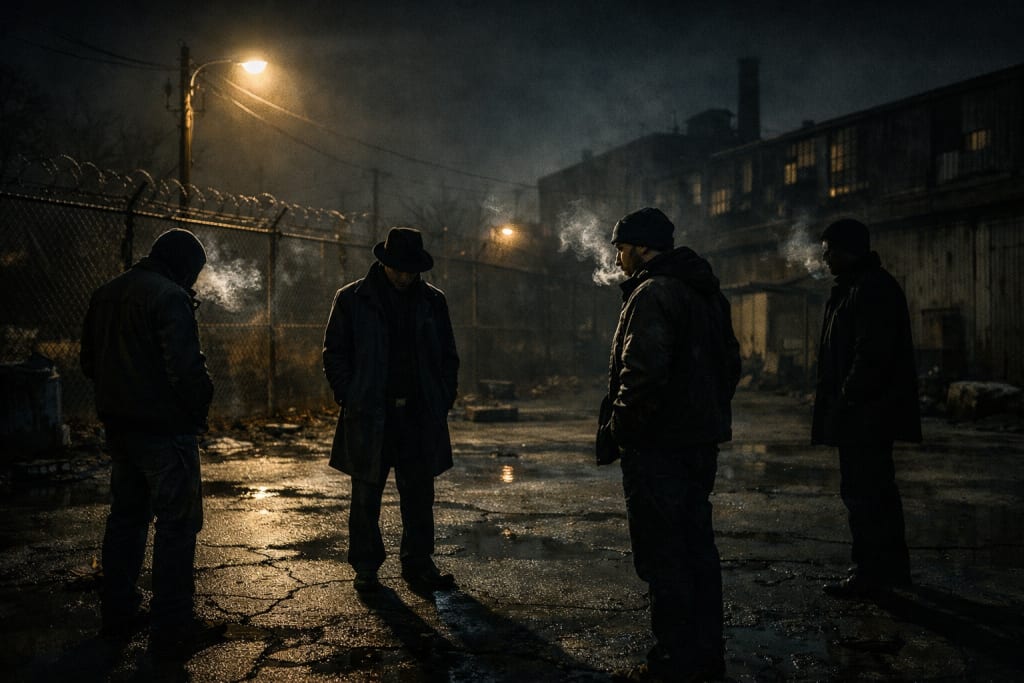
They called the place the Yard, though no grass ever grew there. It was a cracked rectangle of concrete behind an abandoned textile mill, fenced with rusted wire and watched by nobody who officially existed. To the city, it was a dead zone. To the men who gathered there after midnight, it was a community.
Not a gang—at least not in the way movies like to imagine. No matching jackets. No slogans spray-painted on walls. Just men who knew each other’s footsteps in the dark and trusted silence more than words.
I entered the Yard because I had nowhere else to belong.
I was nineteen, recently fired from a grocery store, recently evicted from a room I barely afforded. The city had already taught me its first rule: if you fall, fall quietly. My cousin Rehan found me sleeping in my car and didn’t ask questions. He never did. He just said, “Come tonight. Don’t speak unless spoken to.”
That was the second rule.
The criminal community doesn’t recruit with speeches. It waits. It watches who is desperate enough to listen.
The men stood in loose circles, smoking, exchanging envelopes, checking phones that rang once and never again. Their crimes were small individually—stolen electronics, forged documents, short-term scams—but together they formed an underground economy. They were mechanics of illegality, not kings of it.
And yet, there was order.
No one stole from within. No one spoke to police—not out of honor, but because survival demanded it. Trust was currency. Betrayal was debt that could never be paid back.
Rehan introduced me as “family,” and that word carried more weight than blood. In the Yard, family meant accountability. If I failed, he paid. If I talked, he disappeared with me.
My first job was simple: delivery. No questions about what was in the bag. No curiosity about where it came from. The rule was clear—knowledge creates weakness. Innocence, even false innocence, keeps you alive.
Over time, I noticed something unsettling: these men weren’t reckless. They were careful. Calculated. They studied laws the way students study textbooks—not to follow them, but to bend around them. They knew which cameras were broken, which judges were lenient, which neighborhoods forgot faces quickly.
They knew the system because the system had failed them first.
One man, they called him Uncle Saeed though he wasn’t old, used to say, “Crime isn’t rebellion. It’s adaptation.” He believed society was a locked house and they were learning which windows were loose.
Still, there were nights when the Yard felt heavy. When laughter stopped too suddenly. When someone didn’t show up again.
Nobody asked why.
That was the third rule: absence is explanation enough.
I stayed longer than I planned. Long enough to earn money that felt too easy. Long enough to forget the version of myself who believed in clean choices. The criminal community doesn’t drag you down—it invites you to sit, then slowly moves the floor beneath you.
The turning point came with a job that wasn’t small.
A warehouse. A real one. Real risk. Real consequences.
I was supposed to be lookout. I remember the cold air, the hum of electricity, the sound of my own heartbeat louder than any siren. When things went wrong—and they always do—I saw panic for the first time. Not chaos. Panic is quieter. Faster. Deadlier.
We escaped. Barely.
The next morning, the Yard was empty.
Phones disconnected. Numbers erased. The community dissolved like smoke, because that’s what it was meant to do. Criminal communities don’t last. They scatter before they rot.
Rehan called me once more. Just once.
“You’re out,” he said. “Don’t look for us. Don’t look back.”
I wanted to ask why. I wanted closure, explanation, permission. But I remembered the first rule.
So I stayed silent.
Today, I pass the old textile mill sometimes. The fence is still there. The Yard is still cracked concrete. No trace of what lived there at night.
But I know better.
Criminal communities aren’t defined by violence or greed alone. They are built from neglect, stitched together by necessity, and governed by rules harsher than law. They are shadows cast by systems that refuse to see everyone standing in the light.
I left with clean hands, but not a clean conscience.
Some nights, I still hear footsteps behind me and know exactly who they belong to—even though no one is there.
And that’s the final rule, the one nobody says out loud:
You can leave the community,
but it never fully leaves you.
About the Creator
When Prison Becomes Home: Why Some Elderly Japanese Choose Jail Over Freedom
Japan is often seen as a land of prosperity, discipline, and social harmony. From the neon streets of Tokyo to the quiet countryside towns, the country symbolizes modern success. Yet behind this image lies a growing and troubling reality: an increasing number of elderly Japanese citizens are deliberately committing minor crimes in order to go to prison. For many, prison offers something they can no longer find in society—food, shelter, healthcare, and human connection.
By Irshad Abbasi 6 days ago in Criminal
19-Year-Old Wife Convicted After Pushing Husband Out High-Rise Window
The tragic case of Joshua Hilberling highlights a devastating instance of domestic violence that ended in fatality drawing national attention due to its shocking circumstances and the reversal of typical gender roles in such incidents. On June 7 2011 23-year-old Joshua Josh Hilberling a U.S. Air Force veteran described as a tall physically imposing man (around 6-foot-5 and 220 pounds) plummeted to his death from the 25th floor of the University Club Tower a high-rise apartment building in downtown Tulsa, Oklahoma. He fell 17 stories landing on the roof of the building's parking garage where he succumbed to his injuries despite emergency response efforts.Josh's wife Amber Michelle Hilberling, who was just 19 years old at the time and seven months pregnant with their child was the only other person present during the incident. The couple had married the previous year in 2010 after a whirlwind romance but their relationship quickly deteriorated into volatility marked by arguments and physical altercations. Amber claimed the death was accidental and occurred in self-defense during a heated fight. According to her account, Josh had grabbed her shoulder or otherwise threatened her safety and that of their unborn baby prompting her to push him away. She insisted the window shatter and his fall were unintended consequences of the struggle.
By Kure Garba4 days ago in Criminal
Guard Your Battery
Why are some people so attractive just by standing there? It’s not because they are "likable," but because they don’t need everyone to like them. I realized later that truly charismatic people allow themselves to be criticized, but they never criticize themselves. They never try to please the world; instead, the world stops to watch them.
By Emily Chan - Life and love sharing6 days ago in Poets



Comments
There are no comments for this story
Be the first to respond and start the conversation.