
Evidence of Absence
When the universe stops whispering, start listening.
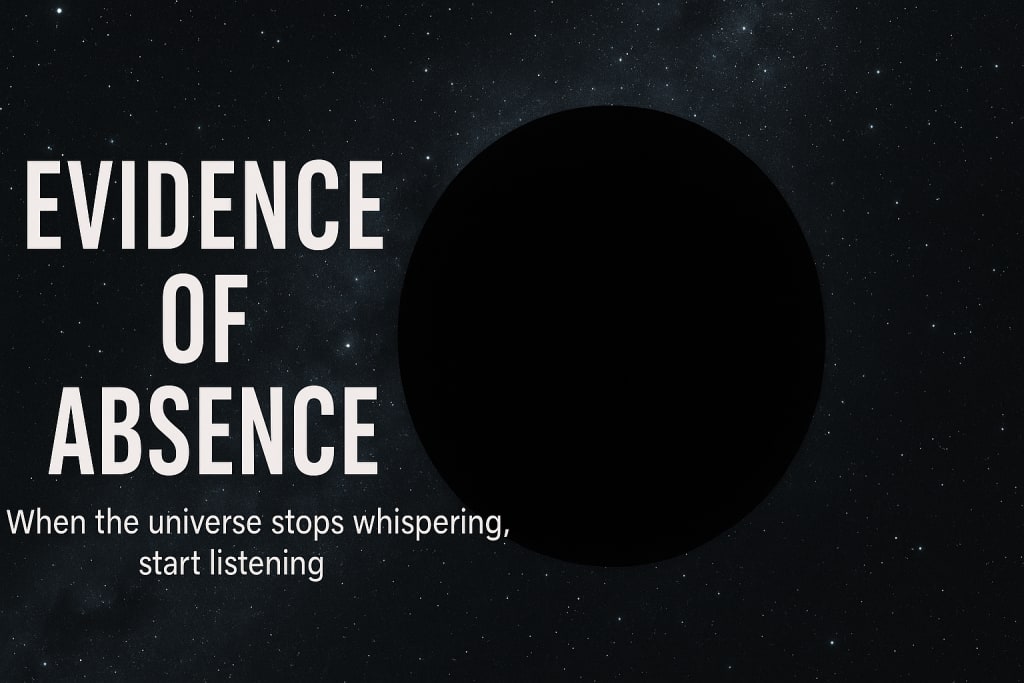
Dr. Nina Holloway stared at the void.
Not the kind of void poets wrote about, or philosophers pondered late at night. This was the literal, data-proven absence of something that should’ve been there. It blinked at her in neat lines of code, nestled in sensor data from her deep-space array. A patch of the cosmos, 22 light-years wide, where nothing—absolutely nothing—registered. No matter, no radiation, no gravitational ripples. No dark matter anomalies. No background hiss. A silence so pure, it was unnatural.
It wasn’t just absence. It was missing.
Nina leaned back in her chair at the Interstellar Observation Facility in Chile and pulled up historical records. Six years ago, this very sector of space had contained a small star cluster. Not remarkable in itself—burning quietly in the backdrop of the Andromeda trail. And now? Vanished. Not decayed. Not gone nova. Not black holes.
Nothing.
She sent a message to Raj, her partner in the South Pole array, where similar instruments confirmed deep-space anomalies. Thirty minutes later, he replied.
Confirmed. Total silence. Data integrity holds.
Her heart thudded.
A dozen theories poured into her mind, each more implausible than the last. But physics did not allow for non-traceable removal. Mass and energy transformed. They didn’t disappear. Even the death of a star left fingerprints—neutrinos, gravitational wakes, echoes. This left nothing.
Evidence of absence.
The term rattled around in her skull like a marble in a bowl.
In science, they’d always said, “Absence of evidence is not evidence of absence.” But now, she was facing something stranger: the presence of absence. A precise surgical hole in reality.
She submitted a preliminary alert to the International Astrophysics Network. It wasn’t her usual style. Nina was cautious, deliberate. But the implications demanded immediacy. Within hours, a flurry of encrypted messages arrived, most of them skeptical, some concerned.
But then came the transmission from Hoshino Yuki, an astrophysicist stationed on the lunar outpost Kaguya-3.
We’ve seen something similar. Not in space. On the Moon.
Nina read it twice, frowning.
A crater that was there last year. Gone. No impact trace. Not filled. Just… erased. Satellite images confirm.
She opened the file attached—images taken eight months apart. In the first: a familiar gray basin, shallow, pockmarked with smaller divots. In the second: a smooth stretch of regolith, seamless as if untouched by time or physics. No evidence of fill-in, no debris. No signs of artificial manipulation.
Erasure.
Something was rewriting reality.
Nina's breath shortened. She leaned closer to the screen, unconsciously tapping her nails against her mug. Earth’s instruments, the Moon’s surface, now deep space. What kind of force could selectively delete matter across the vacuum, ignoring the fundamental conservation laws?
She brought up the telemetry logs from the first detection—down to the nanosecond. That was when she noticed it: a microsecond power fluctuation in the satellite’s AI module. It had reset, just briefly.
Normally, that would be noise. A blip.
But now it echoed with importance.
She dug deeper, chasing a digital thread. Over the next six hours, fueled by caffeine and creeping unease, she uncovered a pattern: every time these ‘absences’ occurred, a low-level power signature surfaced, along with a cascading memory overwrite. Logs scrubbed. Backups blank. Only external redundant sensors, further from the events, had caught the gaps.
As if something didn’t want to be known.
Not cloaked. Not hidden.
Erased.
She called Raj.
“I think we’re seeing selective deletion of reality,” she said quietly. “Not hidden data. Not obscured matter. But literal absence engineered with precision.”
Raj didn’t speak for a few moments. When he did, his voice was tight. “You think it’s intentional?”
“Yes. And intelligent.”
A heavy silence stretched between them. Then:
“Why?”
“I don’t know,” she said. “But the fact that we’re noticing it now means it’s either accelerating… or getting sloppy.”
The thought chilled her more than the data. An intelligence capable of surgically erasing sections of space-time… was either rushing, or didn’t care if they saw.
The next few days brought more reports. A cave system in Patagonia vanished, sensors and all. A digital archive in Geneva blinked out of existence—drives intact, but with zero bit data. A weather balloon, mid-flight, disappeared without triggering any GPS loss.
And with every new event, the same trace pattern: slight memory desyncs, energy flickers, the hum of recalibrated silence.
Eventually, it hit the global media. But by then, the phenomenon had become too large to ignore. The world wasn’t panicking—yet—but there was fear. No enemy to identify, no comet to divert. No signal. No demands.
Just deletion.
That was when the final data packet came through—from the Voyager-3 deep array, a probe positioned past Pluto. A single-frame image sent before its systems went dark.
Nina stared at it for hours. There was no monstrous alien vessel. No void tentacle. No flickering light.
Just a single word, burned into the image sensor like a cosmic watermark:
“TESTING.”
And that was when humanity realized:
The silence wasn’t a void.
It was a question.
And now, it was waiting for the answer.
About the Creator
Keep reading
More stories from Said Hameed and writers in Criminal and other communities.
The Locksmith’s Secret
In the heart of the old town, nestled between a dusty bookshop and a bakery that always smelled of burnt cinnamon, stood a peculiar little shop with a brass sign that read: "Halvorsen & Son – Locksmiths Since 1883." The windows were clouded with age, and a small bell above the door gave a tired jingle whenever someone dared to enter.
By Said Hameed8 months ago in Criminal
Ken Childs and the Shadow Network Behind Celebrity Surveillance
Hollywood is no stranger to intrigue. Behind the red carpets, blockbuster premieres, and glamorous headlines lies a parallel world where privacy is fragile and information can be extremely valuable. Over the years, celebrities have faced stalkers, hackers, and fraud schemes designed to exploit their wealth and visibility. Recently, reports circulating online have drawn attention to a controversial narrative involving private investigator Ken Childs and allegations that place him near the center of a disturbing story about celebrity surveillance.
By Shane Smith3 days ago in Criminal




Comments
There are no comments for this story
Be the first to respond and start the conversation.