
“The Price of Compassion: Aimal’s Descent Into Darkness”
When desperation meets injustice, even the purest heart can fall prey to crime

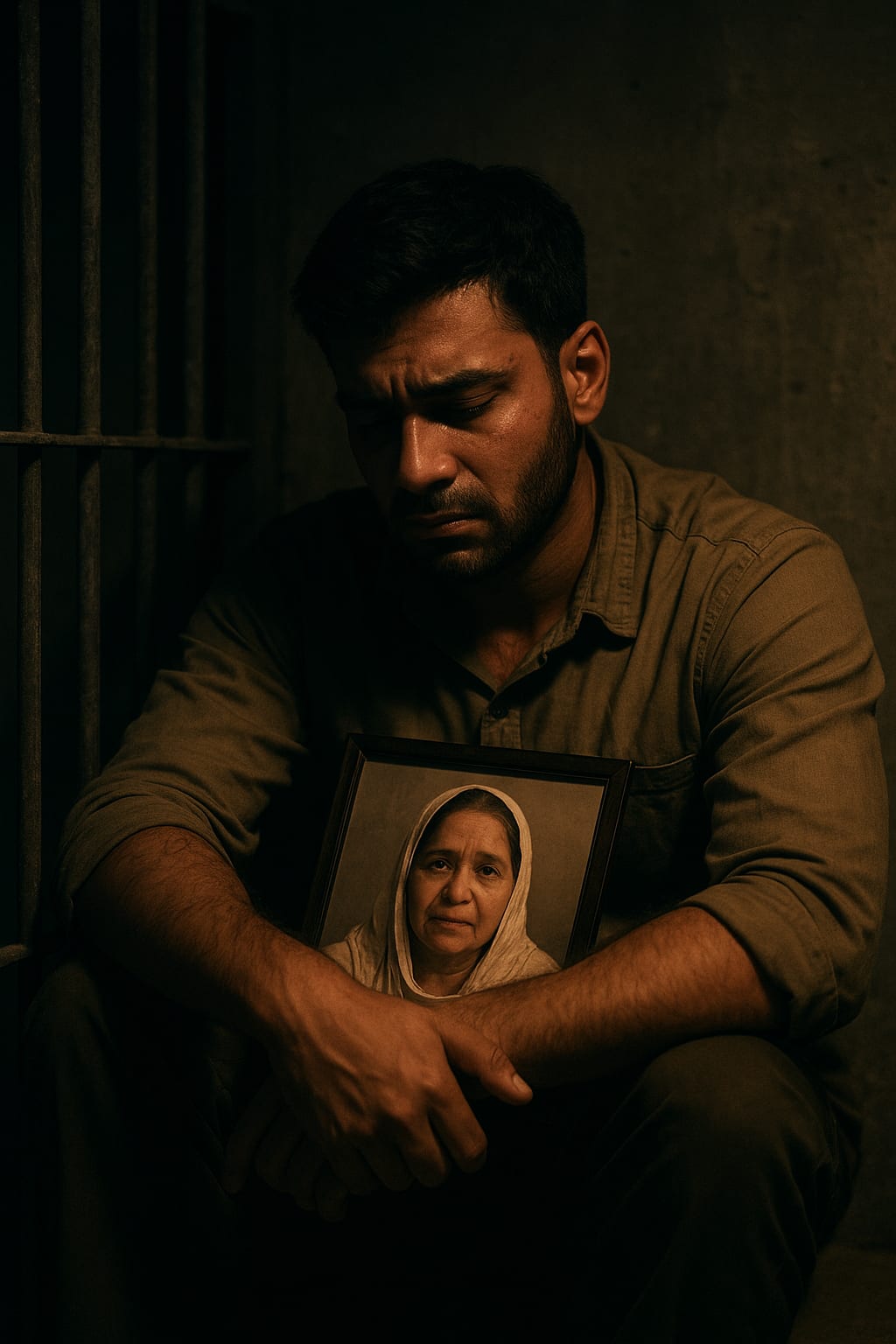
imal sat silently inside his small house, his head resting on his knees, lost in the shadows of memory. His mother’s frail voice echoed in his mind:
> “Son, my medicine is finished. My sugar has risen, and my blood pressure has dropped. When you come from the city, bring my medicine with you.”
Aimal had replied softly, “Mom, don’t worry. Just pray that I find a job soon. Once I do, everything will be fine.”
His mother had prayed for him with all her heart. Then came the voices of his younger siblings — his brother crying over his broken school bag, his sister reminding him not to forget her bangles and necklaces. Their innocent needs pressed heavily on his chest.
Aimal smiled faintly and stepped out of the veranda. His eyes met those of his elder sister, a widow who carried the weight of sorrow with quiet grace. She understood his silence. “May God bring you home safely, Aimal,” she said, handing him food.
But safety was no longer in Aimal’s fate.
His father had died years earlier in an accident, leaving Aimal as the only breadwinner of the family. His mother, despite her illness, had worked hard to educate him up to the fourteenth grade at the mosque school. Poverty had kept him from continuing his education. His sister’s in-laws kept pressing for her remarriage, but Aimal had always delayed it, unable to afford even the simplest of dowries.
He had visited local politicians, MNAs, MPAs, and Nazims, begging for a job. They offered empty promises — or demanded bribes he could never pay. His debts grew heavier, his family’s needs deeper, and his hope thinner.
Aimal was not only responsible but deeply sensitive. His mother’s illness, his sister’s fate, and his siblings’ education weighed constantly on his heart. Yet he also carried a secret — his love for his cousin, his maternal uncle’s daughter. She loved him too, until one day she told him, “Aimal, my parents have arranged my marriage with a government officer. Please, forget me.”
That single sentence shattered what was left of his spirit.
One night, as Aimal sat alone, the sound of metal clanking snapped him back to reality. The prison sentry’s voice boomed, “Boy, haven’t you eaten yet?”
Aimal looked at the untouched food. The sentry sighed, collected the dishes, and locked the cell again. Aimal leaned back against the cold wall. His mind replayed the day his mother collapsed due to lack of medicine. The doctor had told him she needed to be admitted immediately.
> “We’ll start treatment,” the doctor said, “You just arrange the payment.”
Aimal had nodded without hesitation — but his pockets were empty. He went door to door in the village, asking relatives and friends for help. Every door closed in his face.
At last, in despair, he went to Kamal, known in the area as Kamali, a man of influence and shady dealings. Kamali smirked as Aimal explained his troubles.
> “You’re a smart boy,” Kamali said. “Why don’t you do something for yourself instead of begging? The world doesn’t pity the weak — it crushes them. You want money? Then earn it with courage.”
Aimal frowned. “I don’t understand.”
Kamali led him aside, lowered his voice, and whispered, “Take a small parcel to the city. My people will meet you. Deliver it, and you’ll get your money. Easy work. No one will even notice.”
Aimal froze. “What’s in the parcel?”
Kamali smiled. “Don’t ask too many questions, my friend. Just remember — this will save your mother.”
At first, Aimal resisted. But as he thought about his mother’s illness, his sister’s marriage, and his siblings’ hungry faces, desperation defeated conscience. He finally agreed.
The next morning, Aimal bought new clothes for his mother and some groceries. He wrapped them carefully, as if trying to wrap his guilt. Then he took Kamali’s package and boarded a bus to the city.
But fate was already waiting.
At the Sardaryab checkpoint, police boarded the bus. They searched each passenger. When they reached Aimal, he froze. The parcel was opened — and inside were packets of drugs.
His world collapsed.
Days later, Aimal found himself in a cold prison cell. The same sentry who mocked him earlier now called, “Prisoner, don’t be sad. You have company today.”
The next morning, he was taken to court. The judge read from the file without emotion:
“Taking into account all evidence and witnesses, this court sentences the accused, Aimal Khan, to seven years imprisonment with hard labor for the crime of drug smuggling.”
The words struck him like bullets. Tears streamed down his face as his mother’s weak image and his siblings’ voices echoed in his mind.
Aimal whispered bitterly,
“In this crime, I am not alone. Everyone in this society is with me.
So why am I the only one punished?”
About the Creator
Keep reading
More stories from shahkar jalal and writers in Criminal and other communities.
A $600 Car That Became a Trap
A $600 used Chevrolet Monte Carlo sat in a parking lot at Chicago O’Hare International Airport long enough to turn into a six figure problem. By the time the situation became public, the car had been cited a record 678 times and the balance attached to it was reported at more than $106,000. The person whose life was upended was not the person accused of abandoning the vehicle, but the woman whose name was on the registration: Jennifer Fitzgerald.
By Rare Stories5 days ago in Criminal


Comments
There are no comments for this story
Be the first to respond and start the conversation.