
The Poisonous Betrayal: The Tragic Case of Joann and Robert Curley
Unraveling the Deadly Deception Behind a Husband's Mysterious Illness

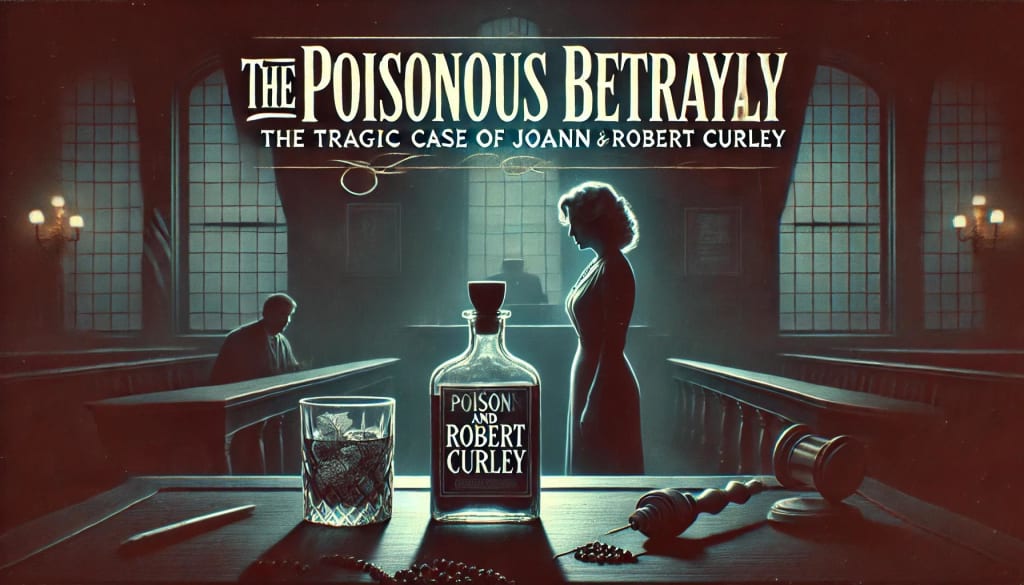
Robert "Bobby" Curley was a hardworking and kind-hearted man, known for his dedication to his family and his strong work ethic as an electrician. Living in Wilkes-Barre, Pennsylvania, he was the kind of person who brought warmth and laughter into the lives of those around him. No one could have imagined that behind the facade of his seemingly stable marriage lurked a deadly secret, one that would shock the entire community and expose the chilling betrayal by the person he trusted the most—his wife, Joann Curley.
In August 1991, Bobby began suffering from a series of perplexing health issues that confounded doctors. At first, the symptoms were subtle—fatigue, mild discomfort, and occasional nausea. However, these soon escalated into more alarming conditions, including severe pain, burning sensations in his limbs, intense sweating, and uncontrollable vomiting. As his health continued to deteriorate, medical professionals struggled to determine the cause of his mysterious illness. Bobby’s condition worsened rapidly, and in a desperate attempt to save his life, he was transferred to Hershey Medical Center, where doctors worked tirelessly to find answers.
The breaking point came when Bobby began losing his hair—a symptom that indicated something far more sinister than an ordinary illness. This alarming clue prompted specialists to conduct toxicological tests, leading to a shocking discovery: Bobby had been poisoned with thallium, a highly toxic metal that had been banned for household use in the United States since 1984. Thallium, once used in rat poison, was notorious for its ability to cause agonizing deaths, often mimicking symptoms of natural illnesses. By the time doctors identified the poison in his system, it was too late. Bobby succumbed to his suffering on September 27, 1991.
In the aftermath of his death, investigators were left with a haunting question—how did Bobby Curley ingest such a lethal substance? At first, suspicions turned to his workplace. As an electrician, Bobby frequently worked in environments that contained hazardous materials. Investigators explored the possibility of accidental exposure or even workplace sabotage. Old chemical bottles containing thallium were found in some of the chemistry labs he had worked in, leading to speculation that he had unknowingly come into contact with the deadly substance. However, extensive testing of his workplace failed to uncover any traces of thallium that could have caused his poisoning.
As workplace exposure theories fell apart, attention turned toward Bobby’s personal life, particularly his wife, Joann Curley. Joann had portrayed herself as a grieving widow, devastated by the loss of her husband. However, cracks in her story soon began to emerge. Friends and family members noticed that she did not display the usual emotions expected of someone who had just lost their spouse in such a horrific manner. Her statements to investigators were inconsistent, and she appeared strangely composed during a time of immense grief.
Financial motives also came into play. It was soon discovered that Joann was the sole beneficiary of Bobby’s life insurance policy. In the months leading up to his death, she had actively made changes to the policy, ensuring that she would receive a significant payout. Investigators found this suspicious, but at the time, they lacked the concrete evidence needed to charge her with the crime. Without a smoking gun, the case remained open but unsolved.
It wasn’t until 1994, three years after Bobby’s death, that investigators made a breakthrough. Determined to uncover the truth, authorities ordered Bobby’s body to be exhumed for further forensic examination. Advances in toxicology allowed specialists to conduct a segmental analysis of Bobby’s hair and nails, a technique that could reveal patterns of poisoning over time. The results were chilling. The analysis showed that Bobby had been receiving multiple doses of thallium over several months, with increasing concentrations leading up to his death. This proved that his poisoning was no accident—it was a carefully orchestrated act of murder.
With this new evidence in hand, investigators turned up the pressure on Joann. Facing undeniable forensic proof, she finally cracked. In a shocking confession, she admitted to poisoning her husband. She revealed that she had mixed thallium into his food and drinks, slowly increasing the dosage until his body could no longer fight the effects. Her motive? A combination of financial greed and personal resentment. She had grown tired of her marriage and saw Bobby’s death as an easy way out, one that would leave her with a substantial financial reward.
Despite the horrifying nature of her crime, Joann Curley was offered a plea deal. She agreed to plead guilty to third-degree murder, which carried a maximum sentence of 20 years in prison. This plea deal was controversial, as many believed that she deserved a harsher punishment for the deliberate and prolonged suffering she inflicted on her husband. However, legal experts argued that securing a conviction for first-degree murder could have been more challenging, especially given the complexity of the forensic evidence. Bobby’s family, seeking closure and justice, accepted the outcome, knowing that at least Joann would spend two decades behind bars.
Joann served her full sentence and was released from prison in December 2016. Her release reignited public debate about the adequacy of her punishment. Many felt that 20 years was not nearly enough for the calculated and cruel manner in which she took Bobby’s life. Others argued that justice had been served according to the legal system, even if the punishment felt insufficient.
The case of Joann and Robert Curley remains one of the most chilling examples of betrayal and deception. It underscores the importance of forensic science in uncovering the truth behind mysterious deaths. If not for advancements in toxicology, Bobby’s death might have remained an unsolved mystery, and Joann might have escaped justice altogether.
Beyond the forensic elements, the case also serves as a grim reminder of how appearances can be deceiving. To the outside world, Joann and Bobby had a normal marriage, free of turmoil. Yet beneath the surface, a deadly plan was unfolding, orchestrated by someone Bobby trusted with his life. The case highlights the devastating consequences of unchecked greed and malice, leaving an enduring impact on those who knew and loved Bobby Curley.
For the town of Wilkes-Barre, the memory of Bobby Curley remains a tragic cautionary tale. His life was cut short not by fate or accident, but by the very person he had vowed to spend his life with. In the end, justice was served, but no punishment could ever undo the suffering he endured. His story continues to remind us of the darkest aspects of human nature and the importance of seeking truth, no matter how deeply it may be buried.
About the Creator
Donald Trump Withdrawing U.S. Forces From Qatar Amid Fears of Iranian Escalation
Donald Trump Considers Withdrawing U.S. Forces From Qatar Amid Fears of Iranian Escalation The recent killing of approximately 2400 protesters in Iran has once again drawn global attention to the deep political and security crisis inside the country. These deaths, linked to widespread demonstrations against economic hardship, political repression, and government authority, have intensified regional tensions and raised serious concerns about Iran’s internal stability. As unrest grows and the risk of external escalation increases, the security balance in the Middle East has come under renewed scrutiny.
By America today 5 days ago in Criminal
My Husband’s Dark Price for Wealth
Please don't be a ghost reader, do engage, let me also learn from you My husband asked me to ab0rt our babies for money r!tual after four years of childlessness, so that he can make money and take care of his poor mother and also relocate to UK.
By Edward Smith3 days ago in Criminal


Comments
There are no comments for this story
Be the first to respond and start the conversation.