
The Pinkertons
Secret Service, Spies, or Thugs?


There are innumerable books and documentaries on the Pinkertons, and Allan Pinkerton, the founder, exclusively, but my intention is to dive as deep as possible into the agency and its operatives. There’s a ton of information, and misinformation, on The Pinkertons everywhere you look, so buckle up because this isn’t your average foray into the past.
Origin of The Pinkerton Detective Agency
Allan Pinkerton, who was born in Glasgow, Scotland in 1819 first made his name as a political agitator, but you might already be familiar with this if you Googled: "Red Dead Redemption 2, the Pinkertons".
The following, however, is not based on a cool video game. A supporter of “chartism”, the working class’s ability to vote regardless of owning land, as well as a few other tenets--because the past was the worst--Pinkerton was eventually issued an arrest warrant for his participation in a riot in 1842.
There are some accounts by James MacKey that this wasn’t the case, but I’ll circle back to that.
Fearing a prison sentence, Allan fled with his wife, a woman named Joan, to Montreal and then Chicago, Illinois.
After working as a cooper, Allan opened his own shop in Dundee, outside of Chicago. Allan was more than a hardworking man, he had principles and values. His shop was more than a mere business, it was part of the underground railroad.
Allan Pinkerton had some ties with abolitionist, John Brown, and although sheltering slaves and helping them escape bondage was illegal, it did not seem to conflict with Allan becoming a sheriff’s deputy, but we’ll get to that.

You see, building barrels for a living--Allan was a cooper--means you need wood. There was a small island rife with pliable timber awaiting harvest not far from the Pinkerton home. Allan often visited the island to harvest that wood. One day, on a trip to that island, he found signs of a campsite and what seemed to be counterfeiting equipment. Because there was no law in America west of the Mississippi at that time, counterfeiters could make fake bills and coins to swindle the masses and then head west. Unfortunately for these bandits, Pinkerton reported his findings to the Chicago police, and together they caught the counterfeiters.
His devotion and heroism led to the townsfolk asking him to fight crime. He was suddenly Bat Man. Well not really. He was mostly asked to find out who stole various items and tools from people, and I’m not sure if he found anything or even took them seriously enough to try.
It was 1846 when he became deputy sheriff. With a penchant for law and order, he did quite well. Two years later he became the first police detective in Chicago in 1848. Contrary to popular belief, Allan Pinkerton was not the first detective ever, just the first in Chicago, but still a pretty big deal, especially if you take into consideration his help along the underground railroad throughout his time as a law enforcement agent.
It was in 1850 that he and his brother Robert, founded the Pinkerton National Detective Agency with Edward Rucker, a friend and lawyer. I wasn’t able to find much about this young man, but it seems, according to rpwhrs.org, that Rucker devised a method of keeping track of recorded instruments and legal proceedings regarding real estate titles. Whatever that means.
For reasons I have yet to discern, Allan and Edward were friends, and both decided to start a detective agency with brother Robert, maybe. I’m going to have to circle back later on.
There's going to be a great deal of circling....
What some don’t know about this agency is that they employed women and freed slaves. Their main goal at their inception was to fight for the people who could not rely on law enforcement, those farther West, and their chief method was through undercover work. It is believed that Kate Warne, the first female employee, often masqueraded as a male soldier in order to garner intelligence and evidence, but that may be second-hand hearsay.
I really could not honestly corroborate this information.
Brother Robert
Desperately tried to find any information on Robert Pinkerton. There was nothing on YouTube, but I guess that’s what you get. However, Henrypoole.com explains that brother Robert born in 1848, and his twin brother, William, (didn’t know there was a William), joined Allan around 1860. Most information states that Robert, Allan, and lawyer Edward founded the agency in 1850, but please bear with me. I’m working with whatever information was left over after the great Chicago fire of 1871. The Pinkerton building was burned down, and innumerable documents were lost. Perhaps, a lot of what remains is hearsay, or something reconstructed from relevant, if partial, documentation.
Anyway, while reading through information on Henrypoole.com, it begins to sound like they’re referring to Allan’s sons, William and Robert, who turned the agency upside down later on, so, I’m sorry. I guess it makes sense that Robert, born 39 years after Allan, is a different Robert. I did manage to find an article on cdnc.ucr.edu from the Los Angeles Herald, Volume 34, that states, “Robert Pinkerton, Detective is dead”, and this is from August 18th, 1907. The small article states that Robert died at sea en route to Germany for his health. He purportedly died of “fatty degeneration of the heart.” He left his portion of the agency to his widow. When she died, the agency reverted to Allan’s sons, William and Robert. Apart from that, there’s no real information on Brother Robert. Too bad.
We Never Sleep
Kate Warne applied to become a detective at the age of 23. She convinced Allan that women had alternative methods of gathering intelligence and evidence, and this did not mean revealing naughty bits, but rather a different approach, such as speaking to wives, and possibly, women of ill repute. Allan Pinkerton agreed to hire her. In 1858, she was sent to investigate embezzlement in the Adams Express Company.
It was believed that a Mr. Maroney, an employee of the Adams Express Company, had stolen $50,000 dollars. It didn’t take Kate long to befriend Mrs. Maroney, and she was able to retrieve 80% of the embezzled money. Just so you can put this into perspective, Maroney stole the 2024 equivalent of about $1.9 million dollars. That’s kind of a lot of money to steal from a company and to be able to retrieve 80% of that is impressive.
It was only a few years later that a supposed plot to assassinate then President Lincoln was foiled, The Baltimore Plot. Kate Warne and some of the Pinks, the female unit of The Pinkertons, along with other detectives, were sent to Baltimore to infiltrate dissidents, who were plotting to kill Lincoln.
In 1861, Lincoln was to journey through the states, unaccompanied by the military, from Springfield, Illinois, to Washington D.C., for his inauguration, and to speak on behalf of uniting the states against the secession states. He believed that most people were ready to abolish slavery, yet the south disagreed, and they were ready to murder the President, because killing the President is the best way to preserve the imprisonment of slaves...allegedly.
Unfortunately, many railroad operators, and even dissidents as far north as Baltimore, Maryland, were willing to side with the south. The Pinkertons caught wind that a Baltimore barber, Cypriano Ferrandini, expressed his desire to assassinate the President.
While this is somewhat disputed, a close friend of President Lincoln did procure the services of the Pinkertons for this very purpose. Allan, who wished to protect the President directly, ended up employing Kate Warne. She had Lincoln pose as her invalid brother, and they switched trains to Baltimore, so that Cypriano and his men would not be able to thwart the President’s inauguration. Along the way, Kate remained awake all night, and that’s where the phrase, “We never sleep” originated.
This has me wondering, though. What if the Pinkertons falsified The Baltimore Plot in order to garner employment and respect of the President? I mean, that’s not a terrible way to become a famous detective agency and eventually develop into the CIA, FBI, and Secret Service...allegedly. We’ll get there much later on.
I said there would be much circling back....
The Pinks
As mentioned earlier, the first of the Pinks was Kate Warne, and when other ladies came along, it was Kate, who trained them. Other notable members of The Pinks included; Hattie Lawton, Elizabeth Van Lew, and Mary Edwards Walker.
According to Prairie Rose Publications, Hattie Lawton was mix-raced. Coming onboard in 1860, she was sent off to acquire intelligence from the Confederate Army. She posed as the wife of a man called Timothy Webster. He was apparently executed, and she sent to be imprisoned at the Castle Thunder prison in Virginia. (John Scobell is not mentioned here, if I recall correctly, and this will be important a bit later.) She was, however, exchanged for a Confederate spy, Belle Boyd, in 1862.
I guess female spies were more prominent than I knew back then.
Hattie Lawton was eventually betrayed and tried as a spy in 1962...according to AI Overview, which means that Lawton was in her nineties when she was tried. Doing more research on this one, so we can find out where all the clues come together….
Elizabeth Van Lew also infiltrated the Confederate Army by working as a nurse. She cajoled whatever information the Union required from wounded men who trusted her, or were possibly high out of their minds on morphine, in which case, I wonder how accurate the intel might have been, but hey, the Union won, so there’s that.
I didn’t find anything on Mrs. Walker, but it isn’t surprising. For one thing, as was mentioned earlier, the great Chicago fire destroyed many records of that time. Secondly, the Pinks often used aliases, so pinning down their true identities and contributions is no easy task.
John Scobell
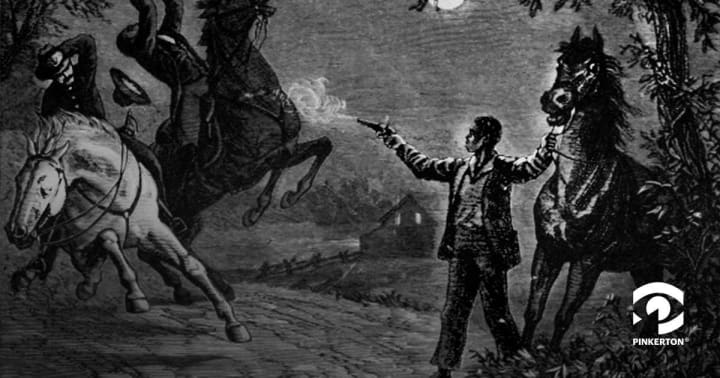
An African American hired by the Pinkertons, he’s said to have posed as a cook, farmer, and servant in order to obtain information from the Confederacy. He even played the role of servant to Timothy Webster and Hattie Lawton, spies for The Pinkerton Detective Agency (mentioned a moment ago) while they were posing as spouses. This is before Webster was executed and Lawton imprisoned. Unfortunately, there is a major point of contention here.
I conducted as much research as I could to find out more about Scobell and simply came up empty-handed, at first. Were the records destroyed in the Great Fire? Had he multiple aliases? Was he not as well documented because he was a minority and former slave?
According to coreyrecko.com--visit the site at your own discretion as it is not secure--John Scobell never existed. His contention is that after writing a biography of Timothy Webster, he intended to write a biography of John Scobell. However, allegedly, he found no real information other than what was previously mentioned.
Allegedly, (yes, there’s going to be a few more allegedlies,) Recko scoured all available records regarding the Pinkertons, their missions, their pay records, the places they visited, routes they took, and employers such as General McClellan of the Union Army. Recko states that he found no direct mention of John Scobell.
While he admits it could have been an alias, and that there have been documents and mentions of people with the initials J.S., there is no mention by the people involved that any mission regarding posing as a slave or servant for Webster and Lawton occurred, nor were there any missions where anyone was paid to infiltrate the Confederacy as a cook or farmer.
Allegedly, Recko claims that it’s more than likely that either there was no John Scobell, and the stories were made up as a collection of information gained from slaves moving north, or fans of the Pinkertons, who wrote books about them, fictionalized so much so, that they created John Scobell for their own fancy. This is allegedly proven by Recko in stating that people who wrote about Scobell simply referenced each other and not any source that could have named or identified Scobell in any way.
Was John Scobell real? The more prominent sources say yes, and all agree on exactly what he did. Will you or I, or anyone reading, comb through all records regarding the Pinkertons and their employers? Probably not. Is Recko telling the truth? What would he have to gain by lying? He could have said that after all his hard work, he was finally ready to write a book on John Scobell, and that would be more lucrative, wouldn’t it?
I’ll leave it at that...allegedly.
At this point, I found out that the Pinkertons actually have a website that is actively maintained, and would you guess that they have John Scobell named, along with his story, under “scouts and spies”? You can simply go to Pinkerton.com and read everything you’d like to your heart’s content, but will you enjoy my silly rants?
Here’s basically what you’ll find on their site if you take a gander yourself:
After earning his freedom, John Scobell and wife (she doesn’t deserve her own name, apparently) traveled to Richmond, Virginia, to look for work. John marched on in to the Secret Service office and explained how he gathered much information throughout his journey north and his time in slavery. Taking a liking to him, Allan Pinkerton debriefed Scobell, who gave a detailed account of his travels through the country including the locations of towns, roads, and streams.
Yes, knowing where water is can be extremely important when fighting a war.
Scobell’s first mission required he join seasoned spy Timothy Webster to gather intelligence and disrupt enemy communication. Their journey began with a carefully planned route through various towns in Virginia. In Leonardstown, the two split up, and Scobell marched to the Confederate camp at Dumfries on his way to Centreville to meet another Pinkerton.
At the same time, Webster met Dr. Gurley, a Confederate deserter, who claimed to have documents for the Confederate Secretary of War. The documents contained the movement of the Confederate rank and file. Webster decided he needed to meet up with Scobell.
(Why does this doctor have such information??)
The two devised a plan. Scobell would ambush Gurley and steal the documents. That night, after a successful mission, Scobell sewed the papers into the jacket lining of another scout and sent him on to meet with Allan himself.
After several short-term assignments, Scobell was sent on a long-term assignment with Timothy Webster and Hattie Lawton to Richmond, who posed as a wealthy Southern couple and their servant.
Scobell assumed the cover of an illiterate freed slave. Ever calm of spirit, Scobell acted ignorant of the Civil War. Confederate officers dismissed Scobell simply as a dunce, who often left important documents out in the open. Scobell, however, made note of anything he saw and heard and sent those reports back to Washington.
Suddenly, the mission was upended. In 1962 (yes, this date is from the Pinkerton website, and no, it does not make sense. Remember I mentioned earlier that Lawton was tried in 1962? That Recko believes there never was a Scobell?) Webster, Lawton, and Scobell were betrayed, arrested, and tried as spies. Webster was sentenced to death. Lawton was sentenced to one year in prison then traded for Belle Boyd, and Scobell was released immediately, which is super sus that Confederates, who fought to maintain slavery, would release a former slave to return to the Union.
You’d think they’d have put him to work in a cotton field, no? I know that’s racist, but this was the past!
Not much more is known about Scobell or his life after the Civil War anyway. Do you think Scobell was a real dude? How accurate is the Pinkerton website? Were any of them really spies?
Spying
Directly from the Pinkerton website: Webster infiltrated secessionist groups in Baltimore, gathering critical information about their plans. His intelligence enabled Pinkerton to devise an alternate, secret route for Lincoln’s train journey to his inauguration, ensuring his safe arrival in Washington, D.C.
When the Civil War broke out, Webster was so committed to the Union that he joined the ranks of the Secret Service, started by Allan, and served as a scout, going out on short-term missions to collect intelligence.
Keep in mind that the Secret Service were simply dedicated to counterfeiting and money laundering from their inception to recent times.
Almost from the beginning of the war, Webster bravely accepted the responsibility of acting as a double agent. Again, according to the Pinkerton website, he masterfully played both sides, but how could he have played them both if he was loyal to the Union? At any rate, he allegedly served the South, but nowhere does it explain how exactly he did so. His minor betrayals to the Federal government were forgiven as they enabled him to gain the Confederacy’s trust for a more profound deception.
Yes, I know, this is all very confusing, but, perhaps, this is how the Pinkertons operated. I still don't know what his "minor transgressions" were.
After Webster’s success in completing short-term scouting missions to Maryland, Kentucky, Arkansas, Mississippi, and Tennessee, he was sent undercover with Hattie Lawton to Richmond, Virginia, where they posed as a wealthy married couple, along with Secret Service agent John Scobell...allegedly.
And this is why I'm conflicted regarding Mr. Scobell's existence. He’s mentioned on the Pinkerton website, and just because there isn’t enough information to write a biography of someone does not mean they did not exist. I do, however, wonder if maybe Scobell didn’t play as big a role as Pinkerton scholars would have you believe. Maybe, he wasn’t really posing as the servant of Webster and Lawton.
Continuing along with the story….
Allan Pinkerton often noted that his scouts and spies were “brave, honest, and intelligent,” commenting that no danger was too great, no trust too responsible, no mission too delicate, allegedly. I mean, I don’t know who heard him say this, much less write it down.
Timothy Webster, who was one of Pinkerton’s first operatives in the 1850s, which would be right around the time the agency was founded, had gained prominence in the agency during the foiling of The Baltimore Plot (the kill Lincoln plot). This is assuming the plot was real, but don’t forget that The Baltimore Plot unfolded in 1861, but even the Pinkerton website doesn’t assure when Webster joined exactly, nor how he unfolded the plot.
These dates, bruh... Highly sus.
Anyhow, when the Civil War broke out, Webster was given orders to join the brand new Secret Service, which was overseen by Allan Pinkerton. Here, the Pinkerton website claims that even though Webster was a Secret Service agent, you know, to battle counterfeiting, he was simultaneously given missions by Allan to work as a double agent for the Union and the Confederacy.
Anyway, within five months, Webster had established himself in Richmond and was accepted there as a secessionist and a Southern secret agent in the Confederacy (Because, evidently, the South hand their own spies, like Belle Boyd….) One of Webster’s duties was to convey underground mail between the South and the North.
He made many covert trips between Richmond and Baltimore (where that barber was going to kill the President), via Washington, where the mail was steamed opened, read, and carefully resealed for delivery to the original recipients. Webster and Lawton sent long, detailed reports describing what was transpiring within the Confederacy war effort. They also sent reports about Richmond’s fortifications, soldier morale, and food prices. However, a severe bout of inflammatory rheumatism in 1862 left Webster incapacitated and unable to communicate with Pinkerton.
So neither Lawton nor Scobell could write for him…? I’m just asking. I have bilateral osteo-arthritis. I can write a message for someone else to take. Maybe, this is all explained in the documents burned in the great fire. Probably not, though, allegedly….
In response to Webster’s condition, Pinkerton dispatched scouts Pryce Lewis and John Scully to assist. (John Scully, J.S., like John Scobell, J.S.) Unfortunately, their cover was blown by a recently released Confederate spy, (whom is never named) leading to their capture, and Scully’s subsequent confession, which ultimately resulted in the arrest of Webster, Lawton, and Scobell.
Okay, so Webster, Lawton, and Scobell, if he’s real, were betrayed in 1862, not 1962 (Like AI Overview and the Pinkerton website state), when Lawton was both tried and subsequently released in exchange for Belle Boyd, and Webster was killed, because a released, but unnamed spy, mysteriously, and possibly single-handedly, obtained Scully’s confession?
Do you believe any of this? Anyway….
Scobell was released because the Confederates “could not believe a servant could be a spy for the North”.
I’m sorry, but according to whom? The aliens that built the pyramids? The ghost of Alexander the Great? Elvis Presley, who is certainly still living and married to Avril Lavigne’s body double? Criminy, I watch too much crap.
Alright, enough about Scobell’s alleged existence. Let’s go on.
Lawton was sentenced to one year in prison, and she was released in 1863 as part of a prisoner exchange with Belle Boyd…allegedly. Webster was found guilty of espionage and was hanged on April 30th, 1862, making him the first Union spy to meet such a fate. I’m sure the Union said so.
Next alleged spy….
Samuel M. Bridgeman was born in Fairfax,Virginia, in 1818. A fit man, he enrolled in the U.S. Marines. Did you know the Marines were incorporated in 1775? I didn’t, but I do now.
In 1846, when the Mexican-American War started, Bridgeman resigned from the Marine Corps and enlisted in the Third United States Cavalry's mounted rifle regiment. Throughout the war, he served as a sharpshooter. After getting wounded, he earned a promotion to sergeant, and at the end of the war, he joined the New York City Police Department.
Somehow, not a hundred percent sure why Pinkerton was in New York at that time, but the two men met and Allan offered Samuel a position in his detective agency. George H. Bangs and William H. Scott also joined up around this time.
Once Allan Pinkerton was appointed the head of the Union Secret Service, he invited a number of his agents to join him. (Didn't Pinkerton invent the Secret Service. I'm so tired....) Although Bridgeman was born in Virginia, below the Mason-Dixon Line (It’s a Civil War North-South thing), he was loyal to the federal government, not the South, and his military experience made him a great scout during the Civil War.
Pinkerton sent Bridgeman and Pryce Lewis, disguised as a coachman and a traveling English nobleman respectively, with forged papers to General Wise’s headquarters in the South. (It should be noted that this was not the first time Bridgeman and Lewis had been detailed together. According to a letter written by Lewis; they had been in New York, Baltimore, and Washington D.C. together, conducting surveillance and gathering information on Confederate spies.)
While disguised, Pryce Lewis became a favorite among the Southern officers. Thanks to Pinkerton’s supplies of champagne, port, and cigars, Lewis was able to win their trust. He kept them entertained with exciting tales of his supposed service in Crimea, stories he simply repeated from the “History of the War with Russia”.
Remember when Russia didn’t own Crimea? But then, I guess, historically, they did….eff me.
Bridgeman, on the other hand, was freely given information from the privates and other staff. Guess he was really charismatic or something. Sometimes, I wonder about how truthful these claims are. Were the Confederates really that stupid and careless?
They could have been. Many of them were just farmers and ranchers that joined up without any previous and formal training, but then again, I wonder if no one wanted to admit that the Pinkertons may have employed certain “techniques” for extracting information. You know? Like the torture and beating and blackmail kind of techniques?
Anyway, the two recorded details about the camp, including the arrangement of the 5,000 soldiers under Wise's command. Eventually leaving the soldier camp, they made for Richmond, Virginia, but detoured along a route Bridgeman previously scouted through the back roads of Kentucky, West Virginia, and Ohio, eventually making their way back to the Secret Service headquarters in Cincinnati.
The information helped General McClellan and the Army of the Potomac launch their first victories of the Civil War at the battles of Rich Mountain and Laurel Hill.
Expansion
According to the Library of Congress, Union General George McClellan organized a Secret Service to obtain military information for the fight against the Confederacy, but due to incompetence, in 1862, McClellan was replaced, and Pinkerton returned to managing his agency.
Much of the work still revolved around protecting the railroads. Due to a need to expand, he opened a new branch in New York in 1865 and one in Philadelphia in 1866. The Pinkertons then started working for larger businesses and corporations.
Unions were also starting to grow and expand, and you can’t have employees demand reasonable pay, safe working conditions, or medical benefits, so the Pinkertons were hired out to gather information on the growing unions.
The 1886 Haymarket Riot
The following is from the Library of Congress:
On May the 4th, 1886, a bomb detonated in Haymarket Square. Police arrived to break up a riot, but someone decided that killing people for an 8 hour work day was the way to go. Eight people were arrested, tried, and convicted.
I conducted a little more research, because this simply didn’t explain anything. It certainly didn’t explain how the Pinkertons were involved, but evidently, this ties into the Molly Maguires, Irish extremists, who thought it best to kill their employers, rather than talk out a plan for fair work for fair pay.
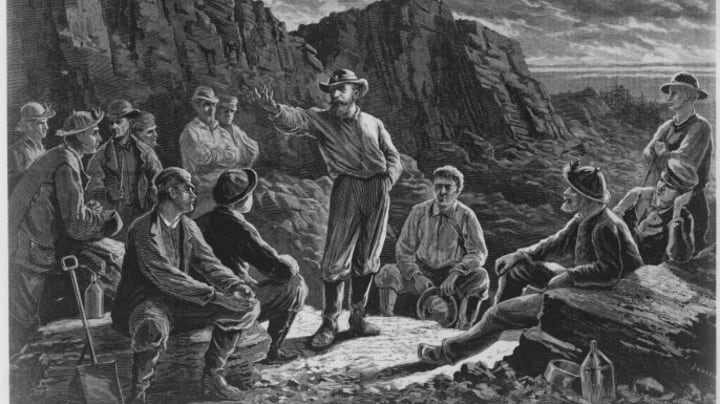
The Pinkertons were hired by the mining corporations to break up the Molly Maguires, but this didn’t happen until 1886, so we’ll get to that. Before the strike busting, the Pinkertons still had some sway when it came to Western law enforcement, and this brings us to some outlaws.
Yeah, sorry, there’s not much information on the Haymarket Riots outside of Wikipedia, and I don’t put too much stock there, but bear with me…. More circling in the near future.
1868 The Reno brothers

The following information was gathered from blog.history.in.gov, so it’s official!
Allegedly….
The Reno gang was credited with the first train robbery in America. The brothers and their friends raided the Indiana and Missouri countryside. Mostly, they robbed banks and treasuries. When trains started carrying money, supplies, and resources from east to west, the gang decided to set their sights on trains.
Trains were not their only goal, though. Remember from two seconds ago, when they robbed banks and treasuries? (The internet….)
There were four brothers; John, Frank, Simeon, (Sim-ee-on?) and William, and when they weren’t burgling (that’s a British word, right? We say robbing, because we aren’t weird) banks, treasuries, or trains, they were busy counterfeiting American money. This, logically, got on local law enforcement’s nerves. Enter, the Pinkertons.
On October 6th, 1866, the Reno gang robbed Ohio and Mississippi railway express. It was a quick job, they say. They boarded the train, got to the bank car, pulled their guns, got the key, emptied the safe, and disembarked. No one was hurt, but no one says how long it took.
The Reno brothers were arrested shortly after, but they posted bail. (Probably with that stolen money!) After a few days, they committed another robber--the Hendrick’s County treasurer’s office. They made away with a ripping $900. That’s close to $20,000 in 2024 cash.
That’s like $5,000 each brother today…. I mean…? Really? If I’m robbing, not that I would or ever have, I’d better get “go to jail money”, like one mill that I could invest in dividend stocks, so when I get out 10 years later, I’m solid, but hey, that’s me….
On November the 12th, they robbed Muncie’s (Mun-sees?) Exchange Bank for around $18,000 between cash and bonds. That’s close to half a million in 2024 money. Gawd Damn.
So, okay, that’s like 125k each? I mean…. Nevermind.
Shortly thereafter, the gang broke up and started hitting different cities and counties, but the banks had had enough and they hired the Pinkertons to hunt down and arrest the Reno brothers. John and Frank had fled to Missouri for a while, but when they returned to Indiana, the Pinekrtons were there, waiting with guns drawn.
John was the first arrested, and he was sentenced to 25 years in prison. The Reno’s didn’t give up, though. Frank and gang robbed 3 safes in Marshfield for a total of $96,000. Let’s put that into perspective. That’s closing in on 2 million in 2024 money. Cheesy crackers! 2 mill split three ways?
Let me map out a few local banks...no! I'm kidding!
A few moths later, they attempted another train robbery, but they all got shot up pretty bad, evidently. This seems to be all hearsay, unless there were papers then that stated as much, but I found none. It’s not quite certain that the Pinkertons were the shooters, anyway, since the townsfolk had gathered a lynch mob, but it seems pretty obvious that the Pinkertons were at least involved in chasing and routing the Reno gang.
On July 20th, 1868, The Jackson County Vigilance Committee, lynched the remaining Reno gang members. The Pinkertons were not mentioned in the local papers as having been involved in the lynching, but no one would be surprised if they had, giving the fact that Jackson County had provided information on where the gang was and where they were going.
1869 stroke
Kind of sad, but, it happens…. Following the escapades of the Reno brothers, demand for more Pinkerton work was continuous, and Allan was getting a little old and too easily recognized. He began heavily delegating undercover operations to others including his sons, Robert and William. Things got even worse, when in April 1869, Allan suffered a stroke. He lost his ability to walk and talk. Doctors claimed he would be confined to a wheelchair for the remainder of his life.
This might be then end for any normal person. This might sideline the CEO of a company today, but we are talking about Allan Pinkerton. Bro was tough.
Undaunted, Allan employed every fiber of his will and determination. After a full year of rehabilitation in New York, he spent countless hours soaking in a mineral bath for six months. This allowed him to move from the wheelchair to crutches. He may not have been able to cover more than a few feet at a time, but for him, it was progress, and proof that if a man sets his mind to a task, it will be accomplished.
Only months later, he managed to walk 12 miles, and from that day on, he took long walks every morning. (I once walked 24 miles when my truck broke down in the country, and it was at night. I don’t ever want to walk that far again). He also returned to his Chicago office. Unfortunately, another setback throttled the Pinkerton Detective Agency.
Bro couldn’t catch a break, but neither can I, or you. I tried to make this one big post, but Vocal can't save a few words and pictures, so stay tuned for Pinkertons part 2. It's coming soon.
In the meantime, visit storiesbydennis.com for all kinds of stuff!
About the Creator
Aaron Dennis
Creator of the Lokians SciFi series, The Adventures of Larson and Garrett, The Dragon of Time series, and more.
Keep reading
More stories from Aaron Dennis and writers in Criminal and other communities.
He Confessed to Murder in My DMs: The Dark Side of Going Viral
When your most-liked story becomes someone else's confession booth The message came in at 2:13 a.m. I saw the notification glow on my nightstand, that soft blue light that usually means spam, or a heart emoji, or someone asking, “Did this really happen?”
By abualyaanart3 days ago in Criminal


Comments
There are no comments for this story
Be the first to respond and start the conversation.