
The Package on the Landing: The Case That Followed Me Home
A missing girl. A symbol from my past. And a package delivered to my child that told me the game had only begun.


It wasn’t just the way he looked at her.
It was the way his entire body shifted — a slow, restless sway, weight rolling from one leg to the other as if he was trying to stay inside his own skin and failing. His eyes cut straight through the crowded room, zeroed in on her with a focus so absolute it felt intrusive… predatory.
For a second, the noise around them thinned out.
People blurred.
Time stalled.
And in that suspended moment, she knew — he wasn’t looking at her. He was hunting her.
The moment snapped, the room rushed back into itself, and she disappeared into the crowd before I could move. I spent the rest of the night pretending everything was normal, knowing deep down that nothing about what I’d seen was.

Two days later, normal found me anyway.
When the Quiet Finally Broke
I woke up to birds chirping, kids yelling in the corridor, and—thankfully—the left side of the bed still empty. Divorce has many downsides, but extra space? That part is bliss.
I dragged myself out of bed, shoved my feet into slippers and opened the door just in time for two children to rocket past me, screaming something about cereal and lost socks. Somewhere in the chaos was a voice shouting,
“Mum, can I go to Sara’s? They’re having a movie night!”
“Yes,” I yelled back, “but not before I speak to Sara’s mum!”
Sara and Kaden sprinted downstairs toward the kitchen, where my housekeeper—more like family, honestly—was waiting with a perfectly made cup of coffee and my iPad already open to the day’s news highlights. She knows I don’t have the patience for full articles; that level of hell can wait until I’m at work.
I took the coffee and the iPad and collapsed onto the sofa, careful to set the mug down before burning my tongue off. I started scrolling, half-awake, when the second headline made my blood slam to a halt.
“Holy shitballs… no way.”
I bolted upright.
“It’s her.”
When Her Face Came Back to Haunt Me
My thumb hovered over the screen as the notification bar slid down and the headline expanded. A grainy still image loaded — dim lighting, a crowded venue, blurred faces in the background.
But hers wasn’t blurred.
The girl from that night.
The same girl the man had been watching with that strange, ravenous stillness.
The same girl who seemed to sense him, even through all the noise.
In the photo, she looked different — drained, frightened, almost… hollow. And the headline beneath her face hit me harder than the coffee ever could:
“WOMAN FOUND MISSING AFTER MYSTERIOUS INCIDENT AT LAST NIGHT’S CHARITY GALA.”

I felt the air leave my lungs.
It wasn’t just recognition.
It was the sickening certainty that I had seen something — someone — right before it happened. Something I couldn’t explain yet, but that had been wrong enough to lodge itself under my skin all night.
I zoomed in.
Her expression wasn’t just fear.
It was a warning.
Like she had known this was coming.
Josaline poked her head into the living room. “You okay? You look like you’ve seen a ghost.”
I swallowed hard.
“Worse,” I said, tilting the screen toward her.
“I think I saw her before she disappeared.”
When the River Called My Name
I stared at the headline until the letters seemed to pulse.
The girl’s face — pale, frightened, caught mid-turn — looked nothing like the vibrant woman I’d seen at the gala the night before. There was something hollow in her eyes now.
Something that hadn’t been there before.
Josaline stepped into the living room, wiping her hands on a dish towel. “Coffee’s still hot if you want a top-up,” she said, then paused when she saw my expression. “Mara? What is it?”
I angled the iPad toward her.
She sucked in a breath. “The girl from the gala?”
“Yes,” I said, my voice flatter than I intended. “She’s missing.”
Josaline lowered herself into the armchair opposite me, concern pulling at her features. “But… nothing happened last night. You came home early. You would’ve—”
“I know what I saw,” I cut in quietly. “She was scared long before anyone else noticed. And someone was watching her.”
A prickle crawled up my arms as the memory surfaced — the man shifting his weight, always in shadow, eyes fixed on her with unnatural focus.
“And now she’s gone,” Josaline murmured.
My gaze drifted to the small wooden box on the side table — my box — its lid closed, harmless to anyone else. It held remnants from old cases, not this one.
Not yet.
The box only comes out after a crime scene.
Not before.
And this morning, it was untouched.

My phone buzzed sharply against the table.
A message.
Short.
Coded.
Serious.
I stood instantly.
“Mara?” Josaline asked. “What happened?”
“They found something by the river,” I said, reaching for my coat. The box stayed where it was—its place wasn’t here. “I need to go.”
Josaline pressed a hand to her chest. “Is it… her?”
I didn’t answer. I didn’t have to.
Instead, I called toward the hallway, “Mia! Kaden! Stay with Josaline until I’m back!”
Two chaotic voices shouted something resembling acknowledgement.
Josaline nodded firmly. “Just go. I’ll handle everything.”
I paused at the door.
“And Josaline…”
She looked up.
“Don’t let them watch the news.”
Her face tightened with understanding. “Of course.”
I stepped outside to the usual London chill — but it hit me like a slap, sharp and biting, the kind of cold that warns rather than bites.
I took two steps down the path, then froze.
Pyjamas.
Grey cotton.
No dignity, no readiness. Just panic stitched into fabric.
“Bloody hell.”
I spun around and rushed back inside.
Josaline blinked as I barrelled through the hallway. “Forgot something?”
“My clothes,” I called, already halfway up the stairs.
I tore through my wardrobe and yanked on a pair of jeans and a thick jumper — I was always cold, a leftover from a childhood I didn’t like to examine too closely. Trainers next. Hair up. Breathe steady.
Back down the stairs.
Coat on.
Door open.
A black cab rolled down the quiet Kensington street, its amber light glowing like a tiny beacon in the fog.

“Taxi!” I shouted, half-running, half-leaping off the curb.
The cab slowed. I yanked the door open and slid inside, breath fogging the window.
“Where to, love?” the driver asked.
“The river,” I said.
And the weight of those words sank into the car like a stone.
The Moment the River Gave Us Our First Clue
The cab pulled away, leaving me in a thin veil of London fog curling over the river.
Even from here, I could see the blue-and-white tape snapping in the wind—cordoning off a stretch of the embankment. Uniforms paced the perimeter, their breath clouding in the cold air, their faces tight with the kind of seriousness reserved for true trouble.
I stepped forward, instincts sharpening the way they always did: a subtle tightening in my chest, a narrowing of the world into sound, movement, silence.
Then I saw him.
James.
Hands shoved deep into the pockets of a painfully sharp suit, hair immaculate, shoes still shining even on wet pavement. He always dressed like he expected paparazzi—delusional, considering he barely makes the internal newsletter.

Next to him stood Misha, our pathologist.
Ex-model, millionaire, terrifyingly brilliant. She crouched beside something near the water, pointing with a latex-gloved finger while James pretended to understand.
I started toward them after tossing cash to the cabbie, who leaned out uselessly. “Officer—what’s all this then?”
“Routine,” I lied, closing the door.
My first step onto the walkway caught James’s attention. He straightened immediately and waved far too enthusiastically.
Misha gave a polite nod.
I ducked under the tape.
“Morning, Mara!” James beamed.
“Keep dreaming, James,” I said without slowing down.
Misha rose, removing a glove with an elegant snap. “You’re early,” she said. “Good.”
“Show me.”
She stepped aside, revealing a single red satin ribbon, darkened with river water, tangled around a piece of driftwood.
The colour hit me first.
The same red the missing woman wore in her hair at the gala.

Misha spoke softly. “No blood. No tissue. But the tear is too clean to be accidental.”
“Could be nothing,” James offered, trying to sound authoritative. “People drop things.”
“No,” I said.
He blinked. “No? Based on what exactly?”
I turned toward the river, replaying the flicker of last night in my mind.
“I was at the gala,” I said. “I was invited—charity I support.”
James nodded, remembering belatedly that I came from the kind of money that bought tables at events like that. Money I’d chosen not to live off.
“I saw her,” I continued. “And I saw someone watching her.”
James frowned. “Him?”
“Yes.”
“How can you be sure it was a man?”
I didn’t look at him. “His stance. His weight distribution. His height. And the way he held himself.”
James snorted. “That’s hardly forensic.”
“It doesn’t need to be,” I said. “Predators have patterns. Men have patterns. And he stayed exactly where the shadows hid him—but positioned perfectly to watch her without being seen.”
Misha folded her arms. “You didn’t see his face?”
“He didn’t have a face to see,” I replied. “He never stepped into the light. Not once.”
James shifted uneasily. “Alright, but that doesn’t mean—”
“It means,” I cut in, “that she knew he was there before anyone else did.”
Silence settled around us, cold and heavy.
Something caught my eye—a faint metallic glint beneath the driftwood, half-buried in wet sand.

“Pass me gloves,” I said.
Misha handed me a pair. I crouched, brushing away the mud until the object revealed itself fully.
A key.
Old.
Heavy.
Hand-tooled edges.
Not dropped.
Placed.
I lifted it, turning it toward the light—and froze.
Etched into the bow was a symbol.
One so familiar my stomach dropped.
A symbol I hadn’t seen since childhood.
A symbol my family kept hidden.
A symbol that should never have resurfaced.
Misha noticed the shift in my breathing. “You recognise it.”
I closed my fingers around the key.
“This isn’t just a missing person,” I said quietly.
James swallowed. “Then what is it?”
I looked out over the water.
“A message.”
When I Realised We Weren’t Alone

Something tugged at the back of my mind again — a wrongness, subtle but insistent.
The kind that doesn’t shout.
It waits.
I let my eyes drift along the riverbank, scanning for irregularities: broken reeds, disturbed mud, anything that felt out of place.
That’s when I saw it.
Not far from the ribbon — just at the edge of the wet sand, resting neatly against a stone — was a rectangle of white.
Too clean.
Too intact.
Too deliberate.
I moved toward it slowly.
Misha followed quietly.
James, predictably, cursed when his shoe sank into mud.
“Christ, who designed this walkway—”
I held up a hand sharply. Silent.
The object lay half-tucked beneath a smooth river stone — not washed up by the current, not dragged, not damaged.
Placed.
I crouched.
It was a photograph.
Glossy.
Dry.
Untorn.
No way it had floated here.
No way it had survived the river.
No way it wasn’t intentional.
Someone wanted us to find it.
Using a glove, I lifted it carefully.
My breath caught.
The missing woman — from the gala — stood in a park. Daylight. Several days before the event. She wasn’t alone. Not quite.
Behind her, framed in the blurred background, was a figure half-concealed behind a tree.
Tall.
Still.
Watching her.
The same posture.
The same unsettling stillness.
The same predator’s patience.
A chill crawled down my spine.

Misha exhaled slowly. “This… this is recent.”
“More than that,” I said. “It’s staged.”
James frowned. “Staged how?”
“It hasn’t been in the river. It hasn’t been exposed to moisture. It’s pristine.”
I held it up. The glossy surface caught the weak sunlight.
“Someone placed it here after the ribbon washed up.”
James looked around nervously. “Wait — so whoever took her was just… here? Watching us?”
“They still might be,” I said.
And I meant it.
Because that glint across the water?
The binoculars?
They weren’t watching the scene.
They were watching me.
When the Case Started Talking Back

I left Misha and James by the river once the scene was secure, the ribbon and key logged, the photograph bagged. The tape snapped in the wind behind me as I stepped back onto the path.
Just before I reached the road, a small, pale stone near the muddy edge caught my eye.
Unremarkable.
Round.
Smooth on one side, jagged on the other.
I picked it up without thinking, feeling its weight against my palm.
It wasn’t evidence.
It wasn’t even interesting.
But it was mine now.
Empty the box, I reminded myself. New case. New trail. No ghosts from old ones.
I slipped the stone into my coat pocket and walked toward the main road to hail a cab. I needed to go back to the gala venue. Standing where she had stood, walking the route she took, talking to staff and security — it might loosen something in my memory.
A black cab slowed at my raised hand.
“Mayfair,” I said, giving the hotel’s name. “Side entrance.”
“Right you are,” the driver replied.
By the time I’d finished at the gala hotel, the staff had given me everything and nothing at once.
Yes, they remembered her.
Yes, she’d seemed nervous.
No, they hadn’t noticed anyone “suspicious” — which usually meant anyone who looked poor.
Cameras covered the main hall, but there were blind spots in the balconies and service corridors.
“Convenient,” I’d said. No one laughed.
I left with a mental map of exits, blind spots and timings, but no new solid leads. Just more confirmation that whoever took her knew exactly what they were doing.
The Watcher Never Left
Outside, the sky hung low and grey. I started walking down the street, the city humming distantly around me, when my phone rang.
Josaline.
“Tell me they’re alive,” I answered.
She laughed softly. “Mia and Kaden are alive, fed, and arguing over whose turn it is on the PlayStation. Kaden went to Ben’s for an hour, Mia was at Lily’s, and both back. I wrote down the times if you want them.”
“I do,” I said automatically.
She knew me well enough not to question it. In my line of work, not knowing was the real horror. I needed timestamps like other people needed hugs.
As we spoke, a familiar prickle crawled up my spine.
The feeling again.
The being-watched feeling.
I scanned the reflections in nearby windows, the faces, the cars.

Nothing obvious.
No glint of binoculars this time.
Mara, you’re tired, I told myself. You felt it at the river. You’ll feel it again in the office. Keep feeding it and you’ll never sleep again.
I pushed the sensation down.
“I’ll be late,” I told Josaline. “Make sure they’re in bed by nine. And… don’t let them watch the news.”
“I never do,” she said. “Come home in one piece.”
“No promises,” I muttered, and ended the call.
Nothing About This Was Accidental
A café on the corner caught my eye — warm light, quiet enough, anonymous enough. I ducked inside and chose a table near the back, where I could see the door.
“Cappuccino,” I told the barista. “Extra hot.”
I sat, pulled the stone from my pocket and rolled it between my fingers on the table.
Such a small, useless thing.
But the case sat inside my mind in fragments, and I knew — the way I always knew — that somewhere in these fragments was a pattern waiting to show itself. Key. Ribbon. Photograph. Stone. Symbol.
What are you trying to tell me? I thought.
The bell above the door chimed.
“Found you,” James announced, far too loudly.
Of course.
He didn’t wait to be invited. He never did. He slid into the chair opposite me like we were on a date he’d imagined and I’d forgotten.
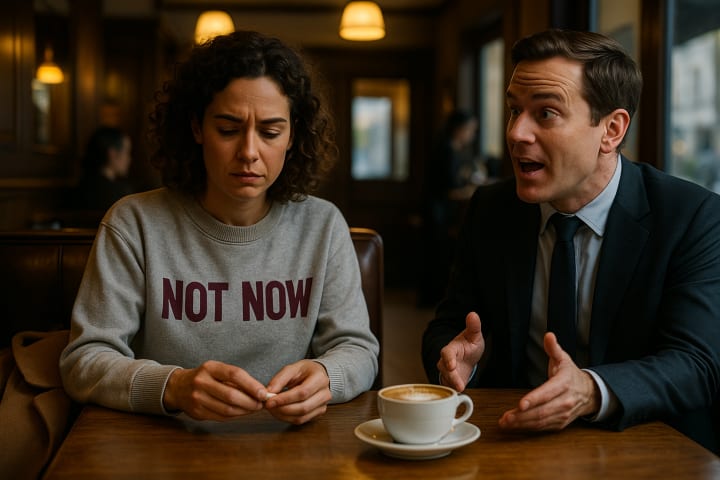
“So,” he said, leaning forward, “the river. The key. The photo. What’s your gut? Serial predator? Stalker? Psychopath with a flair for drama?”
I stared at him. “James, you just described half of London.”
He grinned, unfazed. “Yeah, but which half?”
As he rambled on about profile theories he’d clearly stolen from late-night crime dramas, my phone buzzed on the table.
A message.
No name.
Unknown number.
I barely heard James anymore. I opened it.
The Case Crossed the Line
One image.
No text.
It was a photograph of me.
Taken from outside the café window, no more than a minute ago.
My head was bent, my face half in shadow, but unmistakable.
My hand was in focus.
The stone I’d been playing with sat in my palm.
And someone, somewhere, had drawn a tiny version of the symbol next to my hand — digitally, like a signature.
My breath caught.
I felt the blood drain from my face.
James stopped mid-sentence. “What is it, Mara? For God’s sake, out with it, woman — you’ve scared me half out of my wits.”
I didn’t answer.
For a few seconds, I just stared at the screen, listening to the muffled clatter of cups, the hiss of the coffee machine, the dull thud of my own heartbeat in my ears.

Then I turned the phone around and slid it across the table.
James looked.
His chair scraped back. “Oh, hell no.”
Several heads turned.
“Quiet,” I snapped.
“This was taken just now,” he whispered, too loudly for my liking. “They’re outside. Or they were. We need to—”
He shot to his feet, doing what James does best: panicking in a straight line.
“Stay here,” he said. “I’ll—”
“You’ll what?” I interrupted. “Shout at pedestrians?”
He hesitated.
“Pay the bill,” I said. “Then we go to the station.”
He nodded, still rattled, and fumbled his card toward the barista, insisting on paying for my half-drunk coffee and his order that hadn’t even arrived yet.
“My car’s just round the corner,” he said over his shoulder. “We’ll take mine.”
“I’ll see you there,” I replied, already heading for the door.
I didn’t wait.
The moment I stepped outside, I raised a hand for a cab. One pulled up immediately, as if it had been waiting.
“New Scotland Yard,” I said. “Fast as you can.”
The Threat Was Already Inside

At the station, I took the stairs two at a time, James close behind me, muttering about parking and near-death experiences.
“Roberto!” I called the second we hit Major Crimes.
He swivelled in his chair, dark hair mussed, glasses slipping down his nose, surrounded by three monitors and the unshakable air of a man who trusted code more than people.
“Si?” he said. “You sound like the building’s on fire.”
“Worse.” I tossed him my phone. “Do that thing you do where you pin a message’s location.”
He caught it one-handed, already waking up his system. James arrived seconds later, slightly out of breath.
Roberto’s fingers flew over the keyboard.
“This will take a few minutes,” he said. “Triangulation, route tracing, encryption—”
He stopped.
Brows knotted.
“That’s… odd.”
My chair scraped as I pulled it up beside him, shrugging off my coat and letting it fall over my desk. “Define ‘odd’.”
“My program is fast,” he said slowly. “But not this fast.”
“Why?” James asked.
Roberto adjusted his glasses, staring at the screen like it had insulted him.
“Because,” he said, “according to this, the message was sent from inside the building.”
The air seemed to drop a few degrees.
“Inside the station?” I said. “That’s not possible.”
The Hunter Made the First Error
“I know,” Roberto replied, frowning harder. “But the relay, the routing, the signal strength — everything points here. Right here.” He tapped the desk. “Which is why it didn’t take long to triangulate. There was almost nothing to trace.”
James looked around the room as if our mystery texter might be hiding under a desk. “You’re telling me someone in this building took a photo of Mara in a café and sent it to her from in here?”
Roberto spread his hands helplessly. “I am telling you what the system tells me.”
I leaned back, letting the information settle.
Someone had watched me at the river.
Someone had watched me at the café.
Someone knew about the symbol.
And now someone was using our own systems like a toy.

This wasn’t just a case anymore.
It was an invitation.
A game.
One I hadn’t agreed to play — but one I was clearly already losing.
“Well,” I said quietly, more to myself than to them, “at least they’ve made one mistake.”
James blinked. “Which is?”
“They think I scare easily.”
I stood, every nerve in my body sliding into alignment.
“If they want to play,” I said, “fine. We connect the dots. All of them.”
Connecting dots was the one thing I did better than anyone else.
And whoever was behind this?
They’d just given me my first line.
Routine Is the Easiest Place to Hide a Threat
The rest of the day passed in a blur of screens, files, and walls that felt too close.
I spent hours digging through old case archives — missing women from the past two, three, five years — hoping for a thread, a pattern, the faintest echo of the symbol or the watcher.
Nothing.
Every name led to another dead end.

At some point, between interviews and phone calls and Roberto’s running commentary, I called Josaline. I always did.
“Everything alright?” I asked.
“Yes, dear,” she replied warmly. “They’ve been fed. Kaden’s drawing. Mia’s watching television. Nothing unusual.”
I nodded at the desk, though she couldn’t see me.
Most mothers worry about dinner or homework. I worried about kidnappings, murders, revenge plots, human predators with better eyesight than morals.
A long time ago, I decided I wasn’t going to put them in a traditional school system. Too much risk. Too much unpredictability. Too many ways the world could sink its claws in.
Josaline — miracle worker, housekeeper, teacher, emotional firewall — took on homeschooling like she’d been born for it. My children were safe with her. Safe in ways I couldn’t promise anywhere else.
“Oh — a package arrived earlier,” Josaline added casually. “It’s for Mia. I put it on the landing upstairs.”
A package.
In Mia’s name.
Not unusual, honestly. Her friends adored her for reasons she pretended not to understand.
“We’ll open it together,” I said. “You know the rule.”
“Of course.”
I told her I’d be home late and hung up.
Silence Is Just the Space Before Impact
By the time the office emptied out, it was nearly ten. Only Captain Griggs and I remained — two stubborn women who didn’t know when to quit.
She was still in her office, door cracked open, reading something with her glasses perched on the end of her nose. Her late husband’s photograph sat on the desk beside a stack of reports. Brigadier Griggs. A man who had been loved fiercely and lost suddenly.
Captain Griggs was a minefield — opinionated, intense, impossible to argue with without career consequences — but fair. Tough as steel, sometimes brittle as glass, but fair.
She looked up as I walked past her door. “Call it a night, Detective.”
I checked the time. “Seems like a good idea.”
Outside, the autumn air settled on my skin like a cold whisper.
My favourite season — the city turning gold, the scent of rain, the nights stretching longer. There was comfort in that darkness.
I decided to walk.
Sometimes walking helped me think.
Sometimes it helped me forget.
Tonight it did neither.

I replayed every detail: the ribbon, the key, the symbol, the watcher across the water. My mind began drawing its invisible map — threads crossing threads, connections forming in shadows.
I lost track of time.
Maybe an hour passed.
Maybe more.
Then the sirens cut through the night.
The Sirens Were Only the Beginning
Distant at first.
Then closer.
Then fast.

Six police cars. One ambulance. All heading east, lights slicing through the dark.
Every instinct in me surged awake.
I scanned the street for a cab, growing more impatient with every passing second. Just as I was about to give up, a black cab pulled into view.
I stepped into the road and flagged it down.
“Follow the convoy that just passed,” I told the driver.
He raised an eyebrow.
But he drove.
I leaned back, cold settling into my bones — the kind of cold that wasn’t from the weather.
Something was waiting for me.
Something I already knew was going to be bad.
Very, very bad.
The Tent Told Me Everything
The cab rolled to a stop at the embankment, tyres crunching against gravel.
I stepped out before the driver could reach for the handbrake.
And froze.

I was back at the exact spot from that morning.
Same bend in the river.
Same stretch of walkway.
But now—
A white tent stood where the red ribbon had been.
My stomach tightened in a way I’d come to trust more than logic or evidence.
I already knew what waited inside.
I ran.
The uniforms parted as I approached, some recognizing me, others simply responding to the urgency in my stride. Misha and James stood near the tent’s entrance. Their expressions told me everything.
“This was… expected,” Misha said softly.
James nodded once. His usual bravado was gone.
They let me through.
Inside, the world went silent.
She lay there.
The missing girl from the gala.
Still in the same dress she had worn the night we crossed paths. Its sequins dulled now, fabric torn at the hem. Her tights were ripped, makeup smudged into ghostly streaks across her cheeks. Dried blood had seeped from her ears.
But those weren’t the worst details.
This Wasn’t Murder — It Was Instruction
Her posture was wrong.
Too arranged.
Too deliberate.
She lay flat on her back, arms extended straight above her head as though in surrender, legs crossed delicately at the ankle — almost like a ballerina preparing to rise.
Except she would never rise again.

Then I saw it.
On the bottom of her right foot — faint, but unmistakable — was the symbol.
My breath lodged in my throat.
James stepped beside me, rattled. “Why kill her? If he took her… it hasn’t even been forty-eight hours. Why so soon?”
“We’ll find out,” I said. My voice sounded distant to my own ears.
“She’ll tell us.”
Behind me, Misha’s voice was gentle. “Mara…”
She didn’t finish the sentence.
She knew I didn’t need comfort, but she offered presence — the one thing she always got right.
She started breaking down her early observations, her tone clinical but respectful. Ligature marks. No obvious signs of sexual assault. No water in the lungs. No fractures. Bruising pattern inconsistent with a struggle.
A body positioned, not discarded.
I half-listened, half-scanned the horizon through the small slit in the tent’s flap.
The watcher had been close before.
Close enough to see me.
Close enough to send a message hours later.
Close enough to feel like a shadow behind my ribs.
Arrogance Always Leaves Evidence
When Misha finished, James blew out a shaky breath. “Well… that’s that. Looks like we’ve got our work cut out for us.”
I left without responding.
“Mara! Wait! Where are you going now?” James shouted behind me.
He didn’t wait for an answer — he never did — and hurried after me as I crossed the walkway, heading for the opposite side of the river.
The place where I had seen Him that morning.
“Stop moving,” I said sharply when he caught up, fidgeting like a nervous schoolboy. “And stop breathing so loudly. It’s distracting.”
He raised both hands in mock surrender. “Alright! But I still don’t see what you expect to find over here. This guy is good. Too good. He’s covered his tracks. He’s—”

“Arrogant,” I murmured. “Arrogance is our ally.”
And as if summoned by my words, something red glinted between the blades of grass.
Small.
Shining.
Out of place.
I crouched, parted the grass, and picked it up.
A bead.
Deep red.
Glass, not plastic.
From a bracelet.
James peered over my shoulder. “Mara… that could be from anyone. From any time.”
“Maybe,” I said. “Maybe not.”
I knew better.
Nothing in this case was random.
It was too dark to see much more without help, so I flicked on my flashlight. The beam carved through the night — cold, harsh, unforgiving.
It was almost midnight.
By the time James and I walked back to where we’d left Misha, the tent was already cleared.
The body was gone — taken to the morgue to begin the autopsy.
“I’ll drive you home,” James offered as we stepped back toward the road.
I didn’t argue. Exhaustion had seeped into my bones, slow and heavy.
“Fine,” I said.
He almost looked proud.
The Night Saved Its Worst for Home
James dropped me off at the house just after midnight. The street was silent except for the soft hum of streetlamps and the faint rustle of leaves caught in the autumn wind.

Inside, the house was warm and still.
Exactly how I needed it to be.
I shrugged off my coat and tossed it over the back of a kitchen chair. The sitting room was empty — quiet, dim, undisturbed.
Josaline and the children were already upstairs in bed.
I filled the kettle, dropped a teabag into my “long day” mug, and waited for the water to boil. The steam curled upwards, fogging the cabinet glass. Most people would call it mundane.
But strange things relax me.
When my tea was ready, I took it into the sitting area — the open-plan room that blended kitchen, living room, conservatory, and workspace. I’d designed it this way on purpose. Closed-off rooms made me feel trapped.
I sank into the sofa, letting exhaustion settle across my shoulders.
On the table beside me sat my small wooden box.
My constant companion.
My map.
I opened it, emptied out the remnants of the last case — each insignificant object falling like punctuation to a story finally closed.
“Goodbye,” I muttered to them.
Then I placed tonight’s items inside:
The smooth stone.
The red bead.
The beginnings of a trail.
Clues to a man who thought he was smarter than me.
I sipped my tea and felt sleep pulling at me, soft and insistent.
Eventually, I dragged myself upstairs. On the landing, the package sat neatly on the small table where parcels always waited.
Mia’s package.
The one Josaline mentioned earlier.
I was too tired to deal with it now.
“Tomorrow,” I told myself, heading to bed.
The Box Was Never For the Children
Morning arrived with chaos.
Kids shouting and laughing somewhere downstairs.
I rolled over and texted Josaline: Keep the noise down for ten minutes. Please.
Within moments, blessed silence.
Five minutes later, I heard the stomp of tiny feet racing up the stairs — then Mia materialised in front of me, bright-eyed and excited.
“Mum! Can I open my present now?”
I sat up. “Oh yes — the package. Let’s go downstairs. Aren’t you a lucky girl?”
She shrugged. “Not really. I told my friends that Kaden’s your favourite and he always gets more presents than me. It’s the only way I get Christmas morning all year round.”
I stared at her, part horrified, part impressed.
We’d handle that later.
Downstairs, Josaline was just setting my coffee beside my iPad.
I picked up the package and carried it to the sofa, where Mia and Kaden climbed up beside me, excited and bouncing.

I knelt to open it.
My phone rang.
Griggs.
Of course.
“Don’t touch the package until I get back,” I told the kids, handing the box to Josaline. “Promise me.”
They nodded with exaggerated solemnity.
I stepped into the study — the conservatory-turned-office. Glass walls on all sides so I could see them when I worked, but not from this angle as my back turned toward them.
“Captain?” I answered.
“Mara,” she barked, skipping any greeting. “We found something unusual on the girl’s body. I need you at the morgue.”
“What kind of—”
A scream tore through the house.
High.
Sharp.
Terrified.
Then another.
My blood iced.
“Good Lord, Mara! What was that?” Griggs demanded through the phone.
“Sorry, Cap — I’ll call you back.”
I dropped the phone and ran.
The children had opened the package.
They stood glued to Josaline, shaking, their arms wrapped around her waist.
Even Josaline’s face had gone pale.
The package sat on the coffee table, exactly where they’d opened it.
Closed again.
Untouched.
Like it was waiting.
Josaline looked at me, horror widening her eyes.
“Mara… what was in that package?”
I stepped closer — heart pounding, terrified and already knowing.
The Hunter Just Drew the First Line
I reached the table, closed my hand around the package, and felt my pulse stutter.
The weight was wrong. The temperature was wrong. Everything about it was wrong. And as I lifted the lid — just high enough to see the edge of what waited inside — my breath left my body in a single, sharp exhale.

Not because I didn’t recognise it.
But because I did.
And the moment my eyes met that familiar shape, I knew this wasn’t a message meant for Mia at all.
It was meant for me.
And he’d just told me the game had only begun.
About the Creator
DARK TALE CO.
I’ve been writing strange, twisty stories since I could hold a pen—it’s how I make sense of the world. DarkTale Co. is where I finally share them with you. A few travel pieces remain from my past. If you love mystery in shadows, welcome.
Keep reading
More stories from DARK TALE CO. and writers in Criminal and other communities.
The Facebook Marketplace of Horrors: Inside the groups where bones are traded like baseball cards.
It Wasn't the Dark Web When we hear about the illegal sale of human body parts, we imagine the "Dark Web"—encrypted Tor browsers, Bitcoin wallets, and shadowy Russian servers. The terrifying reality of the Jonathan Gerlach case is that he wasn't hiding in the digital shadows. He was hiding in plain sight.
By Sunshine Firecracker2 days ago in Criminal
What DHS Secretary Kristi Noem said vs. what the videos show
NBC News and PBS recapped the competinBelow is a structured, evidence-backed analysis of the Minneapolis ICE shooting and the claims made by DHS Secretary Kristi Noem—including the applicable federal laws/policies and how intent vs. recklessness factor into a potential case. I’ll keep this clear, precise, and grounded in the video evidence and governing law.
By Organic Products 5 days ago in Criminal



Comments
There are no comments for this story
Be the first to respond and start the conversation.