

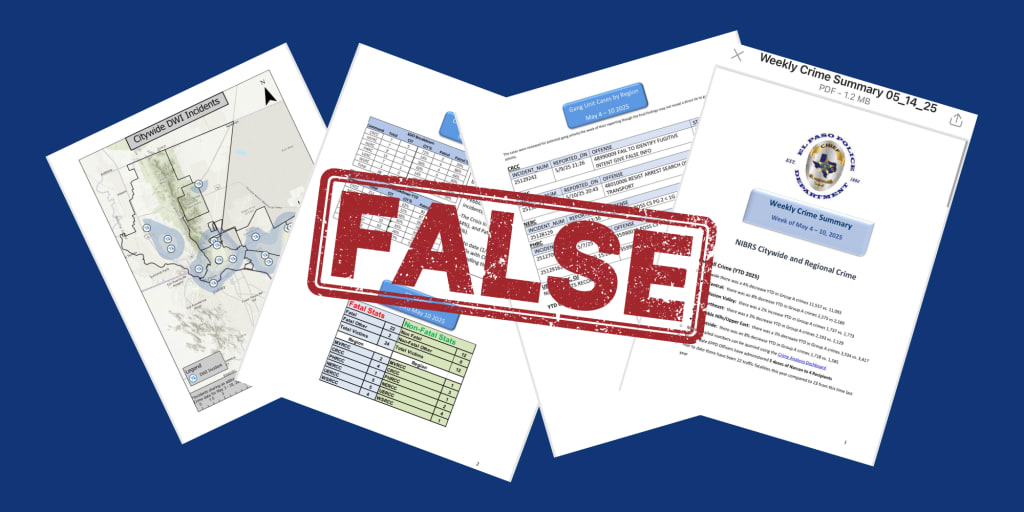
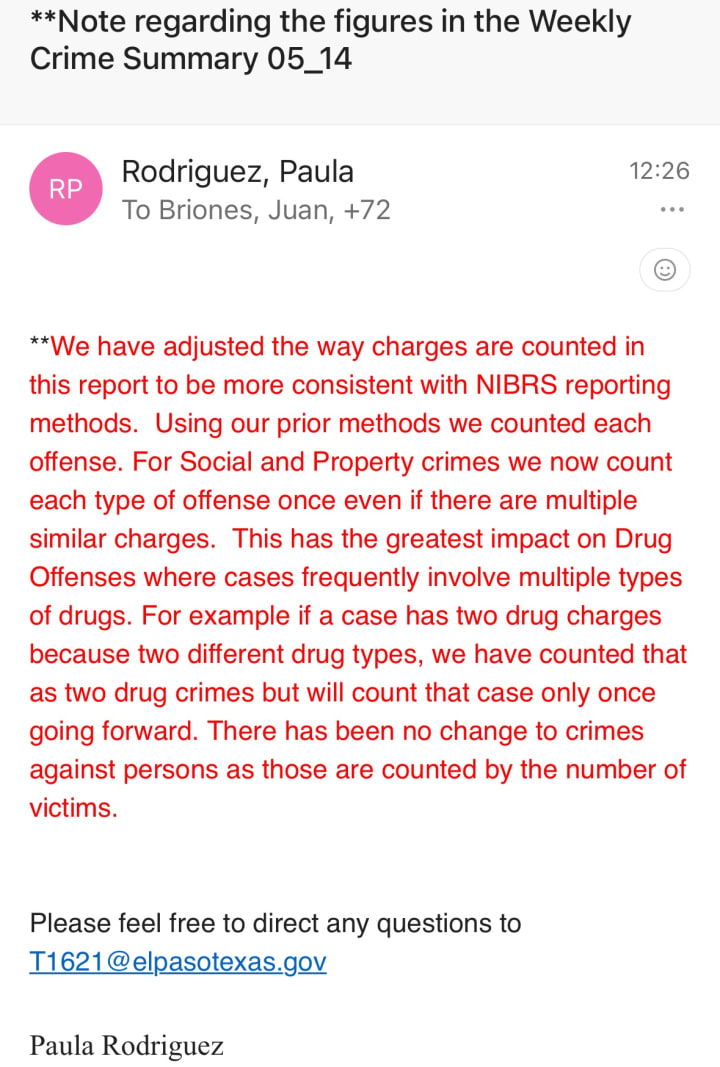
The El Paso Police Department is making mind-boggling decisions. The newest decision is applied to the weekly crime summary for 4–10 May 2025. The following email was sent today to a select number of Officers within the El Paso Police Department:
The City of El Paso and the El Paso Police Department strive to present as fact the fiction that El Paso, Texas, is one of the safest cities in the United States. Even Lt. Jones, from Northeast El Paso, perpetuates the fiction that El Paso has one of the top three largest police departments in the United States per capita.
What Paula Rodriguez said in the above email will only artificially reduce crime statistics, giving people a false sense of safety.
The NIBRS (National Incident-Based Reporting System) reporting system focuses on collecting detailed information about each individual crime incident, unlike the UCR’s (Uniform Crime Reporting) traditional summary reporting system. NIBRS collects data on each incident, including information on multiple offenses within the same incident, victims, offenders, relationships between them, property, and arrest information.
Here’s a more detailed breakdown of the NIBRS reporting methods:
1. Incident-Based Reporting:
NIBRS collects data on each individual crime incident, providing a more detailed and nuanced understanding of crime than the UCR’s summary reporting system.
2. Data Collection:
Group A Offenses:
NIBRS collects data on each incident and arrest within 22 offense categories comprising 46 specific crimes (Group A offenses).
Group B Offenses:
In addition to Group A offenses, NIBRS collects arrest data on 10 additional crimes (Group B offenses), including information about the arrestee’s age, sex, race, ethnicity, weapon used, and disposition for those under 18.
Hate Crimes:
NIBRS also collects data on hate crimes, including the offenses, victim characteristics, and offenders’ bias.
3. Information Collected:
Information on the nature and type of offenses, including whether they were attempted or completed.
Victim and Offender Characteristics:
Demographic information, relationships, and circumstances surrounding victims and offenders.
Property Information:
Types and value of property stolen and recovered.
Arrestee Information:
Characteristics of persons arrested concerning the crime, including age, sex, race, and ethnicity.
4. Reporting Structure:
Monthly Reporting:
Law enforcement agencies (LEAs) report monthly to NIBRS, providing data on officers killed or assaulted.
Annual Reporting:
LEAs also report yearly data on the number of full-time sworn and civilian law enforcement personnel.
5. Benefits of NIBRS:
More Detailed Data:
NIBRS provides a deeper understanding of crime by capturing more detailed information on each incident, including the context and circumstances.
Increased Flexibility:
NIBRS data allows for more flexible analysis, allowing researchers and law enforcement to explore different facets of crime and identify relationships.
Improved Data Quality:
NIBRS is designed to improve the overall quality of crime data, ensuring more accurate and reliable information for research and analysis.
Informed Decision-Making:
NIBRS data can inform policy decisions, resource allocation, and crime prevention strategies.
While Ms. Rodriguez says, “This has the greatest impact on Drug Offenses where cases frequently involve multiple types of drugs. For example if a case has two drug charges because two different drug types, we have counted that as two drug crimes but will count that case only once going forward,” the NIBRS says that each crime should be counted separately and not as one offense.
“The way crimes are being counted, it’s going to reflect badly on the Department,” says a Lieutenant with the El Paso Police Department. “Lower numbers mean less money and fewer bodies on the street to go after crime.”
Another Officer, one in the Command Staff, feels the same way.
“I feel this was not a well thought out plan, something that is being utilized to lower, or cover up the actual crime numbers, crime stats,” a member of Command Staff. “How does this benefit the community or us?”
This new way of reporting data shows that the El Paso Police Department can do more with less. Unfortunately, the amount of overtime Officers are taking contradicts that idea.
“I think they are trying to be a David Copperfield in the eyes of the community,” says another Officer with the Department. “They can fudge the numbers, making it look like the Chief is doing wonderfully. Why are so many good Officers leaving if that were the case?”
One resident we spoke to said they would rather know the truth, even if it is ugly.
“If there are 10 people selling drugs, and they are arrested for and charged with all kinds of drugs, that needs to be counted for each one, for each drug,” says Eric Rivas. “It’s things like this that made me decided to no be a cop. There needs to be a better command structure for PD in El Paso, not what we have today.”
About the Creator
Steven Zimmerman
Reporter and photojounalist. I cover the Catholic Church, police departments, and human interest.
Keep reading
More stories from Steven Zimmerman and writers in Criminal and other communities.
A Mother's Love Lost
It was December 30th, 1988, just two days before the New Year. Jack Dale Walker had convinced a coworker to drive him out to the trailer where his girlfriend lived. Hansel Norton, the co-worker, had known Jack for barely three full weeks. Hansel was trying to be a good friend to this new friend. So, Jack, was young, only 22 years old and appeared to be love sick for the girl who was the mother of his baby.
By Cassie Moore4 days ago in Criminal
Inside the House of Skulls: The Full Timeline of the Jonathan Gerlach Investigation
INVESTIGATION TARGET: JONATHAN C. GERLACH INCIDENT LOCATION: 100 WASHINGTON AVENUE, EPHRATA PA CHARGES: ABUSE OF CORPSE (x100), THEFT, DESECRATION STATUS: INCARCERATED ($1M BAIL) KEYWORDS: #HouseOfSkulls #JonathanGerlach #EphrataCrime #MountMoriah
By Sunshine Firecrackera day ago in Criminal




Comments
There are no comments for this story
Be the first to respond and start the conversation.