
The Night Pakistan Roared: How India’s Miscalculation Led to a Humiliating Ceasefire
"How Pakistan’s Strategic Retaliation Shattered Indian Confidence and Forced an Internationally Mediated Ceasefire"


It wasn’t just another border clash. What happened on the night of May 9 and continued into May 10, 2025, was an explosive turning point that rattled South Asia and shocked the international community. India, hoping to pull off a surprise strike, woke a sleeping giant and by the time the dust settled, they were begging for peace.
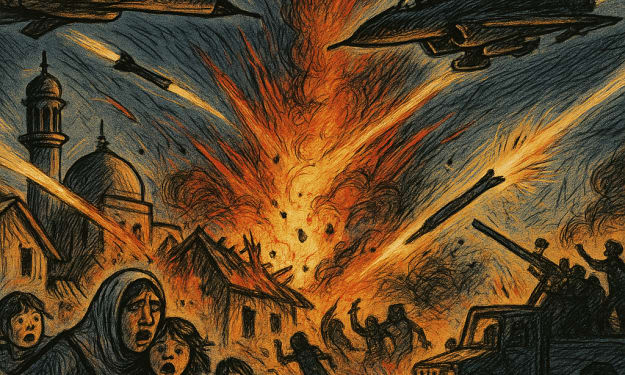
At around 11:30 PM on May 9, India launched what it called “Operation Sindoor,” a sudden air and drone attack targeting alleged militant hideouts in Pakistani-administered Kashmir. The strikes hit areas around Bahawalpur and Muridke. Indian media tried to paint it as a clean, surgical strike, but on the ground, it was chaos and destruction. This wasn’t an operation; it was an act of war.
But Pakistan was watching. And Pakistan was ready.
Within minutes, Pakistani air defenses activated. The night sky over Azad Kashmir lit up with anti-aircraft fire. The initial damage was minimized. But Pakistan didn’t just stop at defense. Around Fajr time, as the call to prayer echoed through military bases in Rawalpindi and Sargodha, Pakistani soldiers raised a single chant **“ALLAHU AKBAR!”**
Then came the thunder.
At dawn on May 10, Pakistan unleashed “Operation Bunyan al-Marsus,” a powerful retaliatory strike that caught India completely off guard. Over 100 drones and ballistic missiles flew across the border, targeting radar installations, air bases, fuel depots, and supply lines in Indian Punjab and Jammu. From Amritsar to Firozpur, to the outskirts of Delhi, explosions rocked military and civilian areas alike.
One missile landed near a fuel station in Pathankot, causing a massive fireball that could be seen for miles. Indian radar centers were taken out. Ground troops were left blind. For the first time in years, India’s defense systems failed to intercept a majority of the attacks.
The Indian response? Panic.
Indian soldiers scrambled for cover. Civilians flooded social media with shaky videos of burning buildings and ambulances. News channels in India either went silent or played patriotic music to distract from the unfolding disaster. Social media was full of blackout reports from Amritsar, Jammu, and even Delhi’s suburbs. The Indian public, completely unaware of their military’s actions the night before, demanded answers. But their government was already busy calling Washington.
Around 7:30 AM on May 10, Indian officials contacted U.S. diplomats. This wasn’t a diplomatic outreach it was a desperate plea. They asked for immediate intervention, urging the United States to help de-escalate the situation before things spiraled into a full-scale war.
Meanwhile, Pakistan continued its precision strikes throughout the day. Pakistani military spokespersons confirmed that fuel dumps, command centers, and radar installations had been successfully targeted. A few hits even reached closer to Indian airfields previously thought to be out of reach. Pakistan had drawn a line and India had crossed it. The reply was loud and clear.
By mid-afternoon, around 3 PM, the Indian government was under enormous internal pressure. Cities were paralyzed. Airports in Punjab and Himachal were shut down. Indian Air Force jets were grounded. Supermarkets and pharmacies ran out of supplies. The fear had taken over.
And Pakistan? Calm. Focused. Deadly.
The international community jumped into action. American, Chinese, and Turkish officials reached out to Islamabad, asking for restraint. But Pakistan made one thing clear: “We did not start this. But we will end it if provoked again.”
It wasn’t until 5:00 PM that India, through backdoor channels and U.S. mediation, agreed to a ceasefire. The ceasefire was not a symbol of peace it was an admission of failure. India had started the fire, but when it burned too hot, they had to call in the firefighters.
The real humiliation came when Indian media confirmed the ceasefire but couldn’t explain the cost. Over 70 confirmed deaths, hundreds wounded, and billions lost in defense infrastructure. Indian political opposition blamed their own government for miscalculation. Military analysts worldwide, including on BBC and Al Jazeera, praised Pakistan’s disciplined, coordinated response.
Even after the ceasefire, skirmishes continued. Both sides accused each other of violating the agreement. But it was clear who had the upper hand.
And here’s what they won’t show you on mainstream media:
On the morning of May 10, Pakistani mosques echoed with verses from the Quran. People were ready prepared not just for defense, but for victory. A nation stood behind its army with unity. Indian forces had never expected this level of resistance.
The Indian gamble had backfired. They thought Pakistan would remain defensive, weak, or slow. But the reality was far from that. The message was clear: Pakistan will not tolerate aggression. And if provoked, it will respond not with empty threats, but with calculated fire.
For hours, Pakistan showed that it had not only military might but unmatched coordination and resolve. Indian surveillance systems failed to detect incoming strikes in real-time, and Pakistani jets flew lower and faster than expected, successfully breaching Indian airspace in selected regions for targeted bombing missions. International intelligence reports later suggested that Pakistan’s response had been pre-planned and ready to execute in the event of Indian provocation a claim Pakistani officials neither confirmed nor denied.
Indian citizens, shaken by explosions and power blackouts, turned to social media asking, “Why did we start this?” The political backlash was instant. Protests erupted in several Indian cities with opposition leaders demanding resignations. In contrast, Pakistani streets were filled with chants, celebrations, and flags. Social media was flooded with clips of the “Allahu Akbar” chant followed by missile launches a powerful psychological narrative that captured the nation’s pride.
Perhaps the most significant blow came in the realm of international diplomacy. While India tried to rally allies, most countries urged restraint and even leaned toward Pakistan’s right to self-defense. Pakistan’s Foreign Office released a clear statement: “India initiated unprovoked aggression. Our response was measured, timely, and necessary.”
What also shook India’s command structure was the clear proof that Pakistani hackers had jammed communication lines during the retaliation. According to unverified Indian reports leaked to local media, Pakistan’s cyber warfare division managed to shut down parts of the Indian military’s internal communications for over 20 minutes. This silence during wartime operations created even more confusion, leading to delays in decision-making on the Indian side.
In contrast, Pakistan’s centralized response remained intact. Pakistani jets flew in coordinated formations, and drone footage released afterward showed precise hits on infrastructure that Indian forces had long considered protected. Multiple Indian military analysts admitted off-record that they underestimated Pakistan’s capability to wage hybrid warfare, which combined traditional military strikes with electronic and psychological operations.
By evening, more reports emerged that families of Indian army personnel were being evacuated from border zones in Rajasthan and Punjab an unprecedented move during ceasefire talks. It revealed how vulnerable India had become within just 24 hours.
Pakistani social media erupted with digital posters, national songs, and slogans praising the military’s bravery. Hashtags like #PakistanZindabad and #NeverMessWithPakistan trended across platforms. Meanwhile, Indian influencers and political commentators were left debating the silence from their leadership.
International news media began picking sides subtly. Russian and Turkish news outlets framed the incident as “India’s provocation gone wrong,” while Western media focused on the “regional instability” caused by India’s miscalculation. The tide had turned in Pakistan’s favor, not just militarily, but also in terms of global perception.
By midnight of May 10, Pakistan had not only answered the call of defense but had also rewritten the strategic balance in South Asia. Its show of force, restraint, and calculated dominance marked a defining moment in regional politics.
May 9–10, 2025, won’t be forgotten.
It will be remembered as the night Pakistan roared.
It will be remembered as the day India begged.
It will be remembered as the moment South Asia held its breath and Pakistan showed its true power.
About the Creator
Muhammad Ayaan
🎙️ Rebooting minds with stories that matter.
From news & tech to real talk for youth no face, just facts (and a bit of fun).
Welcome to the side of the internet where thinking begins.
Keep reading
More stories from Muhammad Ayaan and writers in Criminal and other communities.
"India's Midnight Cowardice, Pakistan’s Thunderous Retaliation: This Blood Will Not Dry in Silence"
In the darkness of May 6, 2025, while the world slept, India orchestrated what it proudly called “Operation Sindoor” a name as decorative as its intentions were deceptive. Under the guise of targeting “terrorist infrastructure,” Indian jets crossed the Line of Control and fired a series of missiles into Pakistani territory. But these missiles didn’t hit any so-called terror camps. They struck homes, mosques, and innocent sleeping civilians.
By Muhammad Ayaan 9 months ago in Criminal
Living in the Blast Zone: The "House of Skulls" and the Collapse of Ephrata’s Luxury Dream
The Morning the Property Value Died On January 6, 2026, the residents of Washington Avenue didn't just wake up to a crime scene; they woke up in a financial blast zone. While the media trucks have packed up and the hazmat suits are gone, the neighbors are left with a permanent scar. In real estate law, this is called "Stigmatized Property."
By Sunshine Firecracker4 days ago in Criminal
So You Decided To Become a Nurse Practitioner:
So you decided to become an "Advanced Practice" nurse. Congratulations!... is what I would say if this was a good idea. Grad school? In this economy? What were you thinking? Likely it was something along the lines of either 1) “I've seen these other chucklefucks do it— Why can't I?” or even 2) “I've got a nice career, I should shake it up. I miss feeling like I have no clue what I'm doing.”
By Sandor Szabo3 days ago in Fiction



Comments
There are no comments for this story
Be the first to respond and start the conversation.