
The Murder of Joseph Augustus Zarelli 2
Theory Analysis

Wow, they’re really going all in on this. It could have been a girl in the box, but it wasn’t – it was a boy. Maybe he had long hair. I mean, I used to cut my own hair throughout college — it’s cheap.
Really?
Yeah.
How’d that turn out? Got any pictures?
Actually, people were kind of impressed when I told them.
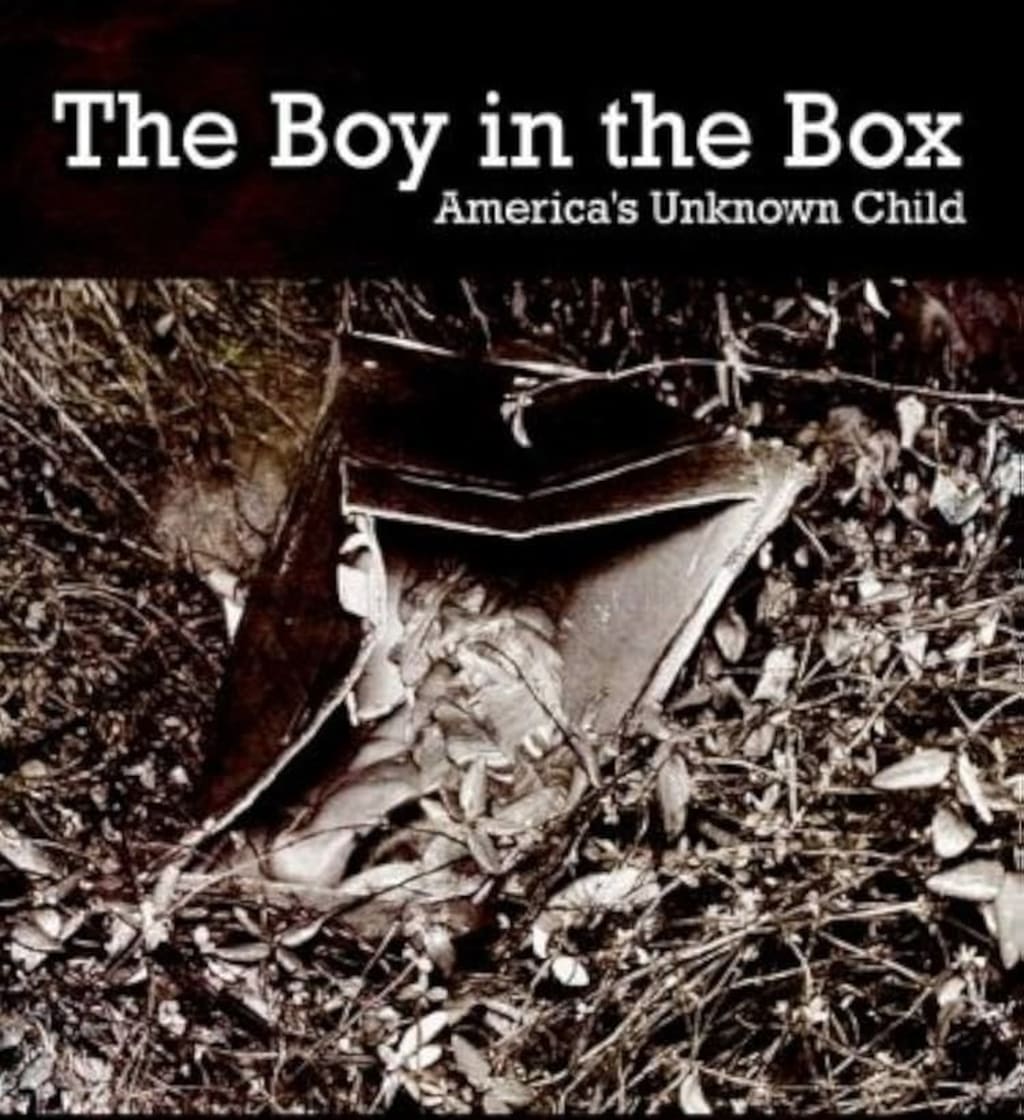
With all these dead ends, let’s dive into the theories — what might’ve happened to this boy, and who he could’ve been.
The first theory comes from authors Lou Romano and Jim Hoffman. They came across a lead from a man in Philadelphia who claimed that his family once rented a place to a man who sold his own son — possibly the boy in the box.
He sold his son?
Yeah. He was renting from this guy and told him he sold his child. Which is odd, because unless you literally saw it happen, that’s not something people usually mention in passing.
“Wow, the place looks great. I’m selling my kid tomorrow.”
“Cool, I’ll take it. How many bedrooms? One box included?”
“How much was rent again?”
A forensic pathologist later examined photos of the possible father and alleged brother, and said there were enough facial similarities to justify further lab testing — things like the shape of the face, the helix of the right ear, and the nose.
A DNA sample was taken from the man believed to be the brother. Oddly, Philadelphia police didn’t say whether they’d test this DNA against the DNA of the boy in the box. They simply said they would “investigate further.”
Which… doesn’t make much sense.
I mean, if you’ve got a potential match and you’ve got DNA — why wouldn’t you run the test?
How much could that even cost?
Right? Maybe they did test it and didn’t get a match — and just never reported it. Or maybe it’s bureaucracy.
Or a cover-up.
The second theory comes from Remington Bristow, a medical examiner who worked on the case for over 36 years. He collected newspaper clippings about the boy, spent thousands of dollars of his own money, and dedicated countless hours trying to solve the mystery.
He even traveled as far as Arizona and Texas to chase leads. At one point, he consulted a psychic, giving them staples from the box the bassinet came in, hoping they could sense something.
Bristow even went so far as to carry a mask of the boy’s face in his briefcase. Let’s take a moment to process that. That’s… a bit much.
Especially the last part — it doesn’t even seem helpful. What, did he wear the mask and go up to people like: “Do you recognize me? Look at this little boy face — ring any bells?”
Or even creepier — imagine interrogating someone:
“Have you seen this boy?”
“No.”
“Okay, let me just show you one more thing...” [pulls out mask]
“Now?”
“…Sir, please leave.”
Bristow believed the boy had died accidentally. His freshly cut hair and nails suggested he had been well cared for. Perhaps the family didn’t come forward because they feared being charged with murder — a theory Bristow developed partially based on the psychic’s clue.
The Investigator Remington Bristow decided to look into a foster family that lived near the location where the boy’s body was discovered. This family had already been interviewed by the police, but in 1961, during an estate sale of the foster family's belongings, Bristow found a bassinet that he believed might have once been shipped in the same box where the boy was found.
There was no conclusive proof that it was the same bassinet, but to Bristow, it seemed like a potential lead. It's important to remember that this wasn’t an official investigation—it was a private pursuit, driven by a deep sense of justice and commitment.
Later, Bristow developed a theory that the boy was the illegitimate child of the foster family’s daughter, and that he may have been abandoned by her to avoid being exposed as a single mother.
Bristow passed away in 1993, but shortly after his death, Detective Tom Augustine from the Philadelphia Police Department picked up the investigation right where Bristow had left off.
On February 23, 1998, Detective Augustine visited the home of Arthur Nicoletti, the man who once ran the former foster home. Nicoletti’s wife, Anna Marie, was the very woman Bristow believed to be the boy’s biological mother. Notably, Anna Marie was also Nicoletti’s stepdaughter.
Yes—it’s as complicated as it sounds: he married his stepdaughter. Technically not incest, but certainly unusual.
Anna Marie told Detective Augustine that she had a son who died under strange circumstances, a story that was supported by morgue records. According to those records, the boy had died from electrocution after riding a coin-operated amusement ride outside a store.
Unfortunately, this turned out to be another dead end.
The Third and Final Theory
This theory came from a woman named Martha. A psychiatrist in Kentucky contacted Detective Augustine and said that one of her patients—who went by the name Martha—insisted on speaking with the police.
Martha claimed that when she was 11 years old, her mother took her to a house, where she handed over an envelope in exchange for a boy.
(This connected back to the earlier theory in which a man said he had sold his son—suggesting this could be the same child being “purchased.”)
Martha went on to say that her mother had sexually abused her, and had planned to do the same to the boy. According to Martha, after her mother had trouble bathing the child, she beat him to death. She then drove with Martha and the boy’s body to Philadelphia, where they abandoned it.
Martha gave her testimony to Detective Tom Augustine, as well as Joseph McGill and William Kelly, two of the original officers who responded to the crime scene in 1957. All three investigators reportedly found her story convincing.
According to retired FBI agent Bill Fleischer, the details Martha gave—addresses, names, descriptions—all lined up with known facts of the case. Her story is considered one of the strongest theories.
However, despite the compelling details, police were never able to confirm whether the boy was indeed the same one from Martha’s account.
His grave at Ivy Hill Cemetery in Philadelphia bears the words:
“America’s Unknown Child.”
To this day, people remain puzzled as to why no one ever came forward to claim him.
Perhaps one day, we’ll finally learn who he was and what truly happened to him.
But for now,
his story remains a mystery — and the case remains unsolved.
About the Creator
ADIR SEGAL
The realms of creation and the unknown have always interested me, and I tend to incorporate the fictional aspects and their findings into my works.
Keep reading
More stories from ADIR SEGAL and writers in Criminal and other communities.
THE Murder of Joseph Augustus Zarelli
On February 25, 1957, the body of a young boy was discovered inside a cardboard box at an illegal dumping site near Bury Road in Philadelphia. The boy was estimated to be between 4 and 6 years old, weighing around 30 pounds and standing 3 feet 3 inches tall.
By ADIR SEGAL5 months ago in Criminal
Michigan Synagogue Shooting: Fear, Faith, and Survival
Places of worship are meant to feel safe. People gather there to pray, reflect, and share quiet moments with their community. For many families, a synagogue is more than a building. It is where children learn traditions, where people celebrate holidays, and where comfort is found during difficult times.The michigan synagogue shooting shattered that sense of safety in an instant. What began as an ordinary day quickly turned into confusion and fear. Families inside the building suddenly faced a situation no one expects in a place meant for peace.
By Muqadas khanabout 10 hours ago in Criminal
Lured, Killed, Decapitated – A Jealous Husband’s Brutal Crime in the Woods
In a chilling case that unfolded in rural New Hampshire in September 2020 Britany Barron then 33 was found guilty of falsifying physical evidence connected to the brutal murder of her co-worker Jonathan Amerault. The crime involved her husband Armando Barron 32 at the time who became convinced she was having an affair with Amerault after discovering flirtatious messages on her phone. This jealousy-fueled rage led to a violent chain of events that ended in kidnapping, torture shooting, decapitation and attempts to conceal the body.The tragedy began on the night of September 19-20 2020 in Jaffrey New Hampshire where the Barrons lived. Armando reportedly abusive in the marriage confronted Britany over Snapchat exchanges with Amerault a 25-year-old attractive co-worker from Keene. Enraged, Armando allegedly used Britany's phone to lure Amerault to Annett Wayside Park (also known as Annett State Park) in Rindge New Hampshire—a secluded spot just north of the Massachusetts border—under the pretense of meeting her.
By Kure Garba5 days ago in Criminal
Top tipple tricks
Been thinking a lot about drinking, lately. Not least because of a recent episode of over-indulgence and the inevitable after effects. Some readers may recall the earlier articles I wrote about beating the booze. Here I set out an experiment in techniques for cutting down on my alcohol intake. The experiment was successful, the techniques worked, and I have armed myself with an arsenal of weapons in the war against the demon drink. I have yet to fire the first round however. It's all a question of timing (perhaps procrastination).
By Raymond G. Taylor5 days ago in Psyche



Comments
There are no comments for this story
Be the first to respond and start the conversation.