
THE Murder of Joseph Augustus Zarelli
The Mysterious Death Of The Boy In The Box

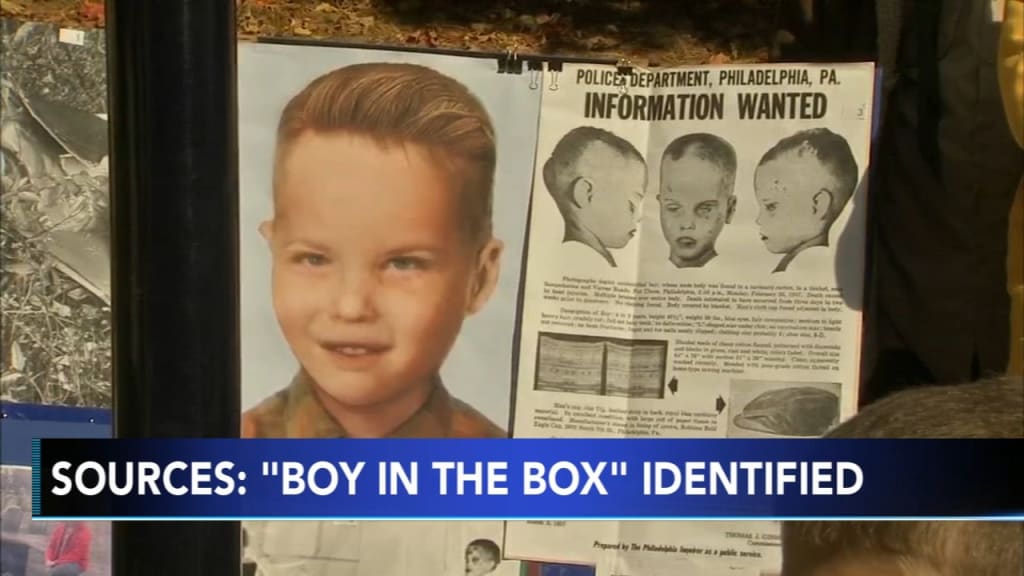
On February 25, 1957, the body of a young boy was discovered inside a cardboard box at an illegal dumping site near Bury Road in Philadelphia. The boy was estimated to be between 4 and 6 years old, weighing around 30 pounds and standing 3 feet 3 inches tall.
He was found naked but wrapped in a blanket. His hair had been freshly cut, and his body appeared to have been recently washed. Several small scars were found on his body — on the chin, groin, and left ankle — some of which suggested he may have undergone a medical procedure. The cause of death was determined to be head trauma, and there were no witnesses.
The body was first discovered by a young man walking through the abandoned area, but he waited an entire day before notifying the police. It was later revealed that another man had come across the body even earlier but chose not to report it, claiming he didn’t want to get involved.Due to the cold weather at the time and the delay in reporting, authorities were unable to determine exactly when the boy had died.
Hoping to learn his identity, the police kept his body at the morgue while people from over ten different states came to try and recognize him — all without success.
More than 400,000 flyers featuring the boy’s image were distributed to police stations, post offices, and courthouses across the country. Even the American Medical Association circulated a description of the child — but none of these efforts led to any answers.
People wondered what kind of description the authorities were even circulating — was it just: "Boy. Found in a box."?
Sure, they had physical details, but kids often look alike. As one person joked, “Newborns always get the same reaction — ‘Oh, what a cute baby’ — when really, most babies just look like babies. Either they’re ugly or just… normal.” They imagined this boy being born with a disproportionately large head, dragging it like a crab creature.
But the truth was much darker.
Police took fingerprints from the boy, but they didn’t match any known records. They also compared his footprints to hospital birth records in the area — and found nothing. It was as if the child had never officially existed.
This was unsettling. In an era when most births were recorded, how could someone — especially a young child — be completely off the grid?
As for the box itself: the investigators followed up on it, because it offered one of the few tangible clues. It had a serial number, which allowed police to trace it back to a shipment from a JCPenney store located about 15 miles away. Before it held the boy’s body, the box had contained a bassinet. The store had sold 12 of these boxes, all paid for in cash — which meant there were no names, no credit card trails.
Eight of the twelve buyers came forward after hearing about the case in the news. They stated that they either still had their boxes or had thrown them out — making it clear their box was not involved. The police were able to confirm that the box had originally been shipped to Upper Darby, Pennsylvania.
Investigators also examined the blanket the boy was wrapped in. The Philadelphia Textile Institute analyzed the fabric and concluded that it was likely manufactured either in Granby, Quebec or Swannanoa, North Carolina. However, since thousands of such blankets had been produced and sold across North America, there was no way to track down the specific buyer. That clue, too, was a dead end.
A potentially more promising lead was a hat found about 15 feet from the box — a blue corduroy Ivy League-style cap, size 7 1/8. It was labeled “Eagle Hat & Cap Company,” a small business owned by Mrs. Hannah Robbins in South Philadelphia.
Mrs. Robbins remembered the man who bought the hat — because she had customized it for him. He was a blond man, between the ages of 26 and 30, and he had requested the addition of a leather strap and buckle. He paid in cash and was never seen again.
Detectives followed this lead vigorously — visiting more than 100 stores in the area to try and trace either the man or the boy. But no one recognized them. Nothing came of it.
Back to the boy: forensic evidence showed stray hairs on his body, suggesting his haircut was done quickly and possibly under stress. One forensic artist, Frank Bender, proposed a chilling theory — that the child might have been raised as a girl. Supporting this, Bill Kelley, an original investigator on the case, recalled that in 1957 and 1958, a West Coast sketch artist had circulated a rendering of the child as a girl — but, once again, it led nowhere.
About the Creator
ADIR SEGAL
The realms of creation and the unknown have always interested me, and I tend to incorporate the fictional aspects and their findings into my works.
Keep reading
More stories from ADIR SEGAL and writers in Criminal and other communities.
The Skid Row Slasher
He stealthily approaches his target and gradually unsheathes a lengthy knife. In a swift motion, he seizes the man's head and slashes his throat from one ear to the other. As blood gushes from the injury, the assailant retrieves a cup, seeking nourishment. Although no names were mentioned, what you have just heard closely resembles the actions of the individual known as 'The Skid Row Slasher' in his attacks on victims. Regarding the cup, he would drain his victims and consume their blood, with law enforcement occasionally discovering the abandoned cups beside the corpses.
By ADIR SEGAL10 months ago in Criminal
The Silence Behind Room 307
M Mehran The rain fell heavily over the quiet town of Ravenshade, turning the narrow streets into rivers of shimmering reflections. Most people had already gone home, locking their doors against the stormy night. But inside the old Hawthorne Hotel, the lights of Room 307 still glowed faintly. That room would soon become the center of one of the most chilling criminal mysteries the town had ever known. A Crime That Shocked the Town At 11:42 PM, the hotel receptionist heard a loud crash echo from the third floor. At first, she assumed a guest had dropped something. But minutes later, a terrified scream shattered the silence. When the police arrived, they found the door to Room 307 half open. Inside, the scene was disturbing. A wealthy businessman named Daniel Mercer lay lifeless on the floor beside a broken glass table. The room looked untouched—no signs of forced entry, no robbery, no struggle. Yet Mercer was clearly murdered. Detective Aaron Cole, a veteran investigator known for solving impossible cases, stepped into the room carefully. Years of experience had taught him that the smallest detail could expose the biggest lie. But this case felt different from the beginning. The Impossible Mystery The first strange detail was the door. It had been locked from the inside. The second strange detail was the window. Closed. Sealed. Impossible for anyone to escape through. This meant one thing: whoever killed Mercer had either vanished into thin air… or was still in the hotel. Cole began questioning the staff and guests. Mercer had checked in earlier that evening, arriving alone and carrying only a black leather briefcase. According to hotel records, he had ordered dinner to his room and made two phone calls. After that, nothing. But one witness changed everything. A young waitress named Clara said she saw someone leaving the hallway near Room 307 shortly before the scream. “A man in a gray coat,” she told police. “Tall. Wearing a hat. I didn’t see his face.” The problem? No guest registered at the hotel matched that description. A Secret Hidden in Plain Sight Detective Cole examined Mercer’s belongings carefully. Inside the briefcase were documents related to a major financial investigation. Mercer had been working with authorities to expose a massive corporate fraud operation involving millions of dollars. Someone powerful clearly had a reason to silence him. But how did the killer enter and leave the locked room? That question haunted Cole. Until he noticed something unusual. The bathroom mirror. It wasn’t aligned with the wall like normal hotel mirrors. When Cole touched its edge, it shifted slightly. Behind it was a hidden service panel used by hotel maintenance workers decades ago. A narrow passage ran between the walls of the building. Suddenly, the “impossible crime” wasn’t impossible anymore. The Killer Revealed The passage led to a storage room on the same floor. Inside, detectives discovered a gray coat hanging on a hook. And inside the pocket was a hotel keycard. The card belonged to Victor Hale—the hotel’s night manager. When police confronted him, Hale tried to stay calm. But the evidence was overwhelming. Hale had once worked for the same corporation Mercer was investigating. If Mercer exposed the fraud scheme, several powerful executives—and their accomplices—would face prison. Hale was paid to ensure that never happened. Using the old maintenance passage, he entered Mercer’s room through the hidden panel, confronted him, and killed him before escaping back through the wall. He then locked the door from the inside using a simple wire trick through the gap under the door. A perfect crime. Or so he thought. Justice in the Darkness When Hale finally confessed, he revealed something chilling. Mercer had refused to stay silent even when threatened. “He said the truth was worth dying for,” Hale admitted quietly. The investigation that followed exposed the entire fraud network Mercer had been trying to reveal. Several high-ranking executives were arrested, and millions of dollars in stolen funds were recovered. But for Detective Cole, the victory felt incomplete. Mercer had paid the ultimate price. The Lesson Behind the Crime Criminal cases like the Room 307 murder remind us that crime is rarely random. Behind every shocking act lies a chain of decisions, secrets, and motives. Sometimes the truth hides in shadows. Sometimes it hides behind a mirror. But as Detective Cole often said: “Every crime leaves a whisper of the truth. You just have to listen carefully.” And in the silent hallway of the Hawthorne Hotel, the whisper of justice had finally been heard.
By Muhammad Mehran5 days ago in Criminal
Why Didn't Anyone Tell Us
Men, move along. This is not for you. This is for the women. I was forty-five when I began menopause. It is pretty young for that to be going on in a woman’s life, but I had undiagnosed PCOS, my entire life. Thank you to all the gynecologists I had seen my entire life. That in itself should encourage women to keep seeking second opinions, especially when you are not getting correct answers or any at all.
By Alexandra Grant3 days ago in Humans


Comments
There are no comments for this story
Be the first to respond and start the conversation.