
The Most Dangerous Cities Around The World
Where the skyline is etched with survival, and every alley holds a story—welcome to the world’s most dangerous cities.

From castles positioned on crumbling cliffs to apartment blocks and toxic wastelands, join me as we check out the scariest cities built on the edge of the earth. With each city, we'll be raising the stakes as each one grows more and more precarious. Starting with some canoe culture in Logos, Nigeria. Living by the ocean sounds pretty fun, but in some places, life on the water can be downright dangerous. On the very edge of Logos is a partially floating community called Makoko that consists of six separate villages making up a gigantic slum. Four of them are based on the water of the Lacos Lagoon on the east coast and most of the structures here are built on strong stilts which keep them from collapsing into the dirty and polluted water. This community is squashed together with population estimates of up to 250,000 people. And I thought living in an apartment with six roommates was grand. You have to navigate the slum on canoe and survive with little electricity and sanitation. Furthermore, the residents are particularly vulnerable to disease and the slum faces incredibly high levels of maternal mortality and childbirth. But residents there have made the most of their watery home. The settlement has several general stores, churches, and a motel. It even used to be home to the Makoko floating school, which was held up by recycled plastic barrels that float on the water and a triangular roof, which kept the structure balanced. But this way of life is under threat. In recent years, Logos has seen increasingly intense floods and rains that pose a threat to the whole city. Makoko's location on the water makes it particularly vulnerable, and there's dangers that rising sea levels caused by climate change will sink the entire slum into the ocean. Several buildings like the floating school have already collapsed, and in future decades, the whole of Makoko might fade away forever, meaning it's literally on the current edge of the earth. Man, there's something eerily scary about knowing your city will eventually be sunk by the sea. Mother Nature is a cruel mistress. sometimes. But Makoko isn't the only community that was built in a life-threatening location. We usually think of a city as a great sprawling metropolis with loads of buildings and bustling streets spread out over different neighborhoods. Yet, Yanzhen in China's Yunan Province is a busy city that's incredibly compact because the entire thing runs along the banks of the Hang River. Trying to fit an entire city on a handful of long winding roads sounds crazy, but incredibly Yanjin has 450,000 residents, which for context beats the population of American cities like Orlando, New Orleans, and Honolulu.
The residents are jam-packed in tall buildings along a stretch of just 3 mi, which sounds like a claustrophobic nightmare. But to make matters worse, the buildings also sit at the bottom of the steep Hing River Valley with cliffs rising sharply above them. The gap between the river and cliffside is just 100 ft wide in some places, making Yanjin the narrowest city in the world, but the residents face danger from both sides as they're constantly threatened by landslides and floods. In 2006, a 5.1 magnitude earthquake hit the larger Yanzhen County, causing rocks from the cliffs to rain down on the city. Dozens were injured and at least 17 residents lost their lives. So since timber and reinforced concrete has been used in construction to strengthen the buildings, but the city also succumbs to floods almost every year as the hang river rises and bursts its banks.
Many of the buildings are built on strong stilt-like columns which defend them from rising water levels. But according to one resident, the flooding causes major accidents and injuries on a yearly basis. So while the city looks beautiful, it sounds absolutely terrifying to live that close to the unpredictable river and the crumbling cliffs above. Talk about double trouble.
Let's move from the bottom of a valley to the highest heights. My cousin Dave likes to force me to go on long hikes up steep mountains, and I always feel like I'm at the edge of the earth when looking down at the landscape below. But I think I'd be way too scared to actually live up there in a hilltop city like this. High above Italy's Latio region sits Chvida Bonarjo, a medieval town from the 7th century BCE that's built on top of volcanic rock. At an elevation of over 1,400 ft, the city literally rises above the clouds, and it's only accessible on foot via a 980 ft long bridge. Previously, you had to travel up a series of steep cliffside paths on a donkey to a main gateway that was accessed through a tunnel carved into the rock. But due to continuous landslides over the ages, the modern foot bridge was built in 1965.
Still, although the route into town isn't as treacherous as it used to be, living there is still incredibly dangerous. See, the top layer of the hill is composed of soft rock made from volcanic ash called tough that's incredibly susceptible to erosion. So, centuries of rainfall has caused landslides that have slowly eaten at Bonarasio, and experts believe the entire town is now just a third of its original size. The entire plateau is in constant danger of a total collapse. And because it lies on such shaky ground, Anorio is known as Lachete Chamore, which translates to the dying town. It's widely acknowledged that one day the city will crumble entirely. But a population of 12 residents still call it home. And as it's a UNESCO World Heritage site, up to a million people visit the city every year. But sadly, scientists say nothing can prevent its inevitable collapse, marking it down as a soontobe lost edge of the earth that will one day die completely. Speaking of death, a city inside a volcano sounds pretty fantastical, right? Like something out of a scary story book.
Well, while Aosima village isn't technically a city, the Japanese hamlet is located on an active volcano over 220 mi from the capital, Tokyo. Aosima's crater has a circumference of 3.3 mi and incredibly it houses the village's 200 residents and another smaller active volcano called Mararyyama. The locals are pretty much cut off from the rest of the world because there's no internet connection or phone signal on the island. In fact, on the 2.3 square miles of land, only one store, three bars, and one post office fulfills the needs of its residents. And if either of the nearby volcanoes do erupt, they're all pretty screwed. If an ash cloud chases you here, there's nowhere to run away to. And Hogosima has had temperate tantrums before. It last erupted in 1785, and it took around 140 lives, which have the island's population at the time. Even today, there's no airport. So to escape and get to the nearest land mass, you'd have to make the 3-hour 50-mi journey from Alushima to Hachi Jojima by boat. So while this luscious oasis may be some people's idea of paradise, the feeling of being trapped on a deadly island like this makes my skin crawl. I'm happy to risk sunburn while on vacation, but getting burnt alive by lava is a step too far.
Now picture a place where the danger isn't just from the earth beneath you, but the freezing air above. Norrials is an incredibly isolated city in Russia, lying 250 mi north of the Arctic Circle.
In winter, temperatures reach an average low of -23.8° F. But the cold isn't the only thing that makes it inhospitable because its air also holds toxic levels of pollution. Xenoriosk was built in the 1920s over rich deposits of metals like nickel, copper, and cobalt. So, a number of mines and metallurgical factories were set up in the mid 1930s. They were constructed by goolog labor camp workers, and the city soon became home to the largest heavy metal ore smelting complex in the world. But the process of burning these ores to extract the metal releases the highly acidic and corrosive gas sulfur dioxide which pollutes the air and causes smog, acid rain, and poisonous clouds that suffocate you as you walk by them. Soon, Norhilsk faced the worst sulfur dioxide pollution in the world. And by the 1980s, all the nearby trees had died due to sulfur dioxide disrupting the photosynthesis process plants need to survive. But it's not just the flora that suffers.
Incredibly, 174,000 people live in Dorilsk and they're constantly affected by respiratory diseases and skin conditions from the pollution. The life expectancy in the city is just 60 years of age. A stark contrast from Russia's average life expectancy of 73. Breathing the air can cause pneumonia and just walking around in it can sting your eyes. So since 2001, Noriosk has been a partially closed city, and outsiders aren't even allowed to enter without special permits from the Russian government. Furthermore, there are no roads to Norio, so it can only be accessed by plane or boat, and it didn't have any internet access until 2017, meaning its residents have been completely isolated from the outside world. So why would anyone want to live there? Well, lots of the locals are used to this way of life, and the city's mining and metal energy jobs offer salaries that are reportedly two to three times higher than the rest of Russia. I'm sure that's tempting for some, but you could give me the largest sum of money in the world, and I wouldn't want to die from sulfur poisoning before I've reached retirement age. After all those toxic fumes, I need some fresh air. So, let's head to one of the greenest and deadliest spots on the planet. Journeying to the edges of the earth through the jungle calls for a lot of planning and a pack stuck with sunscreen, bug spray, and machetes.
Buttos in Peru is one of the only cities that requires a similar amount of thought for tourists because it lies in the middle of the Amazon rainforest.
Located 2,300 m from the Atlantic Ocean and 640 mi from Peru's capital, Lima, Equitos is the largest city in the world that can't be reached by road. And the only way to get there is an airplane or 5-day boat trip. It sits just 78 mi downstream of the two main tributaries of the Amazon River. So, the location couldn't be wilder. But around half a million people live in Aquitos, and the bustling city is complete with museums, a cathedral, and modern streets. Still, rainforest life lingers in the background. The city's infamous market stock meat from alligators, leopards, sloths, and other products from exotic creatures for sale. Furthermore, by the Italia River, you'll find Lower Balin, a neighborhood hosting homes and markets made of wood, palm leaves, and corrugated iron. From December to May, the rainy season raises the water levels and floods the river here, transforming the shanty town into an Amazonian Venice. As a result, its buildings sit on stilts so it can continue to function like a regular neighborhood with shops and hospitals that are accessed by canoe. This must be second nature to blend 7,500 residents, but god knows I'd be scared stiff of the creatures hiding in the water. Still, if this isn't wild enough for you, lots of companies in Aquitos offer expeditions deeper into the rainforest from the city's sport, allowing you to venture into the heart of the jungle and leave civilization behind. Nah, help ass. From Amazon swamp to mountain heights, the ancient monasteries of Thessaly Greece are designed to separate their monks from society, and they're about as close to heaven as you can get. These religious buildings are situated on giant columns of rock known as the meteora, ranging from 1,00 to,800 ft tall. Talk about high praise. But why are there a bunch of monasteries here in the first place?
Well, worship on top of natural columns dates back to Europe and Asia in the fifth century AD when Christian monks known as stylites would live at top pillars full time. They believed that by becoming hermits, they'd avoid the earthly temptations on the ground below.
This would allow them to achieve the spiritual salvation of their souls. At Meteora, Orthodox Christian monks started moving in and settling down around the 11th century AD with 24 monasteries to choose from at the height of its popularity. As you can imagine, before the invention of U-Haul, shifting building materials and the monk's belongings to the top was pretty difficult. But the monks got it done by inserting beams into the rock before using nets and rope ladders to ferry supplies up the columns. Surprisingly, around 50 nuns and 17 monks still live in isolation within the six remaining active monasteries, although they're much more likely to be disrupted by curious tourists who scale the meteora with modern cable cars that have been installed for easier access. But the monks aren't allowed to use them to pop down to the local Mickey De's when they get hungry. And they usually have to rely on visitors to send up food, water, and clothing to help them survive. Plus, they're constantly exposed to bad weather and high winds, which threaten to blow them off the columns entirely.
So, I don't think a spiritual retreat could get any more scary and isolated.
Personally, I'd want to find enlightenment while still having access to FedEx and TV. How else will I watch the prequels? Speaking of, if Star Wars has taught me anything, it's that in a battle, it's always best to have the high ground. And this is why the city of Amedi in northern Iraq is the best place to be in a bus stop. See, the city itself has a prime position on a mountain plateau over 1,400 ft high, and its elevation and high walls have made it a great stronghold against invaders.
Its 3,000-year history makes it one of the oldest cities in the world, and it was originally only accessible with two staircases that led to heavily fortified gates. Nowadays, it isn't much easier to reach, as you can only approach by car on a single winding mountain road. Man, imagine getting into a traffic jam on that high-risk highway. It's no surprise that the first society that established Amedi was likely militarybased, founded sometime in the 9th century B.C.E. under the Assyrian Empire. But over time, the city has been occupied by several empires, including the Parththeians and Persians, swapping hands whenever opposing armies have managed to break through its walls and take it over with brutal force. As a military hot spot, the city has always been a pretty scary place to live, but today it's a part of a rock and it has a population of around 11,000 people squashed into a space that's just under 0.4 square miles.
Unfortunately, the city can't expand outwards due to its unique location. So, despite being around for 3,000 years, it hasn't been able to develop into a larger modern city. I guess you could say that the population has reached a plateau. Get it? To be honest though, that's probably for the best. Living in those ancient cliffside houses already looks terrifying and claustrophobic. So, just imagine that space covered in skyscrapers and apartment blocks. It definitely ruined the city's natural beauty and give anyone a fear of heights. Oh, let's get away from all that vertigo and move on to claustrophobia as we head underground.
Unless you're a rabbit living in a hole in the ground probably doesn't sound very appealing, but in the ancient Capidosia region of Turkey, people have lived and carved out caverns under the surface for thousands of years. Anatolia is a peninsula situated on a plateau north of the Taus Mountains. and it's famous for its tall spires of rock that are affectionately known as fairy chimneys. This alien landscape was formed around 14 million years ago when volcanic eruptions ejected ash over the area which then solidified into soft tough. Then more eruptions coated the tough in lava which consolidated into a layer of hard bassalt rock. As wind and rain ate away at the ground over millions of years, the tough began to erode. But because basalt is slower to erode, the areas topped with the harder rock remain, creating pillars with mushroomlike basalt caps. Some of these giant pillars are an impressive 130 ft tall. And unbelievably, some people have set up homes inside them. The area is believed to have been inhabited since 1200 B.CE when it was ruled by an ancient civilization called the Hittites. They dug out homes in the fairy chimneys and when they came under attack, they started digging tunnels and caves in the ground underneath them to hide from invaders. Over thousands of years, different civilizations expanded on these tunnels, including early Christians who used them to escape capture by the Romans in the first century AD. This resulted in the creation of a giant man-made cave network called Darren Cuyu that is 11 levels deep with 600 entrances and room for up to 20,000 people. As the underground city was built, each civilizations also carve new homes, stables, and monasteries into the fairy chimneys on the surface that were directly connected to the tunnels below.
But unlike the long abandoned cave system, these homes are still populated by some of Capidosia's modern inhabitants. The ancient structures contain handcarved rooms that measure up to 14 ft wide and 10 ft high, resulting in pretty sizable homes. Furthermore, large hotels and restaurants also exist inside some cave areas with all the modcons needed for contemporary life.
Today, the structures are UNESCO protected sites, and carving out more of the rock is prohibited. So, extending your cave house is a big no no. But you can buy yourself a property in an ancient fairy chimney and live just like the Hittites thousands of years ago. I just wonder what the real estate situation is like. Does a cave room with more holes fetch higher prices, or is the cave at the highest peak considered a luxury binge house? Regardless, living in the chimneys can actually be pretty dangerous. Climbing up hundreds of stone steps to get home is a freaky prospect.
Furthermore, the volcanic tough in the area is still eroding over time. And in 2024, an uninhabited fairy chimney completely collapsed, destroying the home inside it. So, from slippery steps to collapsing ceilings, life there can be pretty scary. And I'd hold off moving for now. Everyone likes taking pictures while on vacation. And if you're looking for a place to take some spectacular selfies, then you've hit the jackpot here. But you should mind your step as you lean back to take your picture because it could cost you your life.
Sastola de laa is a striking city that sits 164 ft high on a narrow cliff in Jerona, Catalonia. The buildings feel dangerously close to the cliffside. And at around half a square mile in width, getting from one side of this compact city to the other is like a tightroppe walk. Talk about being caught between a Laroka and a hard place. Am I right? The cliff itself is made from volcanic rock and it was slowly eroded into a ridge by the Fluia and Thoronel rivers that run on either side of the formation. The city itself is believed to have been built between the 11th and 13th centuries and the majority of the medieval houses are made out of volcanic rock dug up from the cliff side. But around a thousand people still inhabit the heavy metal homes and Naroka has become affectionately known as the hanging town due to its precarious location. Just imagine trying to navigate this neighborhood after a night of drinking. Tragically, the ridge is still being eroded by the elements. And in recent years, the area has become more prone to rockfalls that eat away at the town. Eventually, this may put those hanging houses in danger. And it's believed that one day the entire town will collapse and fall off the earth as we know it. So, it's likely that in the future, Castle Dearoko will disappear, and the hanging town is truly hanging on by a thread. Reaching the town is a trick, but it isn't nearly as isolated as this next island that was actually used by the British government to exile their prisoners and make them vanish from society. Saint Helena lies 1,200 m away from Africa and the closest land mass is Ascension Island, 807 mi away.
Its largest city is Jamestown and its 629 residents all live inside a beautiful valley between two steep cliffs on the precipice of the island.
This crab space is just 47 square miles in total, making it roughly the same size as Disney World Orlando, which sounds pretty claustrophobic. If I can't even handle the crowds of Disney, I'm not sure I can handle living in this city, especially as it's composed of just one main street. On the western side of the valley sits Jacob's Ladder, a 699 step staircase that allows you to climb to an elevation of 600 ft and look down at the city below. The ascent is terrifying and whilst you're up there, you can see for yourself just how isolated the Thai island is with nothing but blue ocean stretching into the distance. For context, the island's airport was only built in 2015, and currently the only route there is a weekly six-hour flight from Johannesburg, South Africa. So, flying from a furtherflung part of the world like the US will take well over 24 hours with multiple plane transfers and a price tag of between $3,000 to $10,000.
That dent in your wallet is scary enough on its own, but prior to the airport's construction, the only way to access the island was a treacherous boat trip from South Africa, which could take up to 5 days. I feel seasick. So, Jamestown truly sits on the edge of the earth. And after the city was built by the British in 1659, its big claim to fame was the imprisonment of the French General Napoleon Bonapart. He was captured and exiled to the city after his defeat at the Battle of Waterlue in 1815 before living the last 6 years of his life in isolation elsewhere on Saint Helena. But old Nappy isn't alone and the British Empire actually exiled several prisoners on the island over the years as its remote location would completely remove them from society. So, while lots of people comfortably live in Jamestown today, I can't imagine anything scarier than being stranded there in the 1800s, forced to live thousands of miles away from the rest of civilization. Yikes.
Most cities are known for their famous buildings, monuments, and landmarks. But some places boast more frightening attractions like giant waterfalls churning through the city center. Pirang Town in the Hunan Province of China's is home to a cascading waterfall with buildings and homes built right on top of it. This 130 foot wide and 200t long fall is at its calmst a gently flowing aquatic marvel. However, when heavy rains hit the region, a rush of fast streaming water can cause it to overflow. And if I lived in one of the buildings on top of that cliff, I'd be completely terrified by the water thundering past my window. But the waterfall is actually pretty safe and thankfully firong has stood on its banks for over 2,000 years without collapsing into the falls. However, it isn't the only real life Rivendell and the town of Schaffenhausen in Switzerland borders on one of Europe's largest waterfalls, the Ryan Falls. The monstrous falls reach heights of over 75 ft and a width of nearly 500 ft, allowing over 21,000 cubic feet of water to spill over its vast edges. But unfortunately, this leads to incredibly strong currents in the rine and swimming or falling in the river as it runs through Chaffenhousing is so dangerous that it regularly leads to fatalities. Furthermore, heavy rainfall exacerbated by climate change has resulted in increased occurrences of flooding at the falls leading to infrastructure damage in the town. Of course, Schoffenhausen's government continuously constructs new and improved buildings and defenses to avoid inland flooding, but the constant flood risk has stunted the town's development, preventing it from growing over the decades. That might be for the best, though. If these small towns developed into much larger modern cities with skyscrapers, it'd be pretty scary. I know. If I live 50 floors up, perched right on the edge of the waterfall, no amount of flood defense could convince me I was safe. Now, you might look at this beautiful Spanish city and think, "What's so scary about this?" But don't let its romantic appearance deceive you.
Rhonda is a town built on hideous heights and a horrifying history. You see, at 2,300 ft above sea level, the town rises above the clouds and fog, and it's burged on a giant gorge called El Tahoe in the vast Sana de Ronda mountain range. The point the Noeo bridge connects the two halves of this city 322 feet above the ground below. And while the resulting view is definitely gorgeous, I'd feel completely stuck up there. In the past, the defensive walls of the city and its impenetrable gorge made it an important stronghold. In fact, it was one of the last parts of Andalusia to be taken from the Islamic population during the Catholic conquest of Spain in 1485. However, this cutoff location wasn't great for travelers passing through Rhonda because it also meant that it's historically had a problem with bandits. The isolated city was the perfect place for highway men to rub unsuspecting travelers on their way to the city as the victims would have nowhere to go for help. In fact, in the 19th century, an entire gang of bandits known as the Seven Aiha Boys operated in this area and violently robbed vulnerable people traveling to Rhonda.
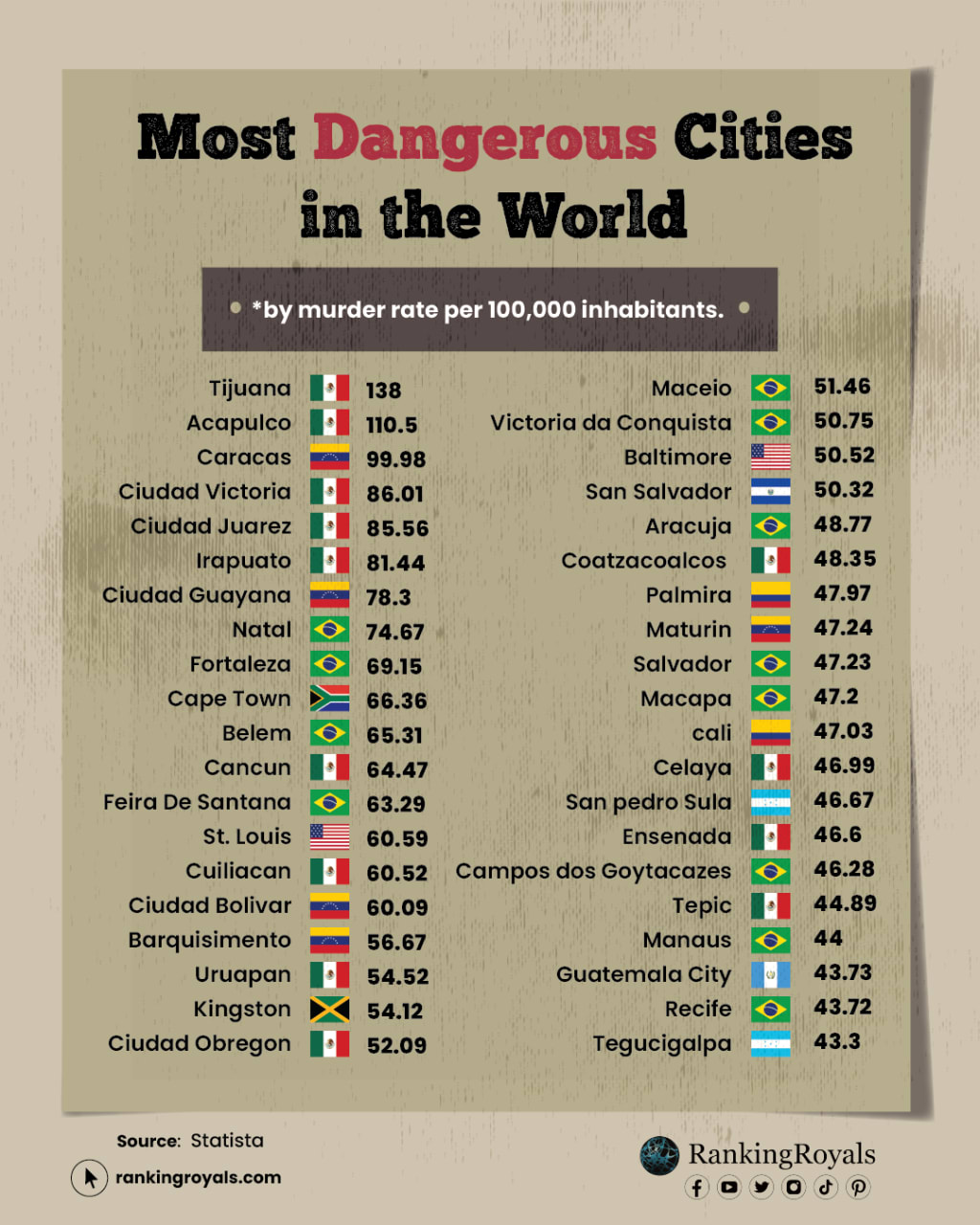
The city's relationship with violence is also clear through its title as the birthplace of modern bull fighting as the current version of the Blood Sport was established there in the 18th century. So, while Rhonda's remote location and elevation offer beautiful views, in the past it was a very violent place to visit. A trip that involves dodging gangs of dangerous criminals before checking out one of the most bloodthirsty sports in modern history doesn't sound like my idea of a relaxing vacation. Living on the edge of the earth can be pretty scary. In the shadowed alleys of the world’s most dangerous cities—where sirens wail like mourning doves and fear hangs thick as smog—the contrast between beauty and brutality is stark and haunting. From the crumbling neighborhoods of Caracas to the gun-riddled streets of San Pedro Sula, life dances on the edge of a knife, and survival is both an art and a daily gamble. These cities, though scarred by violence, pulse with resilience and raw humanity. They are not merely places of peril, but reflections of deeper wounds—poverty, corruption, and inequality—that fester in the absence of hope. And yet, even amid chaos, there are stories of courage, of children dreaming beyond bullet holes and mothers planting peace where the soil is soaked in grief. So, we must ask: Are these cities truly dangerous—or is the real danger our indifference to the reasons they became this way? but if you had to move to one of these isolated cities, which one would you pick? Let me know in a comment section and don't forget to subscribe and like untill next time.
About the Creator
Keep reading
More stories from taylor lindani and writers in Criminal and other communities.
The Dark Side of Fame
The high-gloss world of indie-pop and the gritty reality of a missing person’s investigation collided in a way that no one could have predicted when the name David Anthony Burke—known to millions as d4vd—suddenly appeared on a police report for all the wrong reasons. In a digital age where the distance between a fan and an idol is often just a Discord message away, the tragedy of Celest Rivas Hernandez has become a haunting case study in the dark underbelly of internet fame. What started as a local search for a runaway teenager in 2024 morphed into a nationwide scandal in late 2025, leaving the music industry in shock and the public demanding answers that the legal system is only beginning to provide.
By Teodor Monescu5 days ago in Criminal


Comments
There are no comments for this story
Be the first to respond and start the conversation.