
The Monster of Florence
True Crime: The Italian Serial Killer

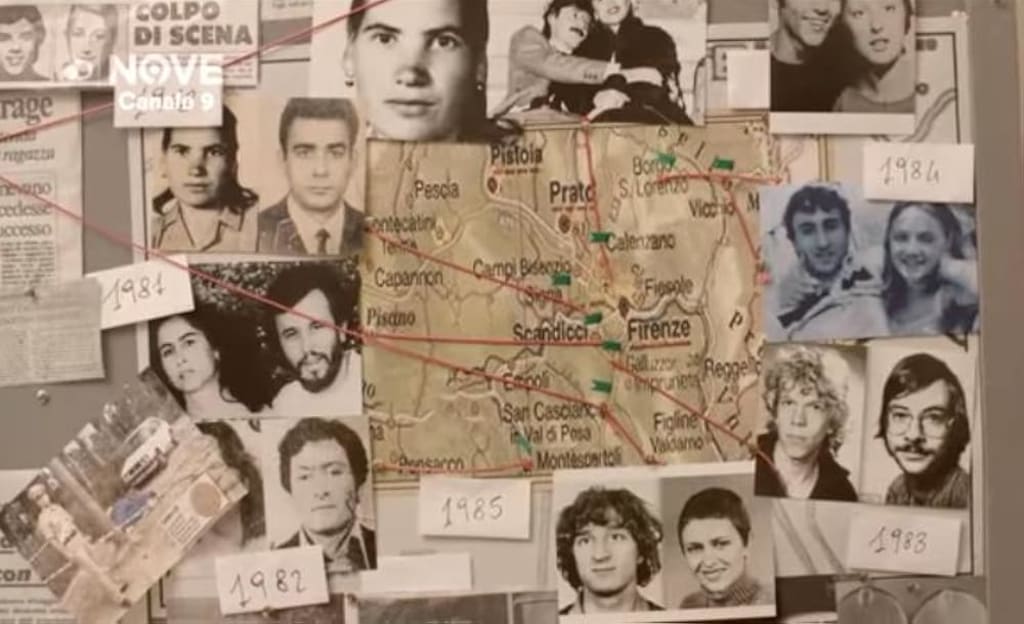
Italy, famed for its art, culture, and romance, also hides one of Europe’s most baffling and chilling criminal cases. The Monster of Florence, an elusive serial killer who terrorized the region between 1968 and 1985, left a trail of brutal murders and confusion that haunted both the police and the public for nearly two decades. The identity of the killer remained a mystery, and even today, many questions linger.
The Monster of Florence
The First Murders: A Disturbing Pattern Emerges
The first killings that would later be attributed to the Monster of Florence took place on the night of September 14, 1968. A young couple, Stefano Baldi and his girlfriend, Susanna Cambi, were found shot to death in a car near the town of San Casciano. Their bodies were found in a position that indicated a horrifying ritualistic aspect to the crime. At the time, this was considered an isolated incident, but it wouldn’t be long before similar crimes followed.
Between 1974 and 1985, the killings would become increasingly frequent and brutal. The victims were always couples, typically in secluded areas, and always shot. However, what set the murders apart was the gruesome ritualistic elements that accompanied the killings. The male victims were usually shot in the head, while the women were often mutilated in an extraordinarily violent manner. The most disturbing part was the ritualistic cutting and removal of sexual organs, a signature that led police to suspect the killings were motivated by deep psychological issues.
The Investigation: A Twisted Web of Clues and False Leads
As the murders continued, the police were under immense pressure to solve the case. However, they faced numerous hurdles. For one, the crimes seemed to defy any logical pattern. The victims came from different backgrounds, and the locations of the killings varied across Tuscany, making it difficult to establish a consistent geographical link.
The first significant break came in 1981, when investigators were able to link the crimes with the discovery of a bloody scene that pointed to a double homicide. However, despite extensive efforts, the case was no closer to being solved. For years, law enforcement chased down false leads and red herrings. Numerous suspects were questioned, but no conclusive evidence was found to tie them to the murders.
The Suspects: A Strange and Frustrating Array of Leads
One of the most notable suspects was Pietro Pacciani, a farmer from the Tuscan countryside, whose name became linked to the Monster of Florence case in the late 1980s. Pacciani had a history of violence and was arrested in 1993 after being identified as a possible suspect. However, the evidence against him was circumstantial at best. Despite being convicted of some of the murders in 1994, Pacciani’s conviction was overturned in 1996 due to insufficient evidence. He would later die in 1998, still proclaiming his innocence.
Other suspects included a man named Mario Vanni, who was allegedly involved in a bizarre cult-like group, and even a suggestion that the crimes may have been the work of a lone wolf with a deep psychological obsession with murder. The investigation would span across multiple decades, but the elusive killer seemed always just out of reach.
The Theory of a Larger Conspiracy
As years passed, the mystery of the Monster of Florence grew more perplexing. Some theorists began to suggest that the killings were not the work of a single individual but a group or even a network of conspirators. This hypothesis was fueled by the lack of solid evidence linking a specific person to all the murders, as well as the bizarre and ritualistic nature of the killings, which suggested a deeper psychological or cultural motive.
The Final Arrest: A Shocking Revelation
It wasn’t until 2000 that a breakthrough would occur. Investigators made another attempt to solve the case, this time focusing on the possibility that the killer was connected to a group of individuals rather than a lone perpetrator. DNA evidence eventually linked Mario Vanni and another individual, Giancarlo Lotti, to the crimes, leading to their arrests. Lotti was convicted of being involved in the murders and sentenced to life in prison, while Vanni was also convicted and sentenced to a lengthy prison term.
However, doubts remain. Some have questioned the validity of the evidence, and others are still convinced that the true identity of the Monster of Florence remains undiscovered.
Conclusion: A Case That Will Forever Haunt Tuscany
The murders attributed to the Monster of Florence remain one of Italy's most haunting criminal mysteries. While suspects have been convicted, the true motivations and the full scope of the killer’s actions remain shrouded in mystery. The case is a reminder of how even in the modern age, a criminal can evade capture for years, leaving a trail of devastation that is only partially understood.
As the story of the Monster of Florence continues to be discussed, it remains an unsettling reminder of the darkness that can lie hidden beneath the beauty of Italy's landscapes.
Thank you for reading. Stay informed and be aware—knowledge is the first step in understanding the darkest corners of human history. Until next time.
Kayleigh Taylor
About the Creator
Kayleigh Taylor
Kayleigh is an experienced writer with a Bachelors in Psychology. She loves true crime and crafting true crime articles, stories, and reviews on music, movies, and games.
Keep reading
More stories from Kayleigh Taylor and writers in Criminal and other communities.
The Milwaukee Cannibal
Jeffrey Lionel Dahmer, infamously known as the Milwaukee Cannibal, was an American serial killer whose gruesome crimes shocked the world. Between 1978 and 1991, Dahmer murdered 17 young men, engaging in acts of necrophilia and cannibalism. Britannica
By Kayleigh Taylorabout a year ago in Criminal
The $23,000-a-Day Question: Ephrata spends $8.5 million a year for police. What are we actually buying?
The Invoice Arrives Every year, Ephrata property owners receive a tax bill. A massive chunk of that bill goes to one place: The Police Department. We are told this is the price of safety. We are told that we have a "Gold Standard" department that warrants premium funding.
By Sunshine Firecrackerabout 21 hours ago in Criminal


Comments
There are no comments for this story
Be the first to respond and start the conversation.