
The Locksmith’s Secret
Some keys unlock more than just doors—they reveal the truths we keep hidden.
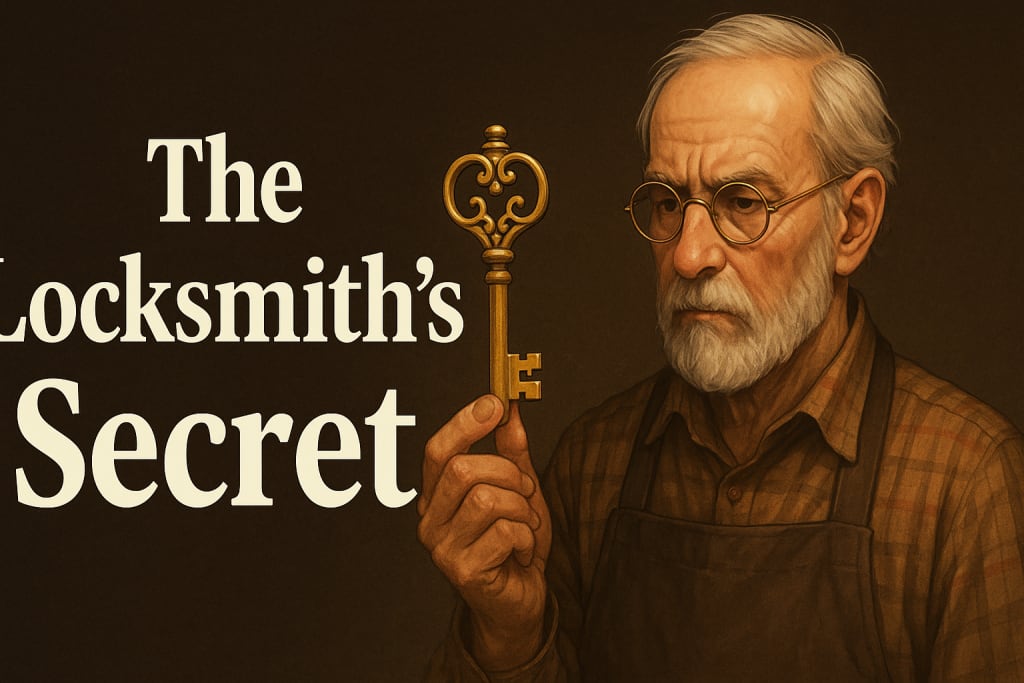
In the heart of the old town, nestled between a dusty bookshop and a bakery that always smelled of burnt cinnamon, stood a peculiar little shop with a brass sign that read: "Halvorsen & Son – Locksmiths Since 1883." The windows were clouded with age, and a small bell above the door gave a tired jingle whenever someone dared to enter.
Few people visited anymore. The younger crowd trusted digital locks and smart home apps. But the old ones still came, those with memories etched in brass keys and stories hidden behind antique safes. Mr. Halvorsen—the “& Son” long faded from relevance—was an old man with a crooked spine, thick spectacles, and hands that trembled only when they weren’t working.
He was known not just for his skill, but for his silence. People often said he could open anything, but he never asked why. Doors, chests, boxes—he opened them, then quietly returned to his corner, as if the lock had never existed.
But what no one knew was this: Halvorsen kept one key that he had never used. It sat at the back of a hidden drawer in his workshop, behind dozens of others, dull with age and nearly forgotten.
Nearly.
It had no tag, no number, no indication of what it opened. But it hummed with mystery. Sometimes, when the wind rattled the windows just right, the key would tremble softly in its drawer.
It had been given to him nearly forty years ago.
He remembered the night well. He was younger then, perhaps in his early forties, working late when a woman in a green velvet coat came in. She had eyes like frost and a voice that was hardly more than a whisper.
“I need a key made,” she said, placing a blank on the counter. “But you must never try to find what it opens.”
He raised an eyebrow. “And if it’s lost?”
She smiled, thin and hollow. “It won’t be. It will find its way back to you, if it must.”
He should have refused, but something about her—her sadness, perhaps, or the glint of something ancient in her gaze—compelled him. He forged the key that night, precise and silent, then handed it back. She touched his hand briefly, thanked him, and vanished into the rain.
The next morning, the key was back on his workbench.
Over the years, others came to his shop with unusual locks. A music box with no opening. A trunk from World War I. A cellar door in a house abandoned since the Spanish flu. Some he could open, some he could not. But he never showed them the key.
He didn’t know why he kept it. He tried to throw it away once, but it appeared the next morning in his coat pocket. He buried it under the floorboards—twice—and both times it reappeared in his drawer. He stopped trying after that.
And then, one rainy Tuesday, long after the bakery closed for good and the bookshop turned into a café, a young woman entered the locksmith’s shop.
She looked nothing like the woman in the green coat—except her eyes. Same frost. Same quiet sadness.
“I believe you have something that belongs to me,” she said, gently placing a small brass box on the counter.
It was about the size of a cigar case, intricately carved with vines and stars. No visible hinge. No seam. No keyhole.
“I don’t see a lock,” Halvorsen said, adjusting his glasses.
“You will.”
As he turned the box in his hands, the air seemed to shift. The workshop fell silent, as though the very walls were holding their breath. Then he saw it—a sliver of a hole, so narrow it might have been mistaken for a flaw in the metal.
His hands trembled, but not from age. He reached for the hidden drawer and pulled out the key.
The moment the key touched the lock, the box opened—not with a click, but with a sigh, like a secret too long withheld.
Inside was a folded piece of parchment, brittle and yellowed. The woman took it gently, unfolded it, and read silently. A tear rolled down her cheek.
“Thank you,” she whispered.
“What is it?” he asked, unable to contain his curiosity for once.
She looked at him, truly looked at him, and in her eyes he saw gratitude and grief braided together.
“My mother left me a promise. That when I was ready, I’d find what she never could. She said the key would wait, and the man who kept it would never know he was guarding her last truth.”
Halvorsen blinked, heart aching at the realization.
“She said you’d understand,” the woman added. “Even if you didn’t know why.”
“I think I do,” he said softly. “I think I always have.”
She smiled then—not sad, but serene—and walked out into the afternoon light, the box and its secret clutched to her chest.
The key didn’t return this time.
Halvorsen stared at the empty drawer, feeling something loosen in his chest. Not grief. Not joy. Just release.
He sat back in his chair, let the silence settle, and closed his eyes.
For the first time in forty years, there were no more secrets left in the shop.
About the Creator
Keep reading
More stories from Said Hameed and writers in Criminal and other communities.
Lies Carved in Stone
In the heart of the ancient kingdom of Virelia stood a monument unlike any other. A towering obelisk, obsidian black and etched with symbols too old to decipher, loomed over the square in the capital city of Iskareth. The locals called it the Pillar of Truth. For generations, people believed that the stone bore the laws and virtues upon which the kingdom was founded — justice, unity, and honor.
By Said Hameed8 months ago in Criminal
Javed Iqbal: The Monster Who Murdered 100 Boys in Six Months
Javed Iqbal Mughal stands as one of the most horrifying and prolific serial killers in modern history earning the grim distinction of being Pakistan's worst serial killer. Born around 1961 in Pakistan Iqbal came from a relatively affluent background. His family provided him with significant privileges early in life by his late teens his father had purchased a villa for him and gifted him a powerful 200cc motorbike. These luxuries would later become tools in his predatory schemes.In the early 1990s Iqbal's dark tendencies first came to light when he was arrested following allegations from one of his victims. He faced accusations of sexually abusing young boys luring them to his residence with promises of food money or shelter. However, the case did not result in lasting consequences—no formal charges stuck, and he was released. This brush with the law left a deep scar on Iqbal. He later claimed that the stress and humiliation his mother endured during his arrest and the surrounding scandal contributed to her suffering a fatal heart attack. Consumed by grief and rage Iqbal vowed revenge—not directly against the authorities, but against society itself. He declared his intention to inflict the same level of anguish on 100 other mothers by taking their sons' lives.
By Kure Garbaa day ago in Criminal
Elon Musk
I was born in South Africa, in a household where strictness and violence were the norm. While other kids played, I hid. I was beaten at school, ignored during recess, and once thrown down the stairs, ending up in a hospital bed. But these challenges didn't crush me. They made me stronger.
By Tariq Pathan 7 days ago in Criminal


Comments
There are no comments for this story
Be the first to respond and start the conversation.