
The Leah Freeman Case
A Body Left Behind, A Town Still Haunted


In the summer of 2000, 15-year-old Leah Freeman vanished from the streets of Coquille, Oregon. Her body was found weeks later, discarded on a remote dirt road. Her murder remains unsolved. But what followed...an investigation riddled with omissions, a conviction built on silence, and a payout that speaks louder than any apology...tells a story far bigger than one town.
This isn’t about blaming Coquille. It’s about confronting the machinery that failed Leah, failed Nicholas McGuffin, and failed the truth.
The Last Known Path
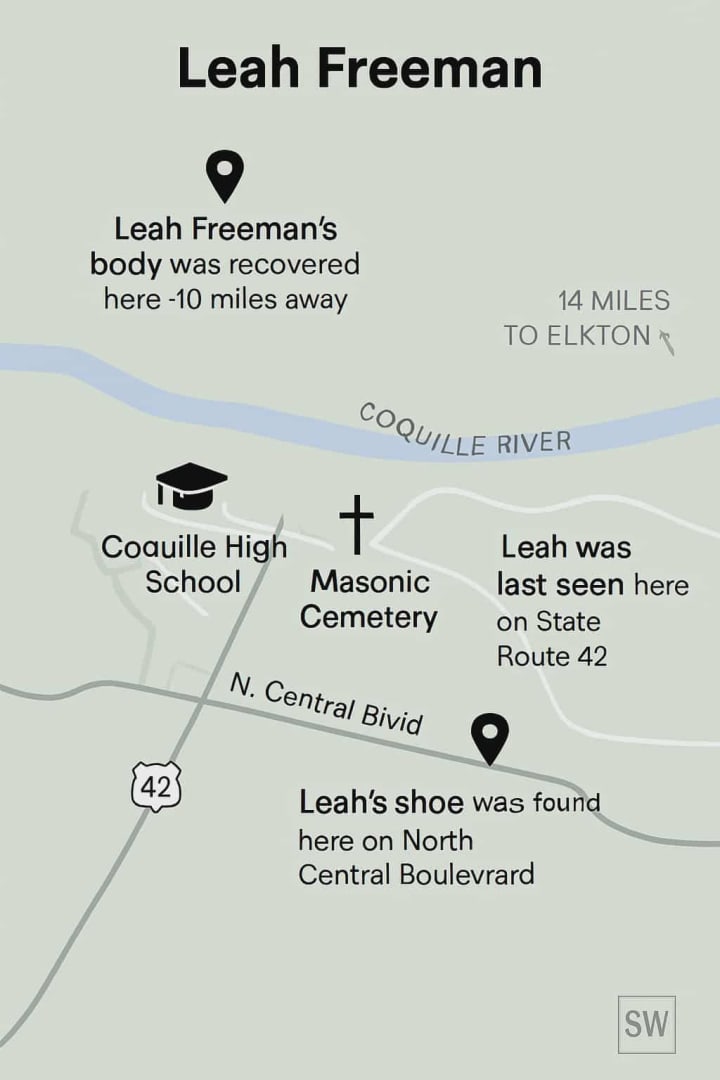
Leah was last seen walking near Coquille High School on June 28, 2000. Her right shoe was found days later on North Central Boulevard, across from Masonic Cemetery, by a mechanic who waited nearly a week to report it. Her left shoe, bloodied, was discovered nearly 10 miles away, near the site where her body was eventually recovered.
These locations form a grim map of unanswered questions. Why the delay in reporting the shoe? Why the remote disposal site? Why no physical evidence linking anyone to the crime?
The McGuffin Conviction: A Case of Circumstance

Leah’s boyfriend, Nicholas McGuffin, was convicted of manslaughter in 2011. The case was built on circumstantial evidence, community tension, and prosecutorial framing. No DNA linked him to the crime. No eyewitnesses placed him at the scene. But the narrative stuck.
What didn’t stick? The DNA evidence found on Leah’s body belongs to an unknown male. It was never disclosed to the defense.
Exoneration and Accountability

In 2019, McGuffin was released. In 2025, he received Oregon’s first certificate of innocence, a legal declaration that he was wrongfully convicted. His civil rights lawsuit led to a $14 million settlement, including $9 million from the Oregon State Police forensic lab.
This wasn’t just a legal correction. It was a public admission that the system got it wrong.
A Divided Verdict: Legal Innocence vs. Public Doubt
Despite the exoneration, public opinion remains fractured. Some believe the system got it right the first time, that McGuffin was the right suspect, and Leah Freeman was failed not by a rush to judgment, but by a reversal they view as bureaucratic overreach.
Others see the exoneration as overdue justice. They point to suppressed forensic evidence, the lack of physical links, and the multimillion-dollar settlement as proof that McGuffin was railroaded.
This divide matters. It shapes how Leah’s story is remembered, how McGuffin is treated, and how future cases in Coos County will be scrutinized. It’s not just about guilt or innocence; it’s about trust, trauma, and the long shadow of unresolved truth.
Grief, Belief, and the Weight of Silence
In a recent interview with The U.S. Sun, Leah’s mother, Cory Courtright, made her position heartbreakingly clear:
“I believe they had the right person. I believe the system failed Leah.”
She described the moment she learned McGuffin had been released:
“I dropped to my knees and screamed. I couldn’t believe it. I was in shock.”
Courtright’s grief is not just personal—it’s political. She believes the exoneration erased Leah’s voice from the courtroom.
“Leah didn’t get justice. She didn’t get her day in court.”
Her words reflect a broader tension: the legal system may have cleared McGuffin, but many still feel Leah was failed. The DNA evidence, while compelling, doesn’t erase the circumstantial weight of the original case. That the payout was a legal maneuver, not a moral resolution.
A Town Caught in the Crossfire
The people of Coquille didn’t convict McGuffin. The system did. The town’s silence, its grief, and its confusion are real. Many residents wanted justice for Leah. They still do. But justice demands transparency, not just closure.
This case isn’t a condemnation of Coquille; it’s a challenge to every institution that let this happen. From forensic labs to courtroom tactics, the Freeman case reveals how truth can be obscured by bureaucracy and bias.
What SWUSA Demands
- Release the full DNA profile of the unknown male.
- Reopen the investigation with independent oversight.
- Audit the forensic failures that led to McGuffin’s conviction.
- Honor Leah Freeman with truth, not just memory.
Leah’s story deserves more than sympathy. It deserves resolution. And Coquille deserves the chance to be part of that reckoning—not the scapegoat, but the starting point.
Silence isn't always golden. For the friends and family of Leah Freeman, it's a void that echoes. It's a neighbor who saw something and said nothing. It's a town that moved on while they stayed frozen in 2000. Silence doesn't protect the guilty. It punishes the grieving. In Coquille, Oregon, the silence has lasted for far too long.
About the Creator
Phoenixx Fyre Dean
Phoenixx lives on the Oregon coast with her husband and children.
Author of Lexi and Blaze: Impetus, The Bloody Truth and Daddy's Brat. All three are available on Amazon in paperback format and Kindle in e-book format.
Keep reading
More stories from Phoenixx Fyre Dean and writers in Criminal and other communities.
He Confessed to Murder in My DMs: The Dark Side of Going Viral
When your most-liked story becomes someone else's confession booth The message came in at 2:13 a.m. I saw the notification glow on my nightstand, that soft blue light that usually means spam, or a heart emoji, or someone asking, “Did this really happen?”
By abualyaanart4 days ago in Criminal
Magic
Note from the Author: I want to let you know that this is an unusual story, and it has been written purely from whatever is in my unconscious mind, because before I start writing, I get into a flow state that reaches my unconsciousness. I also write in my subconscious mind, which is like a mid-flow state between the conscious and unconscious mind.
By Denise Larkin7 days ago in Fiction


Comments
There are no comments for this story
Be the first to respond and start the conversation.