
The Jury Was Missing
When justice was compromised, twelve jurors vanished to expose the truth.
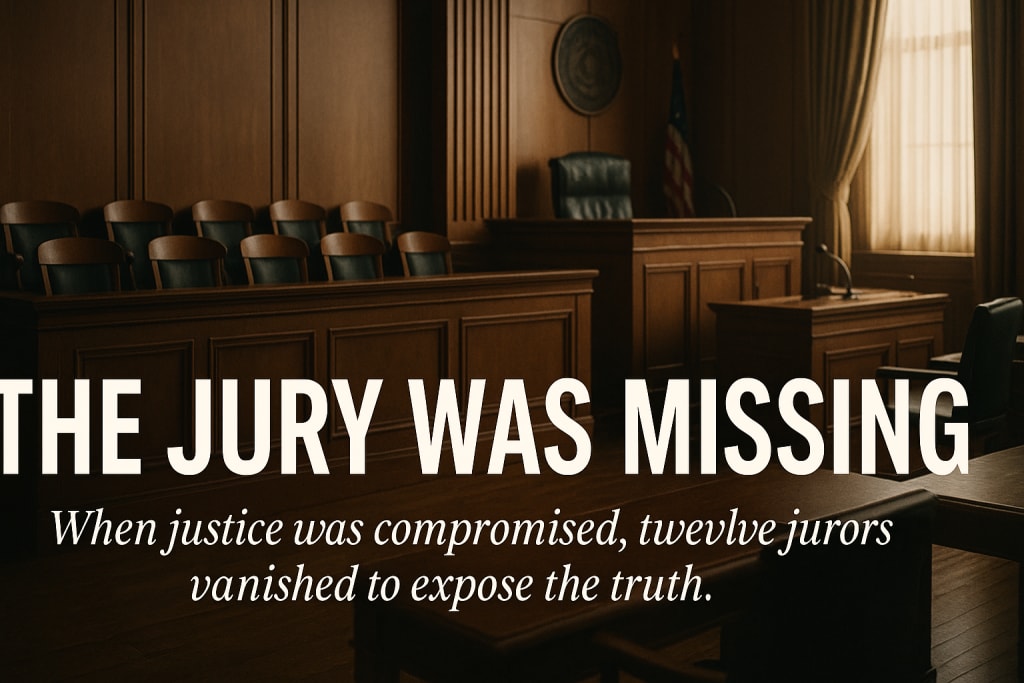
It wasn’t until the bailiff called for the jurors that Judge Albright noticed something was terribly wrong.
“Ladies and gentlemen of the jury, please return to your seats,” the bailiff announced with practiced authority.
But the courtroom remained still. No creak of benches. No shuffle of twelve pairs of shoes. Just silence and the anxious glances of spectators.
Judge Albright adjusted her glasses, eyes narrowing as she scanned the empty jury box. She leaned toward her clerk and whispered, “Where are they?”
The clerk, an efficient woman named Naomi, flipped through her clipboard and frowned. “They were accounted for before lunch. All twelve. They were escorted to the jury room as usual.”
“Bailiff,” the judge called, her voice sharp now. “Find them. All twelve.”
The bailiff hesitated only a moment before exiting briskly.
In the gallery, whispers sparked like wildfire. The defendant, Maurice Kincaid—a middle-aged man accused of orchestrating a massive cryptocurrency scam—smirked slightly at the confusion. His high-priced attorney leaned over and whispered something in his ear. Kincaid nodded, still smiling.
Five minutes passed.
Ten.
Then the bailiff returned, looking pale.
“They’re not there, Your Honor. The jury room is empty. We’ve searched the restrooms, hallway, even the stairwells. There’s no sign of them.”
A hum of disbelief rippled through the courtroom.
“What do you mean, no sign?” the judge demanded. “They couldn’t have just vanished.”
The prosecutor, a young Assistant District Attorney named Megan Tollefson, stood. “Your Honor, I request an immediate investigation. This trial is high-profile. If someone’s tampered with the jury—”
“We don’t have proof of that yet,” the defense attorney interjected, rising smoothly. “Let’s not jump to conclusions. Perhaps there was some confusion—”
“This isn’t a picnic, Mr. D’Angelo,” the judge snapped. “A whole jury doesn’t walk out for sandwiches and forget to come back.”
Tollefson turned to the judge again. “Your Honor, I suggest locking down the courthouse.”
Judge Albright hesitated for only a moment. “Agreed. Bailiff, notify courthouse security. No one in or out until we locate the jury.”
The courtroom doors slammed shut with a finality that made everyone jump.
An hour passed. Then two. Investigators poured over security footage, combed every hallway and room. Nothing. Twelve jurors had vanished without a trace between 12:47 p.m. and 1:00 p.m.—the time between lunch and when they were expected back in court.
At 3:16 p.m., a discovery was made.
“They left their phones,” one of the deputies reported. “All twelve, left behind in the jury room lockers.”
That, more than anything else, sent a chill through the courtroom. Who in 2025 left their phone behind?
“This is coordinated,” Tollefson muttered.
By early evening, the news had hit national outlets: Twelve Jurors Disappear from Federal Courtroom in High-Profile Fraud Case. Conspiracy theories flourished. Protesters gathered outside. Kincaid’s trial had become an international mystery.
The next morning, a single envelope was found taped to the courthouse doors. It was marked in looping script: To the Honorable Judge Albright.
Inside was a handwritten letter:
> Your Honor,
We, the jurors, have chosen not to participate in a system that allows criminals to buy their innocence.
We were offered money, threatened with exposure, watched in our hotel rooms. We reported it. No one believed us.
So we disappeared. We are not in danger—we are free. But we refuse to play the part of pawns in a rigged game.
If you care about justice, look closer. You’ll find the corruption runs deeper than this courtroom.
—The Jury
Judge Albright read the letter three times in her chambers before locking it in a drawer. She didn’t say anything when she returned to court. Just ordered a mistrial and adjourned the session.
Over the following weeks, a federal task force uncovered evidence of jury tampering: hacked hotel security systems, encrypted messages between unknown parties, bank transfers totaling millions routed through offshore accounts. Every line of inquiry pointed toward something deeper—something far beyond Maurice Kincaid.
But the jurors were never found.
Some claimed to have seen them—living under new names, in distant countries. One swore she saw juror #7 working as a dive instructor in Belize. Another claimed juror #3 was teaching yoga in a mountain retreat.
But the FBI closed the file after nine months. Official reason: Insufficient leads.
Unofficially, the case became legend.
Judge Albright retired quietly the following year. Megan Tollefson was promoted to Deputy DA, but her drive had changed—sharpened by suspicion and disillusionment. As for Kincaid, charges were refiled, but the new trial stalled. Evidence mysteriously went missing. Witnesses recanted. Eventually, the case was dropped.
Somewhere out there, perhaps in a cabin in the woods or a beach hut off the grid, twelve ordinary people had done something extraordinary.
They had vanished, not to escape justice—but to expose its fragility.
And for years afterward, anytime a juror hesitated before swearing their oath, a quiet fear lingered in the room:
What if the jury disappears again?
About the Creator
Keep reading
More stories from Said Hameed and writers in Criminal and other communities.
A Bullet for Every Lie
The desert sun beat down like a punishment from the gods. Sand twisted in the wind, whispering secrets long buried. Marshal Elias Thorne rode slow, his duster billowing behind him, silver badge catching sunlight like a mirror to the past. The town of Redemption lay ahead, brittle and sunburnt, its wooden bones creaking in the wind.
By Said Hameed8 months ago in Criminal
What Legal Rights Do Families Have in Alabama Wrongful Death Cases?
The sudden death of a loved one is an experience that can be hurtful to any family. The emotional and financial consequences of a loss may be even more significant when caused due to the negligence of another person or the wrongdoing committed by another person. In such cases, the law gives a means of justice to the families by the wrongful death case.
By Deborah Larson5 days ago in Criminal


Comments
There are no comments for this story
Be the first to respond and start the conversation.