
The Julia Wallace Murder — 90 Years Unsolved
The Locked Room Murder

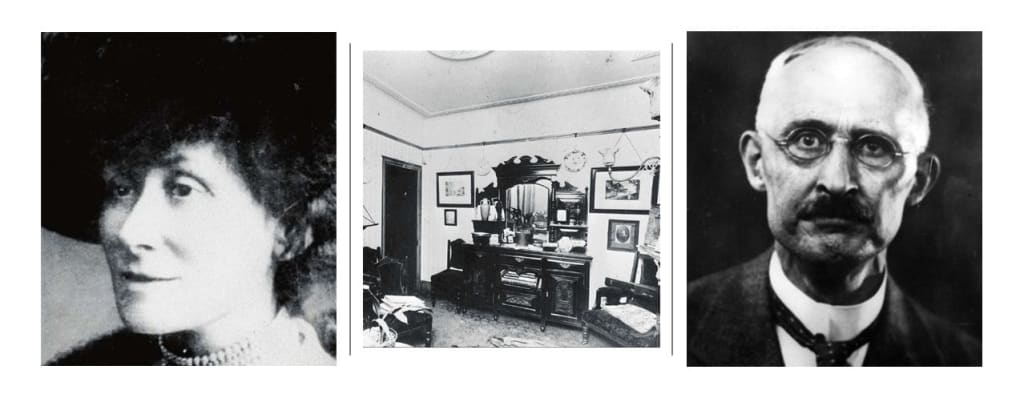
The murder of Julia Wallace, called the “Locked Room Murder” by many, has remained unsolved for over 90 years. In all the time since Julia Wallace was found murdered inside a locked room of her home, there have been many who’ve continued to search for clues. The case remains open to this day with the Merseyside Police.
In 1931, when the murder took place, William Herbert Wallace and his wife Julia lived in the Anfield area of Liverpool, England. They were noted by many to be an unusual couple. Mr. Wallace was a 52-year-old insurance salesman and part-time chemistry lecturer, known to be in perpetual ill health after having a kidney removed in 1907. Julia, 17 years his senior, was somewhat high strung, reported to be difficult, and suspicious of strangers. Their marriage was described by one former friend as “loveless and strained.”
It was in the winter of 1931 when Mr. Wallace returned home one night to find his wife violently beaten to death inside a locked room of a locked house. There was no murder weapon located and no clues that pointed to any suspect other than the one who had access to the house — her husband. Initially, Mr. Wallace was convicted of her death, but he was later released after being cleared of the crime.
The murder occurred on the evening of January 19, 1931, Mr. Wallace attended the matches taking place at the Liverpool Central Chess Club at The City Café on North John Street. Though he was a member of the club, he wasn’t a regular. In fact, this was his first appearance there in months. He was on the game schedule for the night but it wouldn’t have been the first time he missed a scheduled match.
Prior to Mr. Wallace’s arrival at the chess club, Captain Samuel Beattie answered a call and took a message from a man calling himself R. M. Qualtrough. The message was to let Mr. Wallace know that the caller would like to discuss some insurance business with him. He asked that Wallace meet him at 25 Menlove Gardens East the next night at 7:30 p.m. Beattie recorded the message on a piece of paper and handed it off to Mr. Wallace when he arrived. It is unclear why the caller was so convinced he would be there, given his spotty attendance and failure to attend for months.
After the murder, a switchboard worker at the Liverpool telephone exchange helped the police trace the call. It was placed from a phone booth a mere 400 yards away from Wallace’s home — right by where he would have caught the tram to get to the chess club location.
According to Wallace, he had gotten the message about the caller and set out in search of him, catching the 7:06 p.m. tram from Anfield to Menlove Gardens the following night. His odd behavior during the trip attracted the attention of a number of witnesses who saw him as he made his way about the southern portion of Liverpool. Two such people were the conductor and the ticket inspector, who he repeatedly reminded to tell him where he needed to get off for his stop. He seemed to want to impress on them that he was a complete stranger to this part of the city, repeating his story about the call from R.M. Qualtrough and what time he was due to meet him a number of times.
After disembarking from the tram, he continued to stop residents, visit newsagents and even one policeman he saw on duty, asking each for help in finding the location to his mysterious appointment. There was only one problem — there was no Menlove Gardens East and as the appointment time approached, this became quite clear. While there are several Menlove Gardens in the area, the streets are only listed as North, South, and West. There was never one bearing the East designation. Realizing he had wasted his time looking for an address that didn’t exist on a cold winter’s night, Wallace returned home.
Due to his strange behavior on the way to the appointment, he was well covered with people who had seen him out and about that night. In addition, there was a sighting of him on the way back home. A young typist named Lillian Hall said she saw Wallace at around 8:35 p.m. She said he was speaking to another man on Richmond Road, close to his home located at 29 Wolverton Street in Anfield.
Shortly after that time, John and Florence Johnston also saw Mr. Wallace, who appeared to be stranded outside his home. They could tell that he seemed a bit perplexed and stopped to see what was happening. He told them that the front and back doors wouldn’t open. He said the locks simply wouldn’t budge and asked if they’d heard anything unusual that night. In an attempt to assist him, the Johnstons accompanied him around to the back of his home, where he was able to unlock the door with no problem.
Upon walking into his home, lighting a lamp to see better in the darkness of the house, Mr. Wallace returned to where the Johnstons stood waiting and said, “Oh, come and see. She’s been killed.”
The Johnstons entered the home and found Julie splayed out in the sitting room by a gas fire. She had been brutally bludgeoned to death. The room would have undoubtedly been a nightmare to behold. Not only was there Julia’s savaged body lying in a pool of blood but there were blood splatters across nearby walls. Both her dress and a coat that had been laid beneath her were charred from her body’s close proximity to the fire.
Mr. Wallace stood gawking at his wife’s body before turning back to the Johnstons and stated: “They’ve finished her. Look at her brains.”
By all appearances, this was certainly the work of a burglary gone terribly wrong. A locked kitchen cupboard where Mr. Wallace kept his insurance money had been broken into and the cash was missing. That was, however, the only thing missing. Nothing else appeared to have been taken from the house, not even Julia’s handbag. It didn’t appear to have been touched at all. The only other sign of a disturbance was in the bedroom, which seemed to have been rifled through.
At the time of Julia’s murder, there was a serial burglar in the area. He had been nicknamed the Anfield Housebreaker by locals. This, however, did not fit with the other crimes he had committed in the area. John Johnston immediately contacted the Merseyside Police and they came to investigate. It didn’t take long for them to determine that the most obvious suspect in the case was Mr. Wallace himself.
Of course, their handling of the case was far from thorough. A substantial strike in 1919 had left the force shorthanded. Many officers were filling the shoes in roles they were unqualified and ill-equipped to handle. In the absence of a police photographer, a journalist from the Liverpool Daily Post was called upon to take crime scene photos. The images he captured are haunting, a gruesome reminder of the violence Julia suffered.
John Edward Whitley MacFall, a forensics expert from Liverpool University, was called upon to determine the time and cause of death. Using the early methods of determining this based on the stage of rigor mortis that had set in, Mr. MacFall stated that Julia would have died at around 8 p.m., considerably earlier than Mr. Wallace had returned home from his wild goose chase. This, of course, provided him with the perfect alibi.
Both the tram conductor and ticket inspector placed him on the tram at 7:06 p.m. and multiple witnesses saw him in the Menlove Gardens area around the time his wife would have been murdered. Additionally, witnesses back in Anfield claim to have seen Julia alive around 6:30 p.m. or 6:45 p.m. Even if the time of death was a bit off, it would have meant that Mr. Wallace had a mere 15 minutes to murder Julia, wash off the blood, change clothes and take the tram. An exam of the house drains revealed that they had not been used that night, so the killer would have had to escape covered in blood splatter, locking the doors as he departed.
The police believed that Mr. Wallace had enough time to murder his wife before boarding the tram. This was based on the fact that the time of death was later changed to indicate it could have taken place as early as 6:30 p.m. despite any proof to support the earlier time of death. They submitted as proof of this fact that they had sent out a detective to go through the motions of the murder and then run to the tram stop. It should be noted here that this detective was much younger and fitter than the ailing 52-year-old Mr. Wallace.
With no other explanation as to how Julia had come to be murdered behind locked doors and despite having a credible alibi, Mr. Wallace was charged with her murder and found guilty of murder after a brief trial in April 1931. The jury was out for barely an hour of deliberations before returning with a unanimous guilty verdict. He was sentenced to death by hanging and given an execution date for the following month.
One observer in the courtroom noted that it was likely Mr. Wallace’s demeanor that had largely led the jury to see him as guilty, stating:
“What probably harmed [Wallace] most at his trial was his extraordinary composure. Like every other observer, I found enigmatic his seeming indifference to his surroundings. Shock? Callousness? Stoicism? Confidence? We shall never know.”
An immediate appeal was lodged on the grounds that the evidence did not support the verdict. The Court of Criminal Appeal in London agreed, granting Mr. Wallace his freedom. Mr. Wallace attempted to return to his former life as best he could, but found himself still guilty in the public eye, many believing that he had “gotten by with it.” He returned to his old insurance job for a period of time but was shunned by many of his previous customers. He received hate mail and threats, forcing him to take a clerical position at his company away from the public eye.
Finding himself unwelcome in his current location, he made a move to a bungalow in Bromborough, Merseyside. Less than two years after his appeal and release, William Herbert Wallace died at Clatterbridge Hospital, succumbing to complications related to his kidney disease. He was buried at Anfield Cemetery.
No one else has ever been charged with Julia’s death and it remains open to this day. We may still not know who really killed Julia Wallace now that the case has grown so cold, but we can still hope that answers may one day be found.
About the Creator
A.W. Naves
Writer. Author. Alabamian.
Keep reading
More stories from A.W. Naves and writers in Criminal and other communities.
The Isdal Woman — A 50-Year-Old Mystery
The Isdal Woman refers to an unidentified woman who was found dead at Isdalen in Bergen, Norway on November 29, 1970. Her death was originally thought to be a suicide but speculation in the years since the discovery of her remains has led to further investigation into the circumstances surrounding her death.
By A.W. Naves4 years ago in Criminal
Convicted Murderer Escaped Prison 50 Years Ago
It is shocking to know that prison inmates had such freedom in the old days. Lester Eubanks should be in prison right now. He, instead, walked away from an inmate program 50 years ago and hasn't been seen since. By all appearances, he lived a normal life during this time. He worked, dated women, and hung out with friends. He maintained contact with his dad, Mose, until his death. He even attended his funeral. Why did Eubanks go to prison, and how did he elude authorities for so long?
By Criminal Mattersabout 11 hours ago in Criminal
Ten Days of Marriage, A Lifetime Lost: A Wake-Up Call Against Greed, Dowry, and Domestic Violence
Ten Days of Marriage, A Lifetime Lost: A Wake-Up Call Against Greed, Dowry, and Domestic Violence a relationship that only lasted ten days. A young woman who had visions of the future as she entered her new residence. After that, a shocking end: her husband killed her with a broken piece of glass following an argument about money, property, and a car.
By Farida Kabir2 days ago in Criminal
Cassie and Johnny
I’m the kind of dame you notice. I’m no femme fatale, but you can’t ignore me, at least not until I warn you about what’s coming, then everybody ignores me. Hell, they usually blame me afterwards and give Johnny all the credit for saving the day, but my Johnny couldn’t save a seat at the movies without my help. Sure, he’s brawny, but brainy? Not so much. Like that time I asked him to spot me five bucks, and he said he didn’t see it anywhere on me, and believe you me, he looked but good.
By Harper Lewis5 days ago in Critique


Comments
There are no comments for this story
Be the first to respond and start the conversation.