
The Italian Nightmare
Fear and the Axeman in 1910s New Orleans

The Axeman of New Orleans: A Century of Unanswered Screams
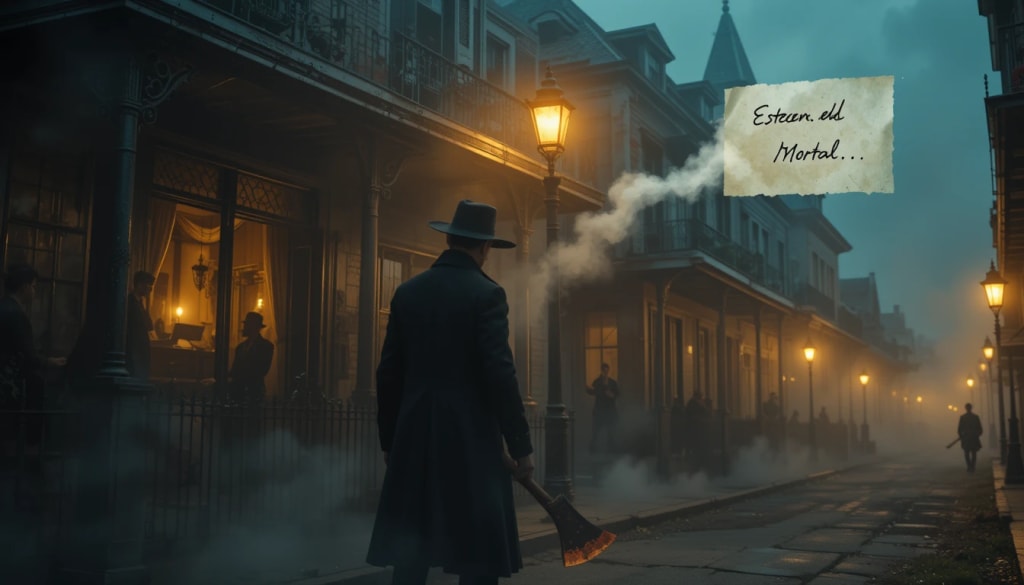
The early 20th century in New Orleans, Louisiana, was a period of vibrant cultural fusion, the birthplace of jazz, and a city teeming with life. However, beneath this lively veneer, a dark and terrifying chapter unfolded between May 1918 and October 1919. A shadowy figure, armed with an axe, crept into homes in the dead of night, leaving a trail of brutalized victims and a city gripped by an unshakeable fear. This enigmatic predator became known as the Axeman of New Orleans, and over a century later, his identity and motives remain one of America's most chilling unsolved mysteries.
The Axeman's reign of terror began, by most accounts, on the night of May 22, 1918. Joseph Maggio, an Italian grocer, and his wife, Catherine, were discovered in their apartment on the corner of Upperline and Magnolia Streets. They had been attacked with an axe, their throats slit with a razor. The brutality of the crime was shocking: Catherine was so viciously attacked that her head was nearly severed. Bizarrely, valuables were often left untouched at the crime scenes, and the murder weapon was typically an axe belonging to the victims themselves, discarded at the scene. A panel on a back door was usually chiseled out, allowing the killer silent entry.
As the attacks continued, a horrifying pattern began to emerge. The primary targets were Italian-American grocers and their families. This led to early speculation of Mafia involvement or ethnically motivated hate crimes. New Orleans at the time had a significant Italian immigrant population, and while they contributed significantly to the city's fabric, they also faced prejudice and suspicion.
The victims that followed the Maggios painted a grim tableau. Louis Besumer and his partner, Harriet Lowe, were attacked in their living quarters behind Besumer's grocery in June 1918. Lowe, who was grievously injured and later died, initially implicated Besumer, accusing him of being a German spy (this was during World War I). However, the Axeman's signature method pointed elsewhere. In August, Mrs. Ed Schneider, pregnant at the time, awoke to a dark figure standing over her. She was bludgeoned severely but miraculously survived, though she could offer little in the way of a clear description of her attacker. Later that month, Joseph Romano, an elderly man, was fatally attacked in his home. His nieces, who discovered him, caught a fleeting glimpse of a tall, dark, heavy-set man fleeing the scene.
The city's terror reached a fever pitch. Gun sales soared, and residents resorted to bolting their doors, sleeping in shifts, and arming themselves with whatever weapons they could find. The police, led by Superintendent Frank Mooney, were baffled and under immense public pressure. Leads were scarce, and descriptions of the attacker were often contradictory or vague. The Italian community, in particular, lived in a state of siege.
Perhaps the most infamous and bizarre episode in the Axeman's saga was the appearance of a taunting letter, purportedly from the killer himself. Dated March 13, 1919, and published in local newspapers, the letter was addressed to "Esteemed Mortal." In arrogant and chilling prose, the author claimed to be a "spirit" and a "demon from the hottest hell." He boasted of his invincibility and derided the police efforts. Then came the most peculiar and enduring part of the letter:
"Now, to be exact, at 12:15 (earthly time) on next Tuesday night [March 19, 1919], I am going to pass over New Orleans. In my infinite mercy, I am going to make a little proposition to you people. Here it is: I am very fond of jazz music, and I swear by all the devils in the nether regions that every person shall be spared in whose home a jazz band is in full swing at the time I have just mentioned. If everyone has a jazz band going, well, then, so much the better for you people. One thing is certain and that is that some of your people who do not jazz it out on that specific Tuesday night (if there be any) will get the axe."
Whether a genuine communiqué from the killer or a twisted hoax, the letter had an undeniable impact. On the designated Tuesday night, the city of New Orleans erupted in a cacophony of jazz. Professional bands and amateur musicians alike played in homes and public halls, hoping to ward off the Axeman's promised visit. True to the letter's "promise," no murders were reported that night. This strange event cemented the Axeman's legend and forever linked him to the city's iconic musical genre.
Despite the musical reprieve, the attacks did not cease entirely. On March 10, 1919, Charles Cortimiglia, an Italian immigrant grocer in the West Bank suburb of Gretna, and his wife, Rosie, were attacked. Their two-year-old daughter, Mary, was tragically killed. Rosie, severely wounded, controversially accused her neighbors, Iorlando Jordano and his son Frank, of the assault. The Jordanos were convicted despite a lack of concrete evidence, only to be released years later when Rosie recanted her testimony. The Cortimiglia case highlighted the desperation and confusion surrounding the investigation.
The final confirmed attack attributed to the Axeman occurred on the night of October 27, 1919, when Mike Pepitone was brutally murdered in his home. His wife, who witnessed the fleeing assailant, described a large, axe-wielding man. After Pepitone's death, the Axeman, as suddenly and mysteriously as he had appeared, vanished.
Numerous theories regarding the Axeman's identity have been proposed over the decades, yet none have been definitively proven. Some of the most prominent include:
* Mafia Connections: Given the targeting of Italian grocers, many believed the killings were organized crime hits, possibly related to extortion or vendettas within the burgeoning Mafia. However, the seemingly random and often unprofitable nature of the attacks didn't perfectly align with typical Mafia methods.
* A Lone Serial Killer: This theory posits the Axeman was a sadistic individual driven by unknown psychological compulsions, deriving pleasure from the act of killing and the terror he instilled. His apparent knowledge of his victims' homes and routines suggested some level of stalking.
* The "Man of a Thousand Faces": Some investigators and amateur sleuths have speculated that the Axeman could have been a master of disguise or even multiple individuals working together or as copycats, which would explain the varying descriptions.
* Joseph Mumfre: One suspect, Joseph Mumfre (or Momfre), an alleged Black Hand extortionist who was shot and killed in Los Angeles in December 1920 by Mike Pepitone's widow, has been a recurring figure in Axeman theories. Some believe he was the Axeman, and his death explained the cessation of the New Orleans attacks. However, concrete proof linking him to all the crimes remains elusive.
* Supernatural Explanations: In a city steeped in voodoo and folklore, it's unsurprising that some attributed the Axeman's deeds to a demonic entity, a notion the Axeman himself played upon in his infamous letter.
The lack of forensic technology at the time, coupled with the chaotic nature of the crime scenes and the intense public fear, severely hampered the investigation. The Axeman of New Orleans left behind a legacy of terror and unanswered questions. His crimes exposed societal fissures, particularly the prejudices faced by immigrant communities. The case has since become ingrained in New Orleans folklore, inspiring books, music, television shows, and countless campfire tales.
More than a century later, the Axeman's chilling promise to "claim other victims" still echoes. While his axe fell silent, the mystery of his identity and the terrifying period he lorded over New Orleans serve as a grim reminder of the darkness that can lurk beneath the surface of even the most vibrant of cities. The Axeman of New Orleans remains an enigma, a faceless specter in the annals of American true crime, his screams forever a haunting undercurrent in the city that jazz made famous.
About the Creator
A Survivor’s Final Stand: How One Woman Helped Convict Her Killer
The story of judy Malinowski is one of devastating violence personal resilience and an extraordinary fight to ensure accountability after unimaginable suffering.Judy was a young woman from Columbus, Ohio whose life, like many others was shaped by circumstances that slowly placed her in harm’s way. She had survived cancer and, during her treatment and recovery, was prescribed powerful painkillers. Over time, she became dependent on them. When her medical insurance later expired, her access to proper care and legal medication disappeared. Without the support she needed to manage both her pain and her growing addiction, she eventually turned to heroin.
By Kure Garba4 days ago in Criminal
The Man Who Stole Silence
M Mehran The city of Karachi never truly sleeps. Even at 3 a.m., when the street vendors have packed their carts and the traffic thins into an occasional growl, there is a pulse beneath the silence. It’s the hum of secrets. And in that hum lived a criminal no one could catch. His name was Farhan Qureshi, though the newspapers would later call him The Whisper Thief. Farhan didn’t carry a gun. He didn’t break locks. He didn’t leave fingerprints. What he stole was far more valuable than gold—he stole silence. For two years, the wealthiest neighborhoods of Karachi reported strange incidents. No jewelry missing. No cash gone. Yet every victim insisted something had been taken. A private conversation. A hidden confession. A secret buried in the dark. The police were baffled. Inspector Danish Malik, a decorated officer known for dismantling organized crime rings, was assigned the case. At first, he dismissed it as paranoia. “People lose money and invent drama,” he told his team. But then he listened to the recordings. Each victim had received a single audio file. In it, their most private moment—an argument with a spouse, a confession of bribery, a hidden affair—played back in chilling clarity. Attached was a simple message: “Pay for your silence.” This wasn’t theft. It was psychological warfare. It was criminal extortion crafted with surgical precision. And Farhan was brilliant. A Criminal Mind Built on Observation Farhan had once studied sound engineering at a local university. He was gifted—top of his class. Professors predicted he would work in film or music production. But talent doesn’t always walk the straight path. After his father’s sudden death, debts swallowed his family. Scholarships vanished. Dreams collapsed. Bitterness replaced ambition. Farhan discovered something during his final semester: people reveal everything when they believe no one is listening. From rooftops, parked cars, and disguised maintenance visits, he planted tiny listening devices in homes of influential businessmen, politicians, and social elites. He never targeted the poor. He chose people with reputations to protect. He didn’t rush. He collected months of conversations before making a move. He built profiles. Studied behavior patterns. Understood their fears. Unlike typical criminals driven by impulse or greed, Farhan thrived on control. And control is addictive. The First Crack in the Perfect Crime Inspector Danish noticed something others ignored. None of the devices were ever found. “Not one?” he asked his forensic team. “Not one,” they confirmed. That meant the criminal wasn’t breaking in repeatedly. He was installing something permanent—or something invisible. Danish reviewed architectural plans of the targeted houses. He discovered a pattern: all the homes had recently installed high-end smart sound systems from the same supplier. The company? EchoWave Solutions. Danish paid them a visit. The office was small, modern, and surprisingly minimal. Only three employees were listed. One of them—Farhan Qureshi. Clean record. No prior arrests. Soft-spoken. Intelligent eyes. When Danish shook his hand, he felt it—the calm confidence of a man who believed he was untouchable. Psychological Cat and Mouse Danish didn’t arrest him immediately. There was no direct evidence. Instead, he started surveillance. Farhan, however, sensed it. Criminal psychology often reveals a dangerous truth: the smartest criminals are hyper-aware. Farhan noticed the unmarked car parked across his apartment. He noticed the unfamiliar number calling and hanging up. So he escalated. Instead of extorting quietly, he released a politician’s secret recording publicly. It exploded across social media. News channels debated ethics, privacy, and corruption. The city panicked. Was he a villain—or a vigilante exposing hypocrisy? That moral confusion protected him. Some citizens secretly admired him. “He only targets the corrupt,” online forums argued. But Danish knew better. A criminal who justifies his actions is still a criminal. The Mistake Every Criminal Makes Arrogance. Farhan believed he understood fear better than anyone. But he underestimated something—human unpredictability. One of his victims refused to pay. Instead, she invited him to release everything. Her name was Samina Rahman, a school principal with nothing to hide. Farhan sent the audio. It was harmless—her crying over financial struggles, her doubts about leadership. Instead of shame, she received sympathy. The public response shifted. If he could invade her privacy, he could invade anyone’s. Now fear replaced fascination. Danish used that moment. He publicly announced a digital trace had been found—bluffing. He described a fictional encryption flaw in the criminal’s system. Farhan panicked. Not outwardly—but digitally. He logged into his secure server from a backup connection he believed was untraceable. It wasn’t. Cybercrime units tracked the IP to a warehouse near the port. Inside, they found walls lined with monitors. Audio feeds labeled with names. Dates. Addresses. And Farhan. He didn’t run. He simply removed his headphones and said, “You’re late.” Inside the Criminal’s Mind During interrogation, Farhan remained composed. “Why?” Danish asked. Farhan’s answer was chilling. “Because silence is power. The wealthy use it to hide corruption. I just borrowed it.” “But you sold it,” Danish replied. Farhan smiled faintly. “Everyone sells something.” Psychologists later analyzed him as highly intelligent, emotionally detached, and morally rationalizing—traits common in non-violent white-collar criminals. Yet what made him truly dangerous wasn’t cruelty. It was patience. The Aftermath The case became one of Karachi’s most discussed criminal investigations. It reshaped conversations about digital privacy, surveillance, and smart home vulnerabilities. EchoWave Solutions shut down. New cybersecurity laws were proposed. And Farhan Qureshi was sentenced to twelve years in prison for extortion, illegal surveillance, and cybercrime. But even behind bars, rumors circulate. Some say he’s writing a book. Some say he’s helping authorities understand criminal behavior. Others whisper that he left hidden recordings no one has found. Because the scariest criminals don’t always steal money. They steal peace of mind.
By Muhammad Mehrana day ago in Criminal



Comments (1)
The Axeman of New Orleans case is seriously creepy. The way he got in through the chiseled door panels is so calculated. And the fact that valuables were often left alone makes it even weirder. I wonder what really drove him to target those Italian - American grocers. Was it something personal or part of a bigger, more twisted plan?