
The Irish Immigrant Who Took the Life of Her Employer for Money and Love
Grace Marks servant and killer, or was she?

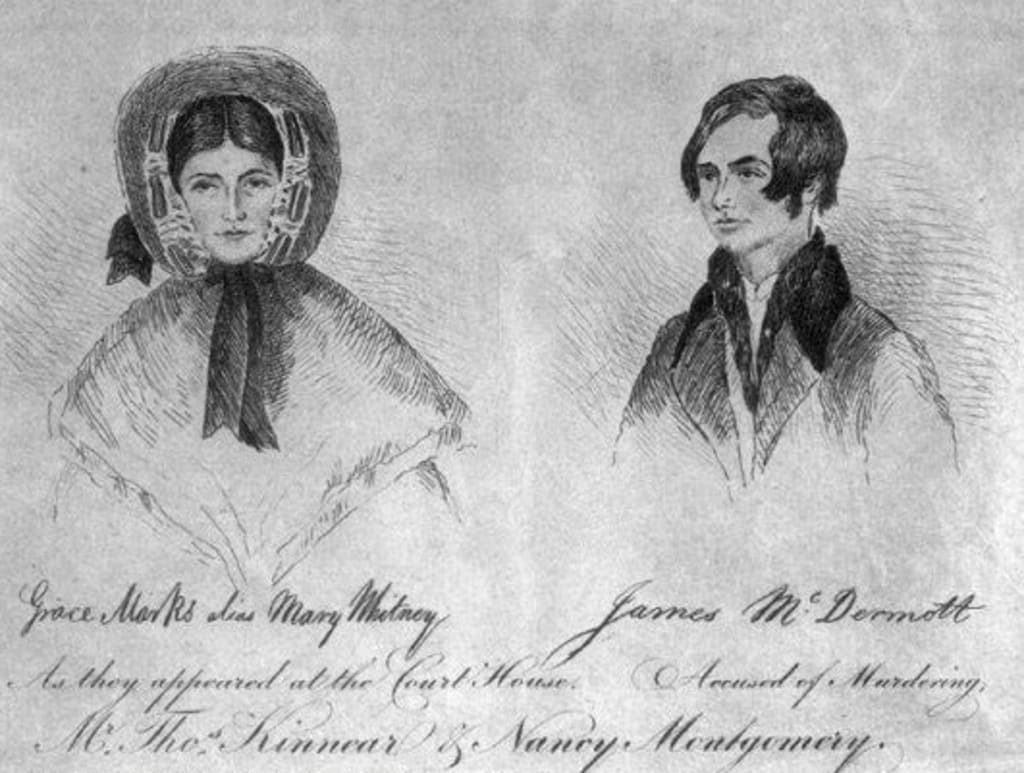
Grace Marks was an Irish immigrant maid who murdered her employer Thomas Kinnear and his housekeeper Nancy Montgomery in Richmond Hill, Ontario. Little facts remain about the case; much is speculation due to the contrasting stories given by the co-defendants.
Tried and convicted with the stable hand, James McDermott. The case sparked much debate, was Marks as guilty of murder as McDermott or was she an unwilling accessory?
Early Life
Marks was born in Ulster, Ireland. Her father was a stonemason and an abusive alcoholic. In 1940, Marks, along with eight siblings and her parents, immigrated to Canada, she was twelve years old. Unfortunately, her mother died en route and was buried at sea. This event changed the course of Marks life as she was now the primary female caring for her siblings.
It wasn’t long before she took several positions as a servant for the wealthy. This profession led her to the employment of Yonge Street farmer Thomas Kinnear.
The Murder
Kinnear was not your typical employer, having a relationship with his housekeeper, Montgomery. The disagreement between the parties allegedly started as Montgomery would constantly criticise McDermott’s work. McDermott, a former soldier, found it hard taking orders from a woman. Before the murder, Montgomery informed him that he would have to leave as he had not passed his probation.
In July 1843, Montgomery was hit in the head with an axe whilst Kinnear was away. McDermott dragged her to the cellar where she was strangled to death, dismembered and hidden under a tub. She was pregnant at the time of her death with Kinnear’s child.
On return to the house, Kinnear was shot by McDermott, an Irish immigrant, and Marks fled to America with money and the belongings of Kinnear. Whilst on the run, Marks would use the alias of Mary Whitney.
Marks claimed she tried to run away from the house after Kinnear was killed, prompting McDermott to shoot at her. Witnesses testified to finding a ball from the weapon lodged in a door near the kitchen. On the other hand, McDermott flipped the narrative in his testimony, insisting that Marks had goaded him until he agreed to help her commit the murders.
Shortly after entering the US in Lewiston, New York, the couple was apprehended and deported to Toronto to face charges.
The Trial
Although both parties were tried for the murder of Kinnear, it is unclear what role each took in the double murder. Kinnear had been shot with his gun, which McDermott admitted; however, he would state that Marks strangled Montgomery. The fact was irrelevant as obtaining a conviction for both on Kinnear’s murder resulted in neither being tried for Montgomery’s death.
Marks showed no emotion during the trial, although she was said to faint as her sentence was readout. Ironically she appeared in court wearing the stolen clothes of Montgomery.
Both were sentenced to be hung; however, campaigners appealed for leniency on Marks behalf, saying that she was only sixteen and had been under the influence of McDermott. As a result, her sentence was commuted to life imprisonment. McDermott, only twenty himself, was not so lucky and was hung in front of a large crowd.
The Aftermath
The case was popular with the press of the time for its scandalous nature. The two victims are in a relationship and coming from opposite sides of the economic scale. The two murderers, who may have been lovers, killed their employer.
Marks spent thirty years in prison, one year of which was spent in the asylum. Records do not state why, although the head of the institution would say she was faking her illness.
Many argued for her innocence; in 1872, she was pardoned and released. When asked, on release, what had been the cause of her misfortunes and crime? Marks was concise in her reply: “Having been employed in the same house with a villain.”
She travelled to New York with the prison’s warden and was set up in a home there. Shortly after, she changed her name and disappeared from the public record. Nothing is known of what became of her.
The subject of Margaret Atwood’s book Alias Grace, her case still brings about much speculation. Was Marks caught up with a man she had romantic feelings for? Was she scared for her life, choosing to become an accessory to murder or was she a cold, brutal sociopath?
Sources
- Margaret Atwood: Alias Grace: London: Bloomsbury: 1996: ISBN 0–7475–2787–3
- https://www.smithsonianmag.com/arts-culture/mysterious-murder-case-inspired-margaret-atwoods-alias-grace-180967045/
- https://annamazzola.com/an-historical-enigma-the-real-grace-marks-and-alias-grace/
If you enjoyed this article, please subscribe to my writing, share it and give it a heart. As a writer tips and pledges mean a great deal to me, so a massive thank you if you send one.
About the Creator
Sam H Arnold
Fiction and parenting writer exploring the dynamics of family life, supporting children with additional needs. I also delve into the darker narratives that shape our world, specialising in history and crime.
Keep reading
More stories from Sam H Arnold and writers in Criminal and other communities.
How One Man Convinced his Wife to Murder his Girlfriend
Ashley Christine Humphrey was convicted in 2006 of the murder of Sandra Rozzo. She received a sentence of twenty-five years for pulling the trigger that killed. Her husband was convicted of the same murder and received a life sentence, even though he was nowhere near the murder scene and had an alibi for the night of the killing. Why did this happen?
By Sam H Arnold4 years ago in Criminal
The Facebook Marketplace of Horrors: Inside the groups where bones are traded like baseball cards.
It Wasn't the Dark Web When we hear about the illegal sale of human body parts, we imagine the "Dark Web"—encrypted Tor browsers, Bitcoin wallets, and shadowy Russian servers. The terrifying reality of the Jonathan Gerlach case is that he wasn't hiding in the digital shadows. He was hiding in plain sight.
By Sunshine Firecracker5 days ago in Criminal
What DHS Secretary Kristi Noem said vs. what the videos show
NBC News and PBS recapped the competinBelow is a structured, evidence-backed analysis of the Minneapolis ICE shooting and the claims made by DHS Secretary Kristi Noem—including the applicable federal laws/policies and how intent vs. recklessness factor into a potential case. I’ll keep this clear, precise, and grounded in the video evidence and governing law.
By Organic Products 7 days ago in Criminal
How to Succeed at the Benson Directory®
Congratulations and welcome to the Benson Directory® employee #22391! As our newest call handler, you will have the privilege of speaking with dozens of unique and interesting people on a daily basis as well as the opportunity to earn bonuses for high performance. Contained within this handbook you will find a set of ease to follow instructions designed to help you settle in to your new role and begin paving the way to success.
By S. A. Crawford3 days ago in Fiction




Comments
There are no comments for this story
Be the first to respond and start the conversation.