
The Informant’s Widow
One woman’s quiet rebellion to expose the truth her husband died to protect.
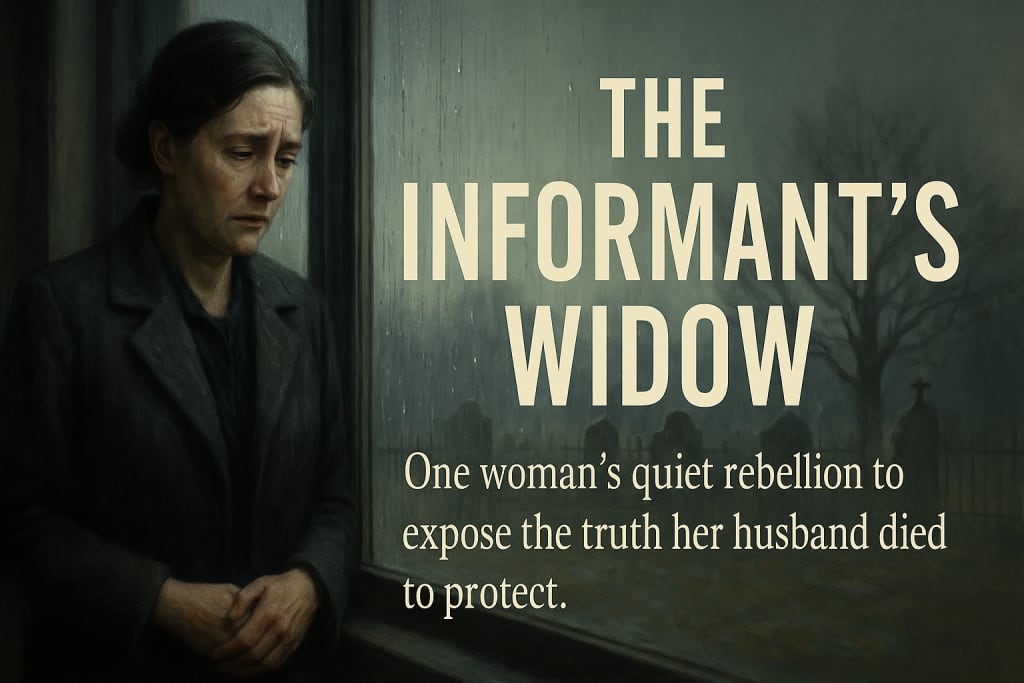
The rain hadn’t stopped in three days.
Margaret Halloran stood at the window of her modest two-bedroom home on the outskirts of Belfast, watching the mist collect over the crumbling headstones of the graveyard across the lane. Somewhere beneath that ancient sod lay Michael Halloran, her husband of seventeen years, and the man everyone now called a traitor.
Three weeks ago, he was simply Michael — quiet, dependable, stubborn as stone. He had taught history at the local secondary school, knew every battle and every treaty that had ever touched Irish soil, and drank his tea with a biscuit precisely at four o’clock. Now, even his name was whispered with venom on neighborhood streets.
The men who came for him wore no uniforms. They didn’t have to. Margaret had known, the moment she saw the van idling at the curb, who they were and what they wanted. She had watched from behind the curtain as two of them stepped out, their faces hidden by scarves, and another remained behind the wheel, engine humming like a warning. Michael, to his credit, didn’t run. He stepped outside, coat in hand, and closed the door quietly behind him.
She never saw him again.
The papers called him an informant, claimed he had been feeding information to British intelligence for years — names, meeting places, weapons shipments. She’d read the headlines in disbelief, her hands trembling as she traced each syllable. The same hands that had folded his shirts, pressed his collars, held him during long, sleepless nights when the bombs were too close and the air too thick with smoke.
The neighbors stopped speaking to her within days. Mrs. O’Reilly, who used to bring soda bread every Sunday after mass, crossed the street when she saw Margaret walking her dog. The priest offered condolences, but not the church for a funeral. And Father Callum had baptized both her sons.
Margaret buried Michael alone, with only the gravedigger for company.
What they didn’t know — what none of them could possibly know — was that Michael had told her everything.
Two years ago, after an anonymous note appeared under their door warning him to “stay loyal or stay dead,” Michael had confessed over a glass of whiskey. He wasn’t proud of what he’d done. But he'd seen too many young boys, barely men, thrown into violence for causes they barely understood. He’d watched families burn, watched children scream over the lifeless bodies of fathers, uncles, brothers. It had become too much.
“I’m trying to stop the killing,” he’d said, his voice cracking like old leather. “I’m not betraying my people. I’m trying to save them.”
Margaret had wept, quietly, into her hands.
And then she had done the unthinkable — she’d told him she understood. She still loved him.
Now, three weeks a widow, Margaret found herself at the kitchen table sorting through his things. There was a key — small, brass, unmarked — hidden in the lining of his jacket. Taped beneath the drawer of his desk was a single slip of paper with a name and an address in Derry. No instructions. Just that.
She considered burning it. Pretending she’d never seen it. But Michael’s voice echoed inside her, not in words but in the silence he had left behind — a silence that demanded action.
Three days later, she boarded a morning train north.
The address belonged to an aging apartment block with peeling paint and a broken lift. On the fifth floor, she found a woman no older than thirty, with sharp eyes and a baby on her hip. The woman said nothing as Margaret held out the paper, hand trembling. But something passed between them — recognition, maybe, or grief.
“You’re his wife,” the woman said flatly.
Margaret nodded.
The woman let her in.
There, amid the clutter of toys and ashtrays, she handed Margaret a manila envelope. “He said to give this to you if anything ever happened. I didn’t ask questions. Don’t intend to now.”
Margaret accepted the envelope with both hands, as if it might explode.
Inside were photos. Documents. Names she didn’t recognize. Some she did. Men with polished suits and double lives. Officers. Arms dealers. Journalists. And tucked inside the pages, a handwritten letter from Michael.
“If you’re reading this, it means they got to me. I never wanted to put you in danger. But if this reaches you, it’s because someone believes in what I was doing. Don’t let them bury the truth with me.”
Margaret pressed the letter to her lips, her tears smudging his ink.
Back in Belfast, she didn’t return home. She checked into a small boarding house under her maiden name, and by the end of the week, she’d mailed anonymous packages to two foreign journalists who had once tried to interview Michael — ones he’d turned away out of fear.
She didn’t include her name. Didn’t need to.
When the story broke a month later — implicating not just paramilitary leaders but also political figures and intelligence handlers — it sent shockwaves through Ireland and beyond. Some saw it as betrayal. Others as revelation. Either way, the truth was out.
And in the quiet corners of Belfast, where whispers once followed her like shadows, people began to speak her name with a different kind of hush.
Not with hate.
But with something closer to reverence.
The informant’s widow had finished what he started.
About the Creator
Keep reading
More stories from Said Hameed and writers in Criminal and other communities.
The Priest’s Other Life
Father Dominic was the kind of priest who made people believe again. Not just in God, but in kindness, in redemption, in something more than their tired little lives. His sermons were poetic and raw, his hands calloused from helping rebuild homes after storms, and his voice calm in times of crisis. He wore the collar with sincerity, not superiority. To his parishioners at St. Augustine’s, he was a saint in waiting.
By Said Hameed8 months ago in Criminal
Factory of Fear: The Escape and 21-Year Manhunt of America’s “Most Wanted” Terror Suspect
In the tense years following the September 11 attacks, the United States launched one of the largest counterterrorism operations in modern history. Intelligence agencies tracked suspects across continents, tightened airport security, and expanded surveillance networks. Yet, amid this sweeping effort, one man accused of building explosives inside his car managed to disappear — evading capture for more than two decades.
By Irshad Abbasi 7 days ago in Criminal




Comments
There are no comments for this story
Be the first to respond and start the conversation.