
The Ghost in the Woods: The Unsolved Death of Hazel Drew and the Real Story Behind Twin Peaks
The True Crime That Inspired a Cult Classic—and Still Haunts Today


Hazel Drew’s story is the kind that sticks to your ribs, sticks in your mind. It’s a tale of a young woman found dead in the woods, a small town full of secrets, and a mystery that’s never been put to bed. Long before TV’s Twin Peaks made “Who killed Laura Palmer?” a national obsession, the real question was, “Who killed Hazel Drew?” This is the story of a life cut short, a case that went cold, and the shadows that linger more than a century later.
Who Was Hazel Drew?
Hazel Irene Drew was born in 1888, the daughter of a working-class family in Sand Lake, New York. She was smart, ambitious, and—by all accounts—easy on the eyes. Hazel worked as a domestic servant, but she had bigger dreams than scrubbing floors. She moved in circles that didn’t always match her station, and she had a knack for making friends in high places. Some called her a flirt. Others said she was just friendly. Either way, Hazel was a young woman trying to carve out a life for herself in a world that didn’t offer many options in that day and age.
Hazel’s life wasn’t all sunshine. In fact, it was a bit chaotic. Her mother died when she was young, and her father remarried. She bounced between relatives, never quite settling in a permanent home. By her early twenties, she was working as a domestic for a wealthy family in Troy, New York. She dressed well, saved her money, and liked to take the trolley into town. She was independent, but not reckless. At least, not on the surface. As far as was known.
The Night Hazel Disappeared
On July 7, 1908, Hazel told her aunt she was heading to Troy to visit friends. She never made it. Witnesses saw her walking along Taborton Road, a lonely stretch near Teal’s Pond, just outside Sand Lake. She wore a stylish blue dress and carried a small handbag. Some said she looked troubled. Others said she looked as if she was just out for a stroll. Either way, Hazel vanished into the woods that night, and the town she left behind would never be the same.
Four days later, two boys fishing at Teal’s Pond spotted something floating in the water. It was Hazel. Her body was badly decomposed, but the coroner found a deep wound on her head. She’d been killed, no question about it. The only real question was why—and by whom.
The Investigation: More Questions Than Answers
Rensselaer County Sheriff Fred Stevens had his work cut out for him. Sand Lake was a small town, the kind of place where everyone knew everyone else’s business. But when it came to Hazel, nobody seemed to know much at all. Or maybe they just weren’t talking.
The investigation turned up a tangled maze of leads. Hazel’s last days were a blur of trolley rides, secret meetings, and whispered conversations. She’d withdrawn money from the bank, bought a train ticket she never used, and sent cryptic letters to friends. Some said she was running from someone. Others thought she was planning to leave town for good.
The list of suspects grew by the day. There was William Taylor, the married man who’d been seen with Hazel in the weeks before her death. There was Frank Smith, the local farmhand with a temper and a grudge. There were rumors of a mysterious stranger, a “man in a straw hat,” seen lurking near the pond. Even Hazel’s own family came under suspicion. But every lead seemed to fizzle out, and every alibi had just enough wiggle room to keep the case cold.
The press had a field day. Reporters from Albany and New York City descended on Sand Lake, turning Hazel’s death into front-page news. They painted her as a femme fatale, a small-town girl with big-city secrets. The truth was probably less dramatic, but no less tragic.
Theories, Rumors, and Small-Town Secrets
Over the years, the theories about Hazel’s death have piled up like autumn leaves. Some say she was killed by a jealous lover. Others think she stumbled onto a secret she wasn’t supposed to know. There are whispers of blackmail, abortion, and even political intrigue. The truth is, nobody knows for sure.
One theory holds that Hazel was pregnant, and that her killer wanted to keep it quiet. Another suggests she was blackmailing someone—maybe a wealthy employer, maybe a local politician. There’s even talk of a secret diary, hidden somewhere in the woods, that holds the key to the whole mystery. But if that diary exists, nobody’s ever found it.
The most likely scenario is the simplest: Hazel trusted the wrong person. Maybe she agreed to meet someone at the pond that night, thinking she could handle whatever trouble was coming her way. Maybe she was wrong.
The Case Goes Cold
By the end of 1908, the investigation had stalled. The coroner’s inquest ruled Hazel’s death a homicide, but the case file gathered dust as cold case files do. Witnesses changed their stories, suspects lawyered up, and the town moved on. Hazel was buried in a quiet cemetery, her grave marked by a simple stone. The woods around Teal’s Pond grew thick again, swallowing up whatever secrets they held.
But the story didn’t die. Every so often, someone would claim to have solved the case. A new theory would make the rounds, and a new suspect would be named. But the truth stayed buried, just out of reach.
Hazel Drew and the Birth of Twin Peaks
Decades later, Hazel’s story found new life in the unlikeliest of places: television. Mark Frost, co-creator of Twin Peaks, spent summers as a kid near Sand Lake. His grandmother used to tell him stories about the “ghost in the woods”—the unsolved murder of Hazel Drew. When Frost and David Lynch set out to create a show about a small town rocked by the murder of a young woman, Hazel’s story was never far from his mind.
Laura Palmer, the doomed homecoming queen at the heart of Twin Peaks, owes more than a little to Hazel Drew. Both were young, beautiful, and full of secrets. Both were found dead in the woods, their lives cut short by violence. And both left behind a town full of people who knew more than they let on.
The parallels don’t end there. The woods around Twin Peaks are thick with mystery, just like the woods around Teal’s Pond. The show’s mix of small-town gossip, hidden affairs, and supernatural overtones echoes the real-life rumors that swirled around Hazel’s death. Even the show’s famous log lady has roots in the local legends of Sand Lake.
Why Hazel’s Story Still Matters
So why does Hazel Drew’s case still haunt us, more than a century later? It’s the perfect true crime, mystery, cold case story. Part of it is the mystery, the other is the intrigue. We’re drawn to stories that don’t have easy answers, that leave room for speculation and debate—this story is true crime gold. Hazel’s death is a puzzle with too many missing pieces, a story that refuses to be tied up with a bow.
But there’s more to it than that. Hazel’s story highlights the dangers faced by women of that time. By women who stepped outside the lines, who tried to make their own way in a world that was not built for them. It’s about the secrets kept, the lies told, and the price paid for both. It’s about the way small towns close ranks when trouble comes calling, and the way the truth can get lost in the shuffle.
Hazel Drew was more than a victim. She was a young woman with dreams, flaws, and a stubborn streak. She deserved better than what she got. And maybe that’s why her story still resonates today—even becoming a popular TV show.
The Legacy of Hazel Drew
I am sure Hazel’s death changed Sand Lake forever. I am sure parents warned their daughters not to walk alone at night. The woods around Teal’s Pond became a place to avoid, a spot where the past evil perpetrated there felt too close for comfort. The case faded from the headlines, but it never really went away for the good folks of Sand Lake, New York.
In recent years, true crime buffs and Twin Peaks fans have rediscovered Hazel’s story. Podcasts, books, and documentaries have picked over the details, searching for answers that still won’t come forward. Of course, the internet has given new life to old rumors, and every so often, someone claims to have cracked the case. But the truth remains as slippery as the mud at the bottom of Teal’s Pond.
What we’re left with is a story that refuses to die or give up the murderous truth. Her story is a reminder that some mysteries never get solved, and that the past is never as far away as we think.
Conclusion: The Woods Are Never Silent
Hazel Drew’s murder is more than a cold case. It’s a mirror held up to the secrets we keep and the stories we tell ourselves about justice, innocence, and the price of silence. The woods around Teal’s Pond are quiet now, but they remember Hazel Drew. Maybe, just maybe, because the woods still feel her walking among the trees. But, I digress. I am a true crime writer, not a teller of ghost stories. So, please, don’t take my word for it.
If you find yourself drawn to the story of Hazel Drew, you’re not alone. Her case is a thread that runs through the heart of American true crime, a reminder that the line between fact and fiction is thinner than we’d like to admit. The next time you watch Twin Peaks, remember the real girl at the heart of the story—the one who never made it home.
Hazel Drew’s life was short, but her story endures. Maybe that’s the best any of us can hope for: to be remembered, even when the world moves on. The woods are never silent, and remember. Every crime has a story. My mission. Tell it.
Follow Up With A True Crime Read
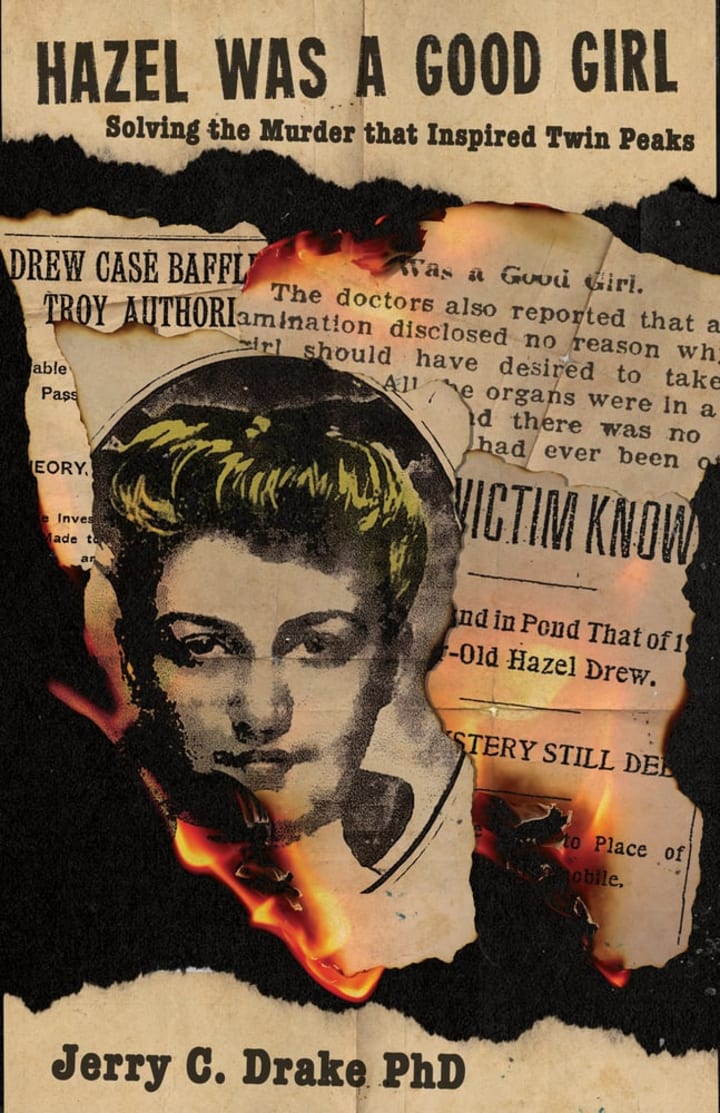
If you want to get past the rumors and dig into the real story behind Hazel Drew—the case that lit the fuse for Twin Peaks—the book “Hazel Was A Good Girl” by Jerry C. Drake is where you start. It doesn’t just skim the headlines or recycle old ghost stories. The authors roll up their sleeves and get into the weeds: court records, family secrets, and the kind of small-town politics that never make the papers. You’ll meet Hazel as more than a victim—she’s a flesh-and-blood woman, caught in the gears of her own time.
This book isn’t a dry history lesson. It’s a walk through the backroads of upstate New York, where every neighbor has a theory and the woods never quite let go of their dead. If you’re the type who likes your true crime with real stakes and no easy answers, this book delivers. Click here to pick up a copy and see for yourself why Hazel Drew’s story still keeps people up at night.
If you enjoy my writing, would you consider a tip of $1.00, $2.00, or $3.00 using the Vocal Media tipping link? Thank you!
This post may contain affiliate links. If you click on these links and make a purchase, I may earn a commission at no additional cost. I only recommend products or services that add value to my readers.
Remember to visit MJonCrime on YouTube for Videos, Shorts, and our MJonCrime Podcast. Also, visit MJonCrime True Crime Reads for great True Crime books for your True Crime reading pleasure.
About the Creator
MJonCrime
My 30-year law enforcement career fuels my interest in true crime writing. My writing extends my investigative mindset, offers comprehensive case overviews, and invites you, my readers, to engage in pursuing truth and resolution.
The $23,000-a-Day Question: Ephrata spends $8.5 million a year for police. What are we actually buying?
The Invoice Arrives Every year, Ephrata property owners receive a tax bill. A massive chunk of that bill goes to one place: The Police Department. We are told this is the price of safety. We are told that we have a "Gold Standard" department that warrants premium funding.
By Sunshine Firecracker3 days ago in Criminal
Man Escaped Death Row, But He Could Not Escape Death: The Story of Troy Leon Gregg
The story of Troy Leon Gregg is one of the most haunting and ironic episodes in the history of the American criminal justice system. It is a narrative that seems almost fictional in its cruel symmetry: a man sentenced to die by the state escapes death row mere hours before his scheduled execution only to lose his life later that same night in a violent confrontation. Gregg’s story continues to resonate not only because of its dramatic events, but also because of the deeper questions it raises about fate, justice, violence, and the limits of human escape.Troy Leon Gregg was a death row inmate in the state of Georgia, convicted of serious crimes that ultimately led to a capital sentence. After years of legal proceedings and appeals, his execution date was set. For the prison system it was meant to be the final chapter in a long process. For Gregg, however the night before his execution would take an unexpected and shocking turn.
By Kure Garbaabout 6 hours ago in Criminal


Comments
There are no comments for this story
Be the first to respond and start the conversation.