
The Experiment
A mysterious home conceals a sinister past
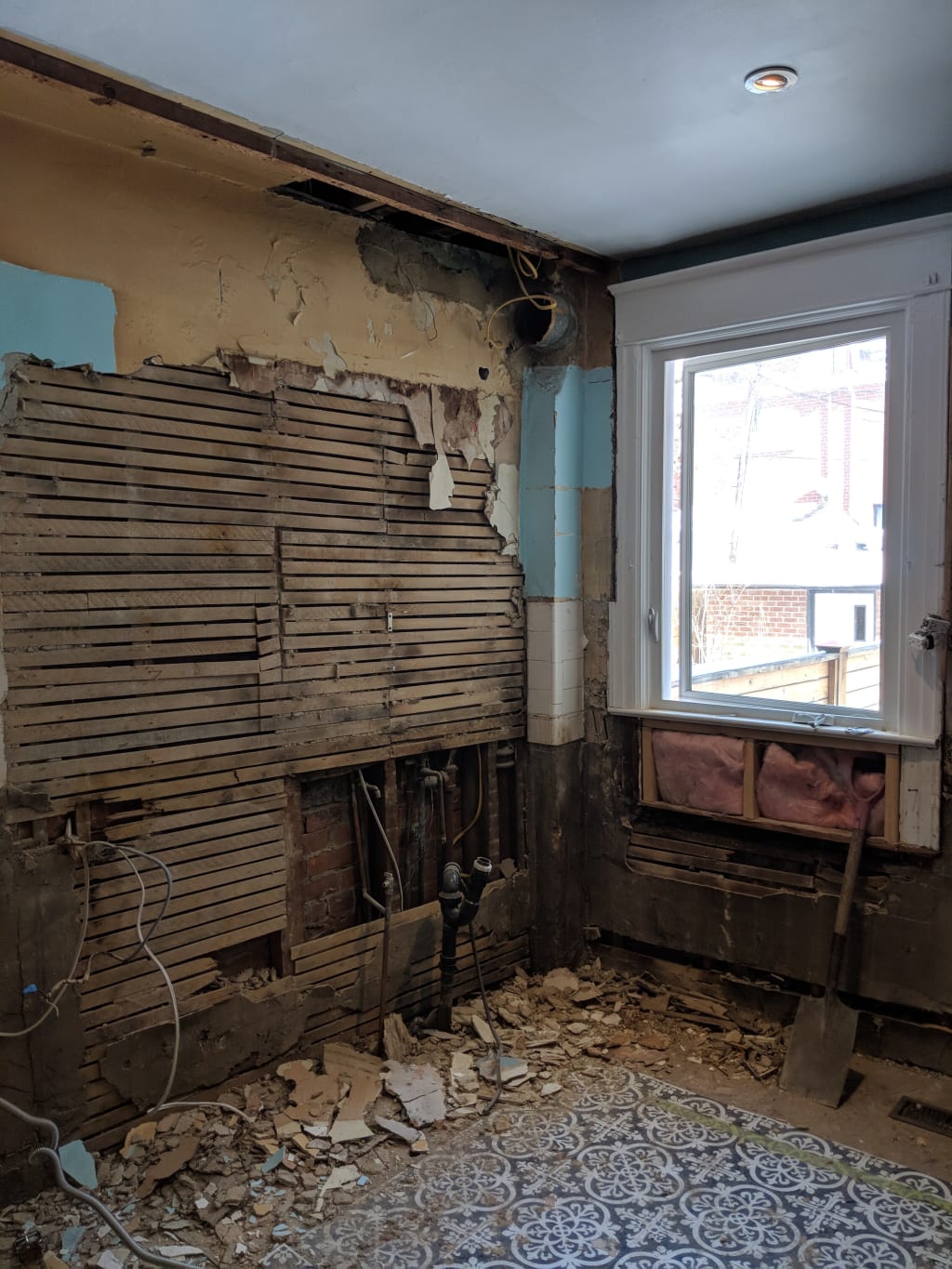
It never would have happened if they hadn’t decided to retile their bathroom.
One thing led to another and before they knew it, they were completely re-doing the little bungalow they had just purchased as their first home together. Angela thought it would be fun. Her husband John thought it would be a hassle. But everything came to a grinding halt when, one Saturday afternoon as they were demolishing an unnecessary wall, a little black book tumbled out of the plaster, landing on the living room floor with a soft thud.
“It must have been sealed in the wall when the house was built,” Angela remembered what the real estate agent had said about their house when they had first gone to look at it.
“It’s a war bungalow,” he had told them, placing a newly printed stack of brochures about the home on the coffee table in the living room. “Very much a product of the time. After the second World War, this was the type of house that soldiers built when they returned home to begin a normal life.”
The real estate agent prattled on about the fixtures, about how well everything had been maintained since the late 1940s. John followed him down the hall and into the kitchen. But Angela stood by herself for a moment. She looked around the perfectly staged living room, trying to imagine what it must have been like for original owners – no doubt a young war vet and his wife – to begin piecing their lives together again after a traumatic five years.
“There’s a list of numbers or something written in here,” John’s voice snapped Angela back to the present. It was hard to make out the tightly packed numerals written in now faded ink. But John was right. Lists of digits spanned top to bottom on several of the book’s delicate pages.
“Can I see it for a sec?” Angela took the book and began to leaf through it slowly. The pages inside were dusty, and nearly made her sneeze.
Then she saw the note.
“John…look at this.”
The handwriting had changed abruptly from the minuscule numbers to bold block letters that almost screamed from the page.
RETURN TO HUMBOLDT FARM, WINGHAM, ONTARIO, IMMEDIATELY.
FAILURE TO DO SO WILL RESULT IN YOUR UNTIMELY DEATH.
PS: YOU WILL BE REWARDED.
John burst out laughing, taking the book back as Angela’s eyes grew wide.
“Some kid probably had a field day making this,” he said. “Might as well be written with newsletter clippings or something.”
But Angela stood still in silence. She skimmed the message again.
“Maybe we should go to this farm,” she said. “I feel like we should figure out what this is about.”
“Are you serious?” John refrained from rolling his eyes. “Angela, it’s some kind of practical joke. Don’t worry about it.”
“It’s creeping me out though,” she said. “I know it shouldn’t, but it is. I feel like someone’s watching us now or something.”
“I’m sure it’s nothing,” he reiterated. “But where is this Wingham place anyway?”
***
They sat down on a sagging couch in the living room of an old farmhouse. The walls were lined with dated floral wallpaper and family photos that spanned generations. Angela looked around, taking as much in as she could about her surroundings. John looked at his phone. A kettle whistled in the background. The young man who had ushered them inside was making them a cup of tea.
“Do you two take milk and sugar?” he shouted from the kitchen.
“Just milk for both of us please!” Angela shouted back. It was kind of him to offer them tea, but secretly she wished he could just get to the point. It was clear he had recognized the book immediately.
Finally the young man returned, placing two mugs of steaming tea down on the coffee table in front of them.
“It takes him a while to get dressed you see, being 95 and all.”
As if on cue, there was a creak at the top of the stairs, followed by what sounded like a slow and laborious descent. Angela and John sat in silence, unsure what to do or say. An old man appeared in the doorway of the living room. Angela noticed immediately that he had a glass eye. She looked down at the floor, embarrassed for staring.
“It’s quite alright, young lady,” the man said, noticing her averting her eyes. “I lost it in the war.”
“In battle?” John slipped his phone into his pocket, now intrigued.
“No. In the camps. Someone clawed it out.”
An eerie quiet settled into the room.
“I’m Heinrich Humboldt,” the man said, “And my grandson here tells me that you found my book.” The man sat down in an overstuffed armchair near the unlit fireplace. “I suppose you’re wondering about the message I left in there.”
Angela nodded, unable to articulate herself.
“While the battles raged on the beaches of Normandy,” the man went on “I myself was involved in a different side of the war. My team and I, well… we were in a race against time to develop a sophisticated chemical weapon. One that didn’t cause obvious immediate death. But one that could slowly infiltrate the human body and be undetectable in any autopsy report conducted after the subject had…deceased.”
“How…where were you doing this?” John mumbled.
“At Dachau, of course,” Heinrich replied.
Dachau. The word seared itself into Angela’s mind and she was frozen. The atrocities committed there were unfathomable, she knew. And here was this man, sitting in his living room, discussing it without flinching.
“So…you’re a Nazi,” The words escaped her horrified mouth before she even realized she was speaking.
“That’s right,” Heinrich smiled. “And you two have become the latest guinea pigs in my most crucial experiment yet.”
“What are you talking about?”
“The moment you opened that little black book,” Heinrich went on “You began participating in the experiment. Haven’t you noticed your eyes have been a little bit more itchy than usual? Your throat, just a little bit dry?”
Angela rubbed her eyes.
“It’s seasonal allergies, that’s all,” she said quickly. “I get them all the time.”
“But I don’t,” John piped in, the fear in his voice palpable. “I never get spring allergies. But I feel it too.”
“This is how it starts,” Heinrich said. “And you’ve just proven that the long lasting shelf life of my weapon works! After being sealed in the wall for nearly 80 years, it works!”
Angela remembered the dust that had lifted lightly into the air the day before as the two of them had turned the book’s worn pages. She assumed it was plaster from the wall they had just knocked down.
“Eventually,” Heinrich continued. “The tingle in your throat will become a cough. The cough will become a wheeze. And before long, a disease similar to pneumonia will ravage your lungs. That’s the beauty of the little weapon you see. It masks itself as a socially acceptable cause of death.”
“What the hell do we do now?” John shouted, rising from his seat on the sofa. “Just wait to die?! I’m calling the cops, this is bullshit.” He reached for his cell phone.
“No one is calling anyone,” Heinrich said calmly, folding his hands on his lap. “I have an arrangement I would like to propose. Eric, fetch me the antidote, will you?”
The young man stood up and disappeared out of the living room. Angela’s heart raced in her chest.
“A great scientist understands the inverse of the formulas they create,” Heinrich gloated. “Of course, in creating this weapon I also set about making an antidote.”
Eric returned with two small glass vials and passed them to his grandfather.
“I will give you this antidote on one condition,” Heinrich said, “that you will never speak of me to another soul.”
“Okay,” Angela said quietly, desperate now for the life-saving elixir in Heinrich’s hand. “Of course. Got it.”
“No, I don’t think you do,” he continued. “You see, I have worked very hard to conceal my identity after the war and for all the years that followed. No one, apart from Eric, and now you two, know the truth about my past.”
Heinrich gestured toward a small black and white photograph sitting on top of the mantle. A young solider, in uniform, stood outside a red brick bungalow that Angela recognized immediately. Beside him, a slender brunette looked at the camera with just the slightest of smiles.
“I never should have told her. But I foolishly thought at the time that she would continue to love me no matter what. Before she left me, she constantly asked what I was going to do to atone for all of the lives I had taken over the course of my experiments.”
“What did you do, then?” Angela asked. “To atone?”
“Every number listed on the pages of that book you found,” Heinrich explained, “Each represented a person used in one of my experiments. For every page in that book, I’m going to give you a five hundred dollars.”
“What are you talking about?” John asked. “What the hell is that going to do?”
“It will never be enough to atone for my sins,” Heinrich acknowledged. “But it will provide you with $20,000, just like that. I’ll have a cheque in the mail by tomorrow. Provided, of course, that you agree to say nothing.”
“Give us the antidote,” Angela said, gesturing toward where the tiny bottles stood on the side table near Heinrich.
“So you agree then,” Heinrich confirmed, “To keep quiet about me, about all of this?”
“What choice do we have?” she hurled back, nearly becoming hysterical but trying desperately to maintain a shred of composure. “It’s that or untimely death, isn’t it?”
“Very well then,” Heinrich replied. “Eric, pass our guests the antidote, will you?”
Angela and John unscrewed their respective vials eagerly and drank the clear liquid. It tasted bitter. But they felt relief.
“The itchy eyes and throat you were experiencing should calm down and eventually disappear,” Heinrich explained. “And you can expect your cheque in the coming days. And now, if you’ll excuse me, I have to get on with my day. Eric, show our friends out will you please?”
Angela and John stood up and followed Eric out of the living room and down the hall to the front door of the farmhouse without making a sound. Before stepping outside, Angela took one final glance down the hall. Heinrich was still sitting in his armchair, his back to her. In his hand he cradled one of the empty glass vials.
***
The local news station mistakenly reported it as a kitchen fire when the blaze erupted and engulfed the tiny redbrick bungalow in flames. Only after the fire department had completed its investigation would they discover it had been arson – someone had wanted this house burned to the ground.
Dousing the floors inside with gasoline and lighting a match in the dead of night would be the last thing Angela and John would do together before joining the witness protection program. And mere days after the fire, the local news station had a far more compelling story to focus on when someone called in an anonymous tip about a former Nazi hiding on a farm just outside Wingham, Ontario.
About the Creator
Keep reading
More stories from writers in Criminal and other communities.
The Fall of "El Jefe": From Olympic Athlete to FBI Most Wanted
The man in custody before you is the subject of today’s most viral story! Ryan Wedding, 44, was one of the FBI's Top Ten Most Wanted fugitives. After a 15-year manhunt and a $15 million reward on his head, he has finally been apprehended.
By Hossam Gamal3 days ago in Criminal
He shouldn’t have touched it… but he did
Mark and Elena were celebrating Mark’s forty-fifth birthday. Elena insisted they dine at a small traditional restaurant in the quiet coastal town of Riverview Heights. They spent the evening laughing, dancing, and enjoying the warm atmosphere, a night that seemed perfect… almost too perfect.
By Ahmed Abdeena day ago in Criminal
Seattle Nightlife Report: Pony
Mid-winter Friday night. Early but already so dark. The days are getting longer but 6 PM is still pitch black. “Firepit!” You declare things after just a few seconds of solemn thought – not a request or suggestion, not a demand. Last week you walked around saying, “Hot tub?” to anyone who would listen. Or one afternoon you pointed at two men holding hands as they crossed 12th Avenue, looked me in the eyes and said, “Boyfriends.”
By Joe Nasta | Seattle foodie poet6 days ago in Wander


Comments
There are no comments for this story
Be the first to respond and start the conversation.