
The Epstein Files – Part 2: The Secret Deal That Shocked America
How a Powerful Financier Avoided Life in Prison — And Why the Case Refuses to Die

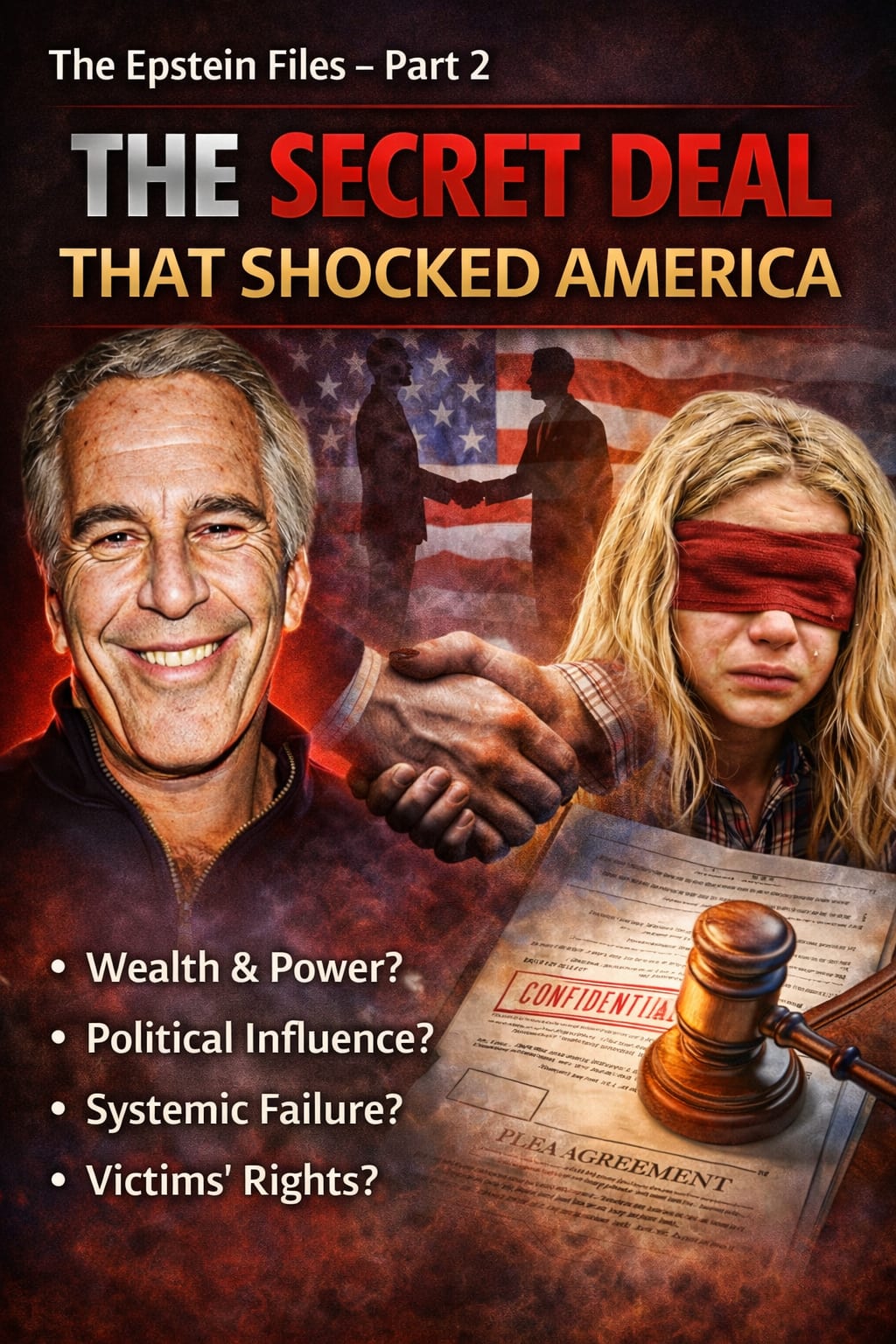
In Part 1, we uncovered how Jeffrey Epstein’s private island became the center of disturbing allegations involving underage girls and some of the world’s most powerful figures.
But what happened next may be even more shocking.
Because when investigators finally built a powerful case against him… the justice system didn’t respond the way many expected.
This is the story of the investigation, the victims, and the secret plea deal that changed everything.
________________________________________
The Recruitment Pattern: How the Network Expanded
The story began with a single complaint in Palm Beach, Florida.
A teenage girl had been told she could earn $200–$300 for giving a massage to a wealthy man. For someone young and financially vulnerable, that amount of money seemed life-changing.
But when she arrived at Jeffrey Epstein’s home, she alleges something very different happened.
According to victim statements, Epstein would often greet girls wearing only a towel. The “massage” would quickly escalate into sexual abuse.
Afterward, the alleged pattern continued.
Victims were sometimes encouraged — and financially incentivized — to bring other girls.
When investigators asked one victim if she knew anyone else who had gone to Epstein’s house, she gave two names.
When police spoke to those two girls, they mentioned two more.
Then two more.
Then two more.
Palm Beach police were stunned.
The chain did not stop.
By the time officers tracked one victim, additional names would surface. What initially appeared to be isolated incidents began to resemble something far more organized.
Within months, the Palm Beach Police Chief had identified 35 minor victims. Authorities suspected the true number was significantly higher.
Many of the girls were under 18.
Some were just 14.
________________________________________
Vulnerability as a Target
One of the most heartbreaking elements of the case was how vulnerability appeared to be exploited.
Several victims later described unstable home lives, financial hardship, prior abuse, or emotional distress. Some believed they were being offered an opportunity — a job, mentorship, or connection to powerful people.
One survivor later reflected that opening up about her struggles may have made her more appealing as a target.
The pattern investigators uncovered looked disturbingly structured:
• Young girls were recruited with promises of easy money.
• They were allegedly abused.
• They were paid afterward.
• They were encouraged to recruit others for additional compensation.
Police described it as resembling a pyramid-style recruitment system.
The more girls brought in, the more the network expanded.
This wasn’t random misconduct.
Investigators believed it was organized.
________________________________________
Building the Federal Case: Operation Leap Year
By May 2006, Palm Beach police had assembled a strong case file against Epstein.
The evidence included:
• Dozens of victim statements
• Witness testimony
• Phone records
• Financial trails
The case was serious enough that in July 2006, the FBI launched its own investigation, code-named Operation Leap Year.
A 53-page federal indictment was drafted.
Investigators expanded beyond Florida, gathering statements from victims in:
• New York
• New Mexico
• The U.S. Virgin Islands
The charges being considered included federal sex trafficking of minors — crimes that carried the possibility of life in prison.
At this stage, it appeared that Jeffrey Epstein’s freedom — and perhaps his entire empire — was about to collapse.
But behind the scenes, something else was happening.
________________________________________
The Secret Plea Deal
While federal investigators were preparing their case, negotiations were taking place quietly.
In Miami, then–U.S. Attorney Alexander Acosta entered discussions with Epstein’s legal team.
The result would later become one of the most controversial plea agreements in modern American legal history.
Instead of facing federal sex trafficking charges, Epstein agreed in 2008 to plead guilty to two state-level prostitution charges.
In exchange:
• Federal prosecutors agreed not to pursue broader charges.
• Immunity was reportedly extended to potential co-conspirators.
• The agreement was sealed from public view.
Perhaps most disturbing — the victims were not informed about the deal before it was finalized.
Under the Crime Victims’ Rights Act, victims are supposed to be notified of such agreements.
In this case, many learned about it only after it had already been signed.
________________________________________
The Sentence: 18 Months
On June 30, 2008, Epstein appeared in court and pleaded guilty under the terms of the agreement.
His sentence?
18 months in county jail.
Not federal prison.
Not life behind bars.
Eighteen months.
But the conditions of that sentence raised even more eyebrows.
Epstein was housed in a private wing of the Palm Beach County Jail. He was granted work-release privileges that allowed him to leave the jail for up to 12 hours a day, six days a week.
He reportedly spent much of that time at his office.
In effect, critics argued, the jail functioned more like a place to sleep than a place of confinement.
And then, in July 2009 — after serving roughly 13 months — Epstein was released early for “good behavior.”
To many observers, it did not resemble justice.
It looked like protection.
________________________________________
Public Outrage and Renewed Scrutiny
For years, the plea deal remained relatively obscure outside legal circles.
But investigative journalists eventually uncovered the details.
When the public learned:
• That dozens of minors had come forward,
• That federal charges had been prepared,
• That the deal had been kept secret,
• That victims were not notified,
Outrage exploded.
The case reignited national debate about:
• Two-tier justice systems
• Wealth and political influence
• Prosecutorial discretion
• Victims’ rights
In 2019, following renewed federal charges against Epstein, Alexander Acosta resigned from his later position as U.S. Secretary of Labor amid criticism over the original plea agreement.
________________________________________
Why This Deal Changed Everything
The 2008 plea agreement didn’t just reduce Epstein’s sentence.
It altered the trajectory of the entire case.
Critics argue it allowed Epstein to:
• Rebuild his social network
• Maintain access to powerful circles
• Continue operating with influence
The agreement also shielded potential associates from immediate prosecution — a provision that remains controversial to this day.
When Epstein was arrested again in 2019 on federal charges, it was seen not as the beginning of accountability — but as a second chance at justice that should have happened a decade earlier.
________________________________________
The Twist That Deepened the Mystery
The story doesn’t end with the plea deal.
In 2019, after Epstein’s re-arrest on federal sex trafficking charges, the world was watching.
But before the trial could begin, Epstein was found dead in his jail cell.
His death was ruled a suicide.
However, the timing, security lapses, and high-profile nature of the case fueled widespread suspicion and conspiracy theories.
For many, the unanswered questions became just as significant as the crimes themselves.
________________________________________
Part 2: The System on Trial
If Part 1 was about the island and the victims…
Part 2 is about the system.
How could dozens of minor victims, a 53-page federal case, and serious trafficking charges result in such a lenient sentence?
Was it prosecutorial discretion?
Political influence?
Systemic failure?
Or something deeper?
The Epstein Files are not just about one man.
They are about power, accountability, and whether justice applies equally to everyone — regardless of wealth or status.
And as more court documents continue to surface, the story is far from over.
About the Creator
Adil Ali Khan
I’m a passionate writer who loves exploring trending news topics, sharing insights, and keeping readers updated on what’s happening around the world.
Keep reading
More stories from Adil Ali Khan and writers in Criminal and other communities.
Cop Hires Escort, Kills Her After She Called Him a "Weirdo"
Sheri Carter of Boynton Beach, Florida, had a bright future. She attended Florida Atlantic University (FAU), hoping she’d work as a lawyer one day. She came from a loving family, had a great boyfriend, and loved life. Sadly, a cop with a violent history would end her story well before she had time to write all the chapters.
By Criminal Matters4 days ago in Criminal
Nancy Guthrie: Faith, Influence, and the Ongoing Search That Captured a Nation
Introduction Nancy Guthrie is a name that, for many years, resonated quietly but powerfully within Christian teaching circles. Known as a respected Bible teacher, author, and speaker, she spent decades helping others understand Scripture, suffering, and hope. But in early 2026, her name entered the national spotlight under heartbreaking circumstances.
By Story Prism2 days ago in Criminal




Comments
There are no comments for this story
Be the first to respond and start the conversation.