
The Day Israel Was Expelled from the United Nations
A Realistic Analysis of Global Fallout

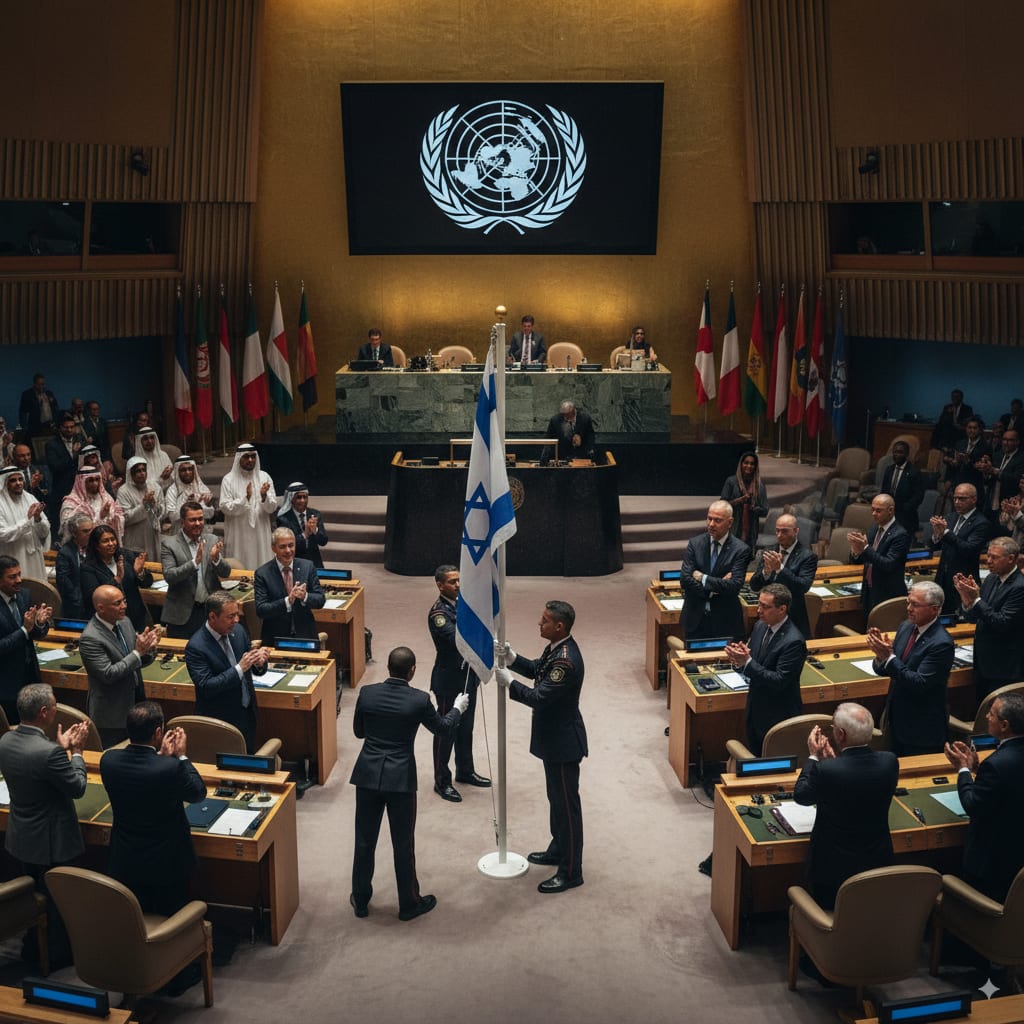
The Day Israel Was Expelled from the United Nations
The idea of the United Nations expelling Israel has long been debated in diplomatic and activist circles, but as of 2025, it has never come close to reality. Yet, imagining such a scenario offers a valuable lens to understand the geopolitical balance of power, the limits of international law, and the possible consequences for global stability. If the UN General Assembly and Security Council were to succeed in removing Israel’s membership, the ripple effects would transform international relations overnight.
The Legal Roadblock
Under the UN Charter, expulsion of a member state is legally possible but almost impossible politically. Article 6 of the Charter states that a member can be expelled for persistently violating UN principles, but this requires two steps:
A recommendation by the Security Council.
A two-thirds majority vote in the General Assembly.
Here lies the first obstacle: the United States. As a permanent member of the Security Council, Washington has consistently used its veto power to shield Israel from punitive measures. For Israel to be expelled, the U.S. would either need to abstain or actively support the resolution — a shift that would signal a complete reorientation of American foreign policy.
The Trigger Event
If we imagine Israel’s expulsion happening, the trigger would likely be an unprecedented escalation: perhaps annexation of large parts of the West Bank, a catastrophic military campaign in Gaza or Lebanon, or a major breach of international humanitarian law too severe for even Israel’s closest allies to ignore. Combined global pressure — from Europe, Asia, Africa, and Latin America — would force the issue to the Security Council.
Diplomatic Earthquake
The moment Israel lost its UN seat, the diplomatic order would shatter. Israel would instantly become a pariah state, recognized by some countries but excluded from the most important global platform. Embassies would close in several capitals, sanctions would tighten, and international trade routes could be disrupted.
The Arab and Muslim World: Nations in the Middle East would claim a historic victory, seeing expulsion as recognition of decades of Palestinian suffering.
The United States: Domestically, the U.S. would face political turmoil. A decision not to veto Israel’s expulsion would fracture Washington’s alliances at home and abroad, splitting Congress, lobby groups, and the electorate.
Europe: Divisions inside the European Union would deepen. Some nations (like Ireland or Spain) would celebrate, while others (like Germany) would warn of dangerous precedents.
The Palestinian Question
For Palestinians, Israel’s expulsion would be a symbolic triumph, but not an automatic solution. The UN could move to grant Palestine full membership, effectively replacing Israel’s legitimacy with Palestinian statehood. Yet, on the ground, realities of occupation, settlement expansion, and military control would remain unless enforced by a stronger international mandate.
Regional Fallout
Expulsion would not end conflict — it could escalate it. Isolated and delegitimized, Israel might double down militarily to demonstrate strength. Neighboring states could feel emboldened, increasing the risk of regional war. Hezbollah, Hamas, and other groups would frame Israel’s removal as justification for further resistance.
Global System Shock
The UN has never expelled a member for political reasons. (South Africa during apartheid was suspended, not expelled.) Removing Israel would set a precedent: if one nation can be expelled for violating international norms, others — from Myanmar to Russia — could be next. This would alter the UN from a consensus-based platform into a more punitive, enforcement-driven institution.
International Law: Expulsion would underline the relevance of humanitarian law, but also expose the UN to accusations of selective justice.
Economy: Markets in the Middle East would reel, oil prices could spike, and military trade flows would shift.
Security: NATO, Russia, China, and regional blocs would scramble to redefine their alliances in light of Israel’s exclusion.
Conclusion
While legally possible, Israel’s expulsion from the UN remains almost unimaginable under current geopolitical conditions. The U.S. veto is the ultimate shield. Yet, if such a day ever arrived, it would mark one of the most seismic shifts in international relations since World War II. For Palestinians, it would be vindication. For Israel, isolation. And for the world, it would signal the dawn of a new, uncertain global order — one where no state, however powerful, is beyond accountability.
About the Creator
Wings of Time
I'm Wings of Time—a storyteller from Swat, Pakistan. I write immersive, researched tales of war, aviation, and history that bring the past roaring back to life
Keep reading
More stories from Wings of Time and writers in Criminal and other communities.
The Secret Ukraine-Russia Tech War: Drones, Cyberattacks & Global Threats
The Secret Ukraine-Russia Tech War: Drones, Cyberattacks & Global Impact In the 21st century, wars are no longer just fought on the ground with tanks and soldiers. The ongoing conflict between Ukraine and Russia has evolved into a high-tech battlefield, where drones, cyberattacks, satellites, and AI-assisted systems are reshaping the rules of modern warfare. What started as a traditional military confrontation has now become a secret war of technology, drawing attention from the entire world.
By Wings of Time 4 months ago in Criminal
Living in the Blast Zone: The "House of Skulls" and the Collapse of Ephrata’s Luxury Dream
The Morning the Property Value Died On January 6, 2026, the residents of Washington Avenue didn't just wake up to a crime scene; they woke up in a financial blast zone. While the media trucks have packed up and the hazmat suits are gone, the neighbors are left with a permanent scar. In real estate law, this is called "Stigmatized Property."
By Sunshine Firecracker3 days ago in Criminal
Inside The Br@ tal Methods Of N@ zi Secret Police GESTAPO
They worked deep undercover with a name feared as words moved across Nazi occupied Europe. Gestapo: short form of Geheime Staatspolizel, or Secret State Police: the steel fist of Hitler and his machine of terror, entrusted with the job of tracking down foes of the Reich. However their actions behind the scenes were more terrible than many would ever imagine. In contrast to ordinary police, Gestapo never faced any supervision, did not present any warrant, and acted freely. Their methods was cruel: they could arrest a person because somebody whispered something, because a neighbour pointed an accusing finger, even because he shared a joke. Upon arrest individuals just vanished off the face of the earth with some never being heard of once again... (more)
By Live World Storiesabout 2 hours ago in Criminal



Comments
There are no comments for this story
Be the first to respond and start the conversation.