
The Crimes of Andre Rand: Urban Legend Turned True Life.
The True Life Cropsey Legend

The Urban Legend
The origin of the Cropsey legend is shrouded in mystery and has been retold in various forms over the years. The tale is said to have begun in the 1970s at a Staten Island, N.Y. summer camp, where the stories of Cropsey’s origin are debated but often involve a family tragedy. In one version, a once-respected businessman named George Cropsey goes insane after losing his family or child/children near a small summer cottage. The reason for the tragedy is sometimes attributed to an irresponsible camper or camp staff member causing a fire. The legend emphasizes the power of children’s storytelling habits and how innocent tales can transform into something horrifying. Whether the legend is based on facts, inspired by headlines, or simply an urban myth remains to be determined.
The legend of Cropsey became intertwined with the real-life disappearances of children on Staten Island in the 1970s and 1980s, leading to the arrest and conviction of a homeless man, Andre Rand, who had a connection to the Willowbrook State School, a closed institution for the developmentally disabled.
Who is Andre Rand
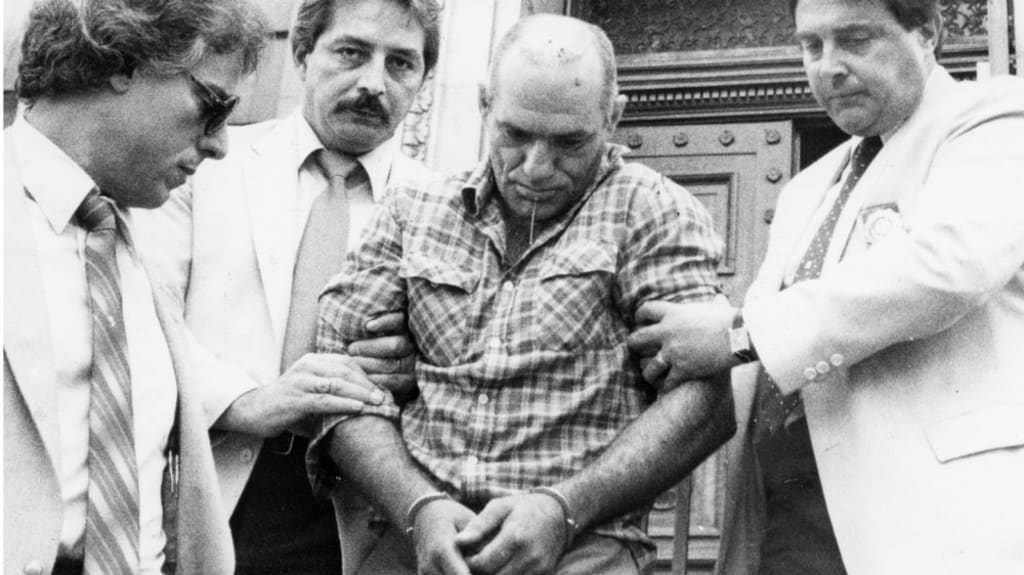
Andre Rand, also known as the “Pied Piper of Staten Island,” was Born Frank Rostum Rushan in 1944. Rand, who has been branded the true life “Cropsey,” was convicted of a series of disturbing crimes, including kidnapping, sexual abuse, and unlawful imprisonment. His criminal activities spanned from 1969 to 1987, primarily centered in New York, particularly Staten Island and the South Bronx.
Specifically, Rand’s criminal record includes the following notable incidents:
1969: Rand was arrested in the South Bronx for kidnapping and attempting to rape a 9-year-old girl. He enticed the girl into his car, drove to a vacant lot, and tried to assault her. He was arrested and served 16 months in prison for this crime.
1983: While working as a school bus driver, Rand picked up eleven children from a Staten Island YMCA, bought them a meal without parental consent, and took them to Newark Liberty International Airport. He was apprehended and served ten months in jail for this incident, which was classified as unlawful imprisonment.
1983: Arrest for the murder and abduction of Jennifer Schweiger, a 12-year-old girl with Down Syndrome. While he was charged with her murder, he was only convicted of her kidnapping and sentenced to 25 years to life.
2004: Rand was convicted of the 1983 kidnapping of a 7-year-old girl named Holly Ann Hughes. He was never charged with her murder due to a lack of evidence but was sentenced to 25 years in prison for her abduction.
Even though he was only ever charged and convicted in two child abductions, Rand’s connection to the disappearances of multiple missing children and his disturbing criminal history has led to widespread suspicion that he was involved in more cases than those for which he was charged and convicted.
Rand’s Connection to the Willowbrook State School
The Willowbrook State School, later known as the Staten Island Developmental Center, was a state-funded institution for children with disabilities in Staten Island, New York. It was established in 1947 and was designed to accommodate a maximum of 4,000 students, but by 1965, it had a population of 6,000. The school gained notoriety due to its deplorable conditions, including overcrowding, disease, and abuse, which were exposed by journalist Geraldo Rivera in 1972. This led to the production of the documentary “Willowbrook: The Last Disgrace.” The facility was eventually shut down in 1987 after the discovery of the staff’s mistreatment and neglect of the children in its care.
Andre Rand had an employment connection to the Willowbrook State School. From 1966 to 1968, he worked as a custodian and physical therapy aide at the school under the name Frank Bruchette. After the school’s closure, Rand was reported to be homeless and began camping out in the woods surrounding the abandoned institution. His association with the school and the subsequent disappearances of children in the area, as well as his arrest and conviction in connection with some of these cases, led to his infamous reputation and the intertwining of his story with the local urban legend of Cropsey.
In 1987, the body of Jennifer Schweiger, a 12-year-old girl with Down syndrome, was found in a shallow grave on the grounds of the Willowbrook school near where Rand was camping. This discovery further solidified the connection between Rand and the institution, as he was reportedly seen walking alongside Schweiger before her disappearance. Rand’s presence at the abandoned school and its disturbing history added a chilling dimension to the already haunting narrative surrounding the disappearances of children in the area.
The Cropsey Documentary
The 2009 documentary “Cropsey” suggests that Andre Rand may have been the real-life inspiration for the “Cropsey” urban legend. The film explores the blurring of myth and reality as Rand, a convicted child kidnapper and suspected serial killer, became associated with the mythical figure of Cropsey. The documentary delves further into the disappearances of children on Staten Island in the 1970s and 1980s, the arrest and trial of Rand, and the impact of the local urban legend on the community. It also raises questions about the nature of urban legends and the complexities of the criminal justice system.
Extra Context About Willowbrook State School
About the Creator
MJonCrime
My 30-year law enforcement career fuels my interest in true crime writing. My writing extends my investigative mindset, offers comprehensive case overviews, and invites you, my readers, to engage in pursuing truth and resolution.
The Facebook Marketplace of Horrors: Inside the groups where bones are traded like baseball cards.
It Wasn't the Dark Web When we hear about the illegal sale of human body parts, we imagine the "Dark Web"—encrypted Tor browsers, Bitcoin wallets, and shadowy Russian servers. The terrifying reality of the Jonathan Gerlach case is that he wasn't hiding in the digital shadows. He was hiding in plain sight.
By Sunshine Firecracker3 days ago in Criminal
What DHS Secretary Kristi Noem said vs. what the videos show
NBC News and PBS recapped the competinBelow is a structured, evidence-backed analysis of the Minneapolis ICE shooting and the claims made by DHS Secretary Kristi Noem—including the applicable federal laws/policies and how intent vs. recklessness factor into a potential case. I’ll keep this clear, precise, and grounded in the video evidence and governing law.
By Organic Products 6 days ago in Criminal



Comments
There are no comments for this story
Be the first to respond and start the conversation.