

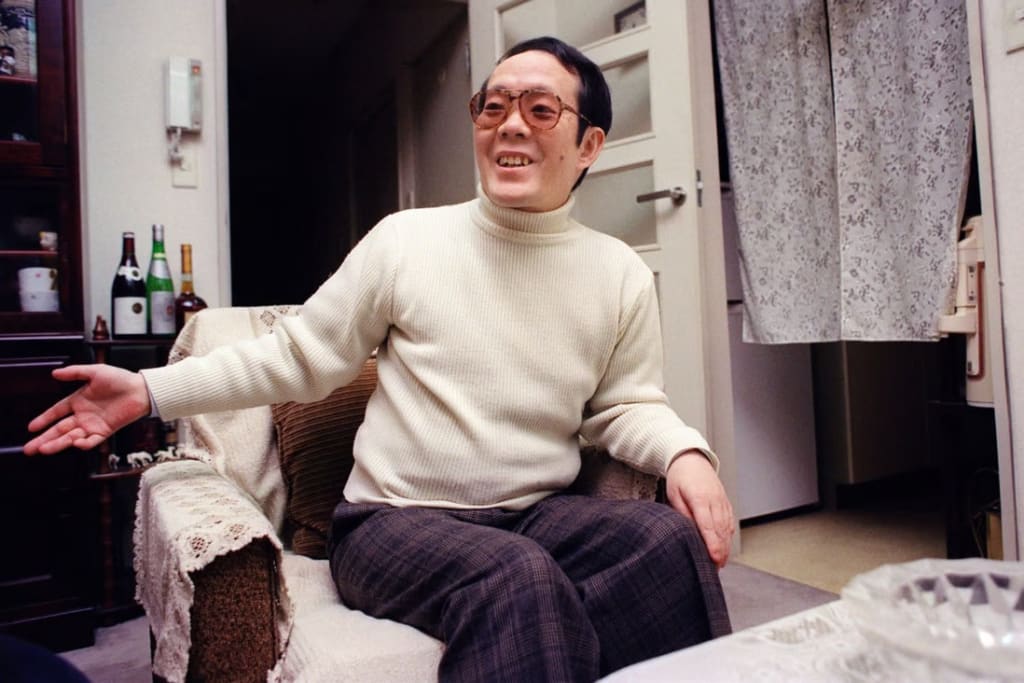
Issei Sagawa was born into a wealthy family in Kobe, Japan. From a young age, he showed a fascination with death and the macabre, which was encouraged by his grandfather, who often took him to see movies featuring horror and violence. Sagawa also developed an obsession with Western culture and language, which he felt would give him greater access to the world of art and literature.
As a teenager, Sagawa began to experience intense sexual fantasies involving cannibalism. He later claimed that these fantasies were fueled by a desire to consume his lover's beauty and preserve it forever. Sagawa's obsession with cannibalism continued to grow over time, and he began to experiment with eating raw meat, including his own flesh.
After graduating from university in Japan, Sagawa moved to France to pursue a PhD in literature. It was there that he met Renée Hartevelt, a Dutch woman who was studying at the same university. Sagawa became infatuated with Hartevelt, and began to obsess over the idea of consuming her flesh.
On the evening of June 11, 1981, Sagawa invited Hartevelt to his apartment under the guise of discussing poetry. Once there, he shot her in the neck with a rifle, and proceeded to rape and dismember her body. Sagawa later claimed that he ate parts of Hartevelt's body over the course of several days, storing the rest in his refrigerator.
Sagawa was eventually caught when police found bloodstains and other evidence in his apartment. He was charged with murder and spent several years in a French psychiatric hospital undergoing evaluation.
Sagawa's trial was highly publicized, with many people calling for him to receive the death penalty. However, due to his diagnosis of schizophrenia, he was found not guilty by reason of insanity and committed to a psychiatric hospital.
In 1986, Sagawa was deported to Japan, where he was confined to a mental institution. However, due to a legal loophole, he was eventually released in 1986 and returned to a life of relative anonymity.
Sagawa himself became something of a celebrity, with many people seeking him out for interviews and even paying for his company. Some were fascinated by his crime, while others saw him as a cautionary tale of the dangers of mental illness and the legal system.
Despite the controversy surrounding his release, Sagawa continued to live a relatively low-key existence in Japan. He occasionally gave interviews to the media, but mostly kept to himself, living off the royalties from books and films about his life.
Sagawa's case raises many questions about the psychology of cannibalism. What drives a person to want to consume human flesh? Is it a sexual fetish, a form of mental illness, or a cultural practice? In this chapter, we will explore the various theories surrounding the psychology of cannibalism, including the role of childhood trauma, cultural beliefs, and neurological factors.
Sagawa's diagnosis of schizophrenia played a significant role in his trial and eventual release. But what exactly is schizophrenia, and how does it relate to violent behavior? In this chapter, we will examine the relationship between schizophrenia and violence, and explore the various treatments available for this complex mental illness.
Sagawa's case also raises important questions about the intersection of mental illness and the legal system. How should society treat individuals who have committed violent crimes but are also struggling with mental illness? Should they be held responsible for their actions, or treated as victims of their illness? In this chapter, we will explore the various legal and ethical issues surrounding the treatment of mentally ill offenders.
Sagawa's case also highlights the cultural differences in attitudes toward mental illness. In Japan, mental illness is often stigmatized and individuals may be reluctant to seek treatment for fear of being ostracized by their community. In this chapter, we will explore the cultural differences in attitudes toward mental illness, and how these differences can impact the diagnosis and treatment of individuals with mental illness.
Sagawa's case was highly publicized in both Japan and France, and he became something of a media sensation. But how does the media's portrayal of crime impact our understanding of the criminal justice system and mental illness? In this chapter, we will explore the relationship between media and crime, and how the media can shape public perception of these complex issues.
True crime stories, like Sagawa's case, have become increasingly popular in recent years. But what are the ethical implications of consuming and sharing these stories? In this chapter, we will examine the ethics of true crime, and explore the potential harm and benefits of consuming these stories.
Sagawa's case has had a lasting impact on the world of true crime and the public's perception of mental illness. But what is his legacy, and how should we remember him? In this chapter, we will explore Sagawa's legacy, and consider the broader implications of his case for our understanding of crime and mental illness.
Sagawa's case highlights the importance of forensic psychology in understanding the motivations behind violent crimes. But what is the future of forensic psychology, and how can we continue to develop our understanding of these complex issues? In this chapter, we will explore the future of forensic psychology, and consider how new research and technology can help us better understand the relationship between mental illness and violent behavior.
Sagawa's case garnered international attention, particularly in France and Japan, but what was the international response to his crime and subsequent release? In this chapter, we will explore the different reactions to Sagawa's case, and how it reflects cultural differences in attitudes toward mental illness and criminal justice.
Sagawa's case raises important questions about the relationship between mental illness, violence, and the legal system. In this chapter, we will reflect on the lessons learned from Sagawa's case, and consider how we can improve our understanding and treatment of individuals struggling with mental illness.
As we conclude our exploration of Issei Sagawa's case, it is important to consider how we can move forward as a society. How can we better address the complex issues surrounding mental illness and violence, and work to prevent tragedies like Sagawa's from happening in the future? In this final chapter, we will reflect on the impact of Sagawa's case, and consider how we can take steps to improve mental health care and the criminal justice system for the benefit of all individuals.
About the Creator
Kawsar
"Welcome to my page!
Multinational Crisis
Part One: Nigeria You have all heard about Nigerians, Nigeria in general. The infamous scammer country. But let’s have a real conversation. Let me give you some extremely boring stats, so we are on a level playing field, on my thoughts. I’ll be as brief as possible considering, no one wants an hour long dissertation on economic issues.
By Alexandra Grant4 days ago in Criminal
Oklahoma Murder for Hire
Murder for hire in 1988 must have been a real monster of a time to find for a woman who was bored, and just lazy. A woman that claimed she was abused, knew how to work a young man up, back in those days it was much easier to find “a knight in shining armor”. Men all over wanted to be one, no man how scuzzy they really were.
By Cassie Moore6 days ago in Criminal
How, Too
Many people wonder how, too. You are not alone, and I am an expert. I will teach you how, too! First, you need to remit a small application fee and fill out an application describing the nature of your financial situation and how often payments will be made, as this will have great bearing on how well I teach you how, too.
By Harper Lewis3 days ago in Fiction




Comments
There are no comments for this story
Be the first to respond and start the conversation.