
The Beaumont Children
An Enduring Mystery and New Developments


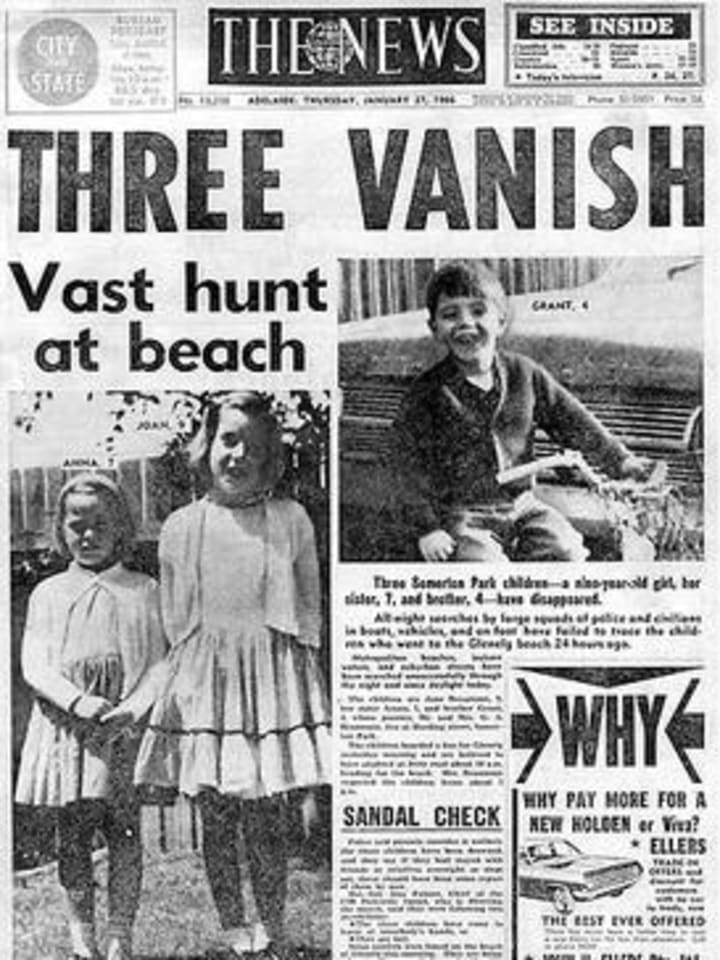
Nearly 50 years ago, the three Beaumont children went missing from Glenelg Beach in Adelaide, Australia. The day, intended to be filled with fun, turned into a waking nightmare. The children’s disappearance caused an outpouring of sympathy for parents Jim and Nancy Beaumont, who hoped for years that their children would return home.
Nearly five decades later, the case remains open, but new leads may prove essential to solving the cold case of the Beaumont Children’s disappearance. A fresh excavation of a defunct factory will hopefully provide new information, unlocking the mystery of this decades old cold case.
The Beaumont Family
The three Beaumont children, Jane Nartare (9), Arnna Kathleen (7), and Grant Ellis (4), lived with their parents, Grant “Jim” and Nancy Beaumont. Jim was a retired serviceman and cab driver. Nancy was a homemaker. The couple married in 1955. Together, the family lived in Somerton Park, a suburb of Adelaide in South Australia, roughly two miles from where the children disappeared.
The Disappearance and Timeline
On January 26, 1966, Jane, Arnna, and Grant made the three kilometer trip to Glenelg Beach by bus from their home. South Australia was experiencing a heatwave, and the day prior, before heading to Snowtown for a three-day sales trip, the children’s father, Jim, had dropped them at the same beach. The following day, the children asked their mom if they could go to the beach again. The children caught the 8:45 a.m. bus, which would have arrived at the beach roughly five minutes later. Their mother expected them home at noon for lunch.
When the noon and two o’clock busses arrived without the children, Nancy became worried. Jim arrived home early from his work trip at three that afternoon and, upon finding his panicked wife, immediately drove to the beach to find the children.
The Search Begins
Jim arrived at Glenelg Beach, which was packed with people celebrating Australia Day and trying to escape the heat. Unable to locate the children, he returned home, hoping they had missed each other. From there, he and Nancy scoured their neighborhood, searching the children’s usual haunts and friends’ houses. At 5:30 that evening, Jim and Nancy reported their children missing to the authorities.
The Blond Haired Man
Several witnesses reported seeing the children in Colley Reserve, near Glenelg Beach, playing with a tall, fair-haired man in his mid-thirties. The man wore swim trunks and had a tanned, athletic build. Witnesses claimed the children seemed relaxed with the man, so they didn’t feel the need to raise any alarms or intervene. The man approached witnesses and asked them if they had seen anyone messing with the children’s bags, since their money was gone. He then left the children to change while they waited for him. Police estimate that at 12:15, the children left with the man carrying an airplane bag similar in description to the one Jane (the eldest Beaumont child) had taken to the beach.
Other Witness Reports
This sighting surprised Jim and Nancy Beaumont, who described their children, especially Jane, as timid. Jane would never have been relaxed around someone she didn’t know. Investigators theorize the children had met the man on previous visits to the beach, and he had built a report with them. An offhand statement by Arnna about Jane appears to confirm this theory. Arnna commented Jane had made a boyfriend at the beach. A statement Nancy assumed meant a playmate, not an actual love interest.
A shopkeeper at Wenzel’s Bakery, on Moseley Street, sold Jane a meat pie and pasties with a £1 note. This purchase surprised the shopkeeper, who knew the children. They had never bought a meat pie before. Nancy had given her children six shillings and sixpence for bus fare and lunch. These observations further support the theory that the children were with someone else when they vanished.

At 2:55 that afternoon, a postal worker familiar with the children reported seeing them walking along Jetty Road toward their home. He claimed the children were laughing and holding hands. This statement concerned investigators, as by this time the children were nearly three hours late returning home. The postal worker later changed his statement, claiming he saw the children in the morning, not that afternoon.
Initial Police Investigation
The police jumped into action, putting together a search party for Glenelg Beach and surrounding area along with the children’s neighborhood, hoping to discover they had lost track of time and were safe. When they came up empty, the police expanded the search to the sand dunes and nearby buildings in case the children had ventured off the beach and had an accident. The investigation further expanded to observing railways and the airport in case of an abduction.
The media latched onto the case, and within 24-hours of their vanishing, the Beaumont Children’s disappearances were on the lips of every Australian.
Patawalonga Boat Haven
Three days after the disappearance, investigators drained the Patawalonga Boat Haven, searching for the children’s bodies, fearing they had drowned. A woman claimed she had spoken with three children, fitting the missing Beaumonts’ description at 7:00 pm on the day the Beaumont children went missing. The search turned up no evidence of the children.
Strange Sighting at an Abandoned House
A number of months after the children’s disappearances, a woman claimed to have seen them enter an abandoned house with a man. Later that day, she claimed she saw a young boy running from the abandoned house, only to be chased and caught by the man they’d entered with, and taken back inside. The next day, the house was empty again and there was no sign of the children or the man. As one would expect, the police found this witness report highly suspicious since she had waited so long to inform investigators of the sighting.
Clairvoyant Gerard Croiset
By autumn, the trail had gone cold, and the police were desperate for any break in the case which had garnered international coverage. On November 6, 1966, Dutch clairvoyant Gerard Croiset guided police to a factory near the children’s school, where he claimed their bodies were buried. He urged police to unearth a kiln in the building. To appease public pressure, the owners demolished the building; however, they found no sign of the children.

More sightings occurred across the continent, but none lead to the discovery of the missing Beaumont children.
Suspects and Theories
Dozens of potential suspects have been associated with the Beaumont case over the decades. Among them was Bevan Spencer von Einem, whom a court found guilty of the 1984 death of teenager Richard Kelvin. Arthur Stanley Brown also came under scrutiny after he was accused of the 1998 murders of Judith and Susan Mackay. James Ryan O’Neill, who received a life sentence for the murder of a nine-year-old Tasmanian boy, and told others he was responsible for the murder of the Beaumont children. Investigators verified his claims to be untrue. Briefly, police investigated Alan Maxwell McIntyre, but they cleared him concerning the Beaumont case. In 2017, a jury found McIntyre, a former scoutmaster, guilty of child molestation for crimes dating back to 1962. Yet, out of all the potential suspects and theories, Harry Phipps stood out to police.
Harry Phipps
Phipps, part of the social elite, bore an uncanny resemblance to the fair-haired man seen with the Beaumont children. He lived 300 meters from the beach where the children were last seen and was fond of giving out £1 notes. Phipps son, Hayden, 15 in 1966, reported to police in 2013, after the publication of a book titled, The Satin Man: Uncovering the Mystery of the Missing Beaumont Children, that he remembered seeing the children in his backyard on January 26. While The Satin Man does not come out and accuse Phipps of the children’s disappearance, Hayden Phipps came forward after its publication and claimed his father was the Satin Man. Two more individuals, teens in 1966, came forward to say that Phipps had paid them to dig a large hole at Castalloy factory, owned by Phipps.

Recent Developments
In 2013 and again in 2018, police discovered a soil anomaly in Phipps’s Castalloy factory using ground-penetrating sonar. However, upon excavating, investigators found no connection to the missing children. A new dig is planned for February 22, 2025. Independent MP Frank Pangallo will oversee the new dig, aided by two forensic anthropologists. Pangallo claims that the first two digs didn’t go deep enough, and there is now new information that could change the tide in this infamous cold case. This private excavation is the last chance to unearth any secrets the Castalloy factory might hold as the land has recently sold.
Where Things Stand
The disappearance of the Beaumont’s three children changed the landscape of Australia and the freedom children enjoyed. Their disappearance revealed a darker side of society. Where once children could safely frolic and explore, danger now lurked.
Jim and Nancy waited for years in their Somerton Park home for their children’s return. After a while, their marriage deteriorated, and they separated, selling their home. Nancy passed away at 96 in 2019 and Jim in 2023 at 97, without ever knowing what happened to their children.
About the Creator
Cynthia Varady
Award-winning writer and creator of the Pandemonium Mystery series. Lover of fairy tales and mythology. Short stories; book chapters; true crime. She/Her.
Keep reading
More stories from Cynthia Varady and writers in Criminal and other communities.
Solved: Joy Hibbs 31-Year-Old Murder
A Horrible Surprise At one in the afternoon of April 19, 1991, David Hibbs arrived home, excited to hand his report card over to his mom, Joy Hibbs, with the good news that he'd made the honor roll. However, instead of finding his home in its normal state, plumes of smoke billowed from his home in Corydon, Pennsylvania, in the Bristol Township. Noting that his mom's car was in the driveway, David hurried to the back kitchen door, but thick smoke pushed him back.
By Cynthia Varady2 years ago in Criminal
Sergeant Isaac Woodard Jr.
His sacrifice must never be forgotten. BY LEAVIE SCOTT The Story of Sergeant Isaac Woodard Jr. February 12, 1946 began like a day of promise. After years of service in the Pacific during World War II, Sergeant Isaac Woodard Jr. stepped off a military bus wearing the uniform he had earned through courage and discipline. He had served his country faithfully from 1942 to 1946, working as a longshoreman in dangerous combat zones, unloading ships under enemy fire, and carrying out the labor that made the Allied war effort possible. He had been awarded medals for good conduct and bravery. He had survived the hazards of war. He had survived a world where the enemy’s bullets and bombs were a daily threat. Now his service was complete, and he was headed home.
By Organic Products 2 days ago in Criminal


Comments
There are no comments for this story
Be the first to respond and start the conversation.