
The 5,000-Year-Old Murder Case Investigated by Police.
The 5,000-Year-Old Murder Case Investigated by Police

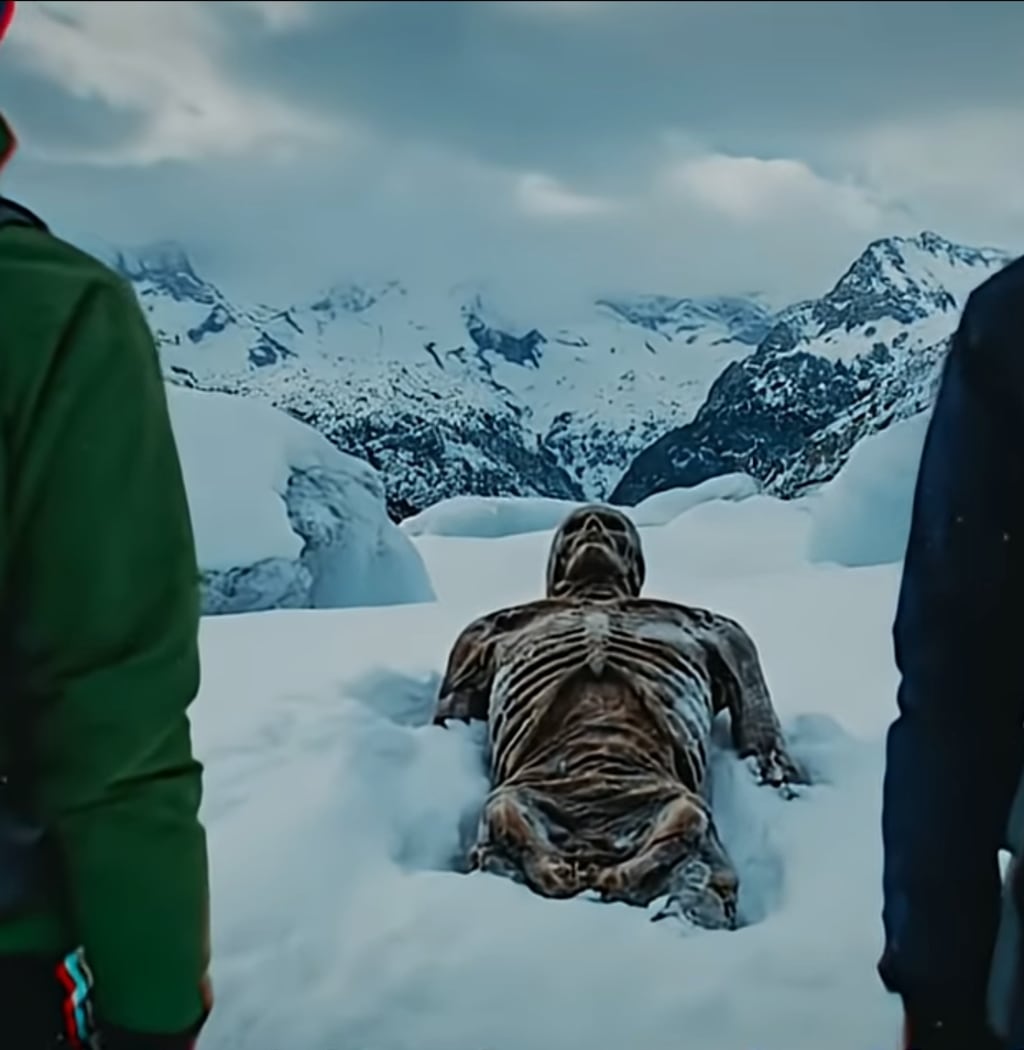
On 19 September 1991, two German hikers, Helmut and Erika Simon, discovered a body in the Ötztal Alps. At first, they thought it was the remains of a lost or recently dead climber, so they informed the Austrian police. After investigation, scientists found that it was not a modern corpse but a murder victim from about 5,300 years ago.
The body was so perfectly preserved in the ice that even the food in his stomach remained intact. Tests revealed that his last meal was goat meat and wheat bread. The mummy was later named “Ötzi the Iceman.”
Ötzi had 61 tattoos on his body, which were not decorative like modern tattoos but may have been used for pain relief. Ötzi’s tattoos were simple straight lines and small crosses, placed mainly near his aching joints and back, likely for pain relief rather than decoration.
He suffered from arthritis in his joints, hardened arteries that increased his risk of heart disease, a stomach infection with Helicobacter pylori, Lyme disease, worn and decayed teeth, as well as fresh injuries including cuts, bruises, and the fatal arrow wound in his shoulder.
He died alone in the mountains after being shot in the back with an arrow that pierced his shoulder. More than 5,000 years later, in 1991, his body was rediscovered. DNA testing has also shown that 19 men living in Austria today share a rare genetic link with Ötzi, making them his distant relatives.
Why his body didn't decay :-
Ötzi’s body did not decay like others because soon after his death he was quickly buried under snow and ice high in the Ötztal Alps, where the freezing temperatures, thin oxygen, and constant cold acted like a natural freezer. Over time, the glacier sealed and protected him from animals, weather, and bacteria, preventing the normal process of rotting. As a result, instead of breaking down, his skin, organs, clothing, and even the food in his stomach were preserved for more than 5,000 years, making him a rare natural mummy.
At the time he was found, Ötzi was wearing a coat made of goat and sheep hide, goatskin leggings, a bearskin hat, leather shoes stuffed with grass for warmth, and a cloak woven from grass.
Ötzi was found carrying a remarkable set of tools and belongings, including a copper axe with a wooden handle, a flint knife in a scabbard, a quiver with unfinished arrows, a bow, a fire-starting kit with flint and pyrite, a medicine pouch with dried fungi, and everyday items like a backpack frame, showing how he was well prepared for survival in the mountains.
Ötzi is now preserved in the South Tyrol Museum of Archaeology in Bolzano, Italy, inside a specially designed cold chamber that recreates the conditions of the glacier where he was found. The room is kept at –6 °C (21 °F) with 98% humidity to prevent his body from drying out or decaying. Visitors can see him through a small window, while scientists regularly monitor his skin, organs, and tattoos using advanced imaging techniques. To protect him further, the body is occasionally sprayed with sterile water so that his skin remains frozen and does not crack. Thanks to this careful preservation, Ötzi continues to provide new scientific discoveries more than 5,000 years after his death.
There are a few other cases where very old human bodies were naturally preserved like Ötzi, though none are quite the same. Here is one famous example :
Tollund Man :-
In 1950, two brothers cutting peat in a bog in Silkeborg, Denmark, uncovered the body of a man so well preserved that they thought he had died recently. Scientists later discovered he was about 2,400 years old and from the Iron Age. Known as the Tollund Man, he had a leather noose still around his neck, showing that he had been hanged. His body was placed carefully in the bog, lying curled as if asleep, suggesting a ritual sacrifice rather than a criminal execution. The unique chemistry of the peat—acidic, cold, and without oxygen—acted as a natural preservative, keeping his skin, hair, and even the stubble on his chin intact, though his bones had dissolved. Today, the Tollund Man provides historians and archaeologists with a hauntingly human glimpse into Iron Age beliefs and customs.
The Tollund Man is now kept at the Silkeborg Museum in Denmark, where his remarkably preserved head and face are on display, while the rest of his body was studied and is preserved under special conditions for research.
Amazing Truth :
Today we eat the same food, love our families in the same way, and even get tattoos. It’s amazing how similar we are to humans who lived 5,000 years ago.
About the Creator
Keep reading
More stories from Muhammad Talha and writers in Criminal and other communities.
The blood bath. The legend Elizabeth Báthory
On 7 August 1950 Elizabeth Báthory was born in Hangry. She was born into a rich and powerful family. From her childhood, people talked about her beauty—bright, delicate, and almost unreal. Some even said her eyes were so sharp that they could look deep into a person’s soul. She was married very young to a brave soldier, the commander of a strong fort. Their marriage was short, because her husband was killed in battle. Still a teenager, she became the owner of the huge stone fort, which soon became her home and her world.
By Muhammad Talha4 months ago in Criminal




Comments
There are no comments for this story
Be the first to respond and start the conversation.