innocence
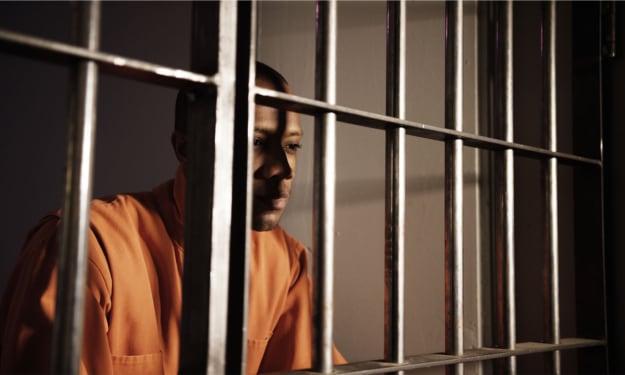
The presumption of innocence is a cornerstone of the American legal system and a right that should not be taken for granted.
The Art Thief's Dilemma. Content Warning.
In the shadowy underworld of art theft, where stolen masterpieces exchanged hands like stolen glances, there lived a brilliant but tormented figure known as "The Maestro." He was the most renowned art thief of his generation, a connoisseur of crime who had successfully orchestrated some of the most audacious heists in history. However, his life took a dramatic turn when he found himself ensnared in a web of intrigue, double-crossings, and an art connoisseur's dilemma that would test his wit, loyalties, and principles.
By Rajesh kumar 2 years ago in Criminal
Tears in the Sand
Title: Tears in the Sand: The Heartbreaking Saga of the Israel-Palestine Conflict In a land where history was etched deep into the golden sands and whispers of ancient tales echoed through the air, two peoples, the Jews and the Arabs, once shared a common dream. This was a time when laughter transcended language and shared history painted a mural of unity. However, beneath the surface of this serene landscape, a tempest brewed—a storm born of age-old grievances, fervent faith, and the political chaos of the 20th century, propelling the Israel-Palestine conflict into existence.
By Amani Kassim2 years ago in Criminal
The Catastrophe of 1948: The Palestinian Exodus 🇵🇸 . Content Warning.
The creation of the state of Israel in 1948 led to one of the largest mass displacements in modern history. Over 750,000 Palestinian Arabs fled or were expelled from their homes during the conflict, in what Palestinians mourn as Al-Nakba, which translates to “The Catastrophe”. This mass exodus had long-lasting repercussions that still impact the region today. To understand how this came to pass, we must examine the political events and military actions that precipitated the Palestinian refugee crisis of 1948.In the late 1940s, the landscape of Palestine was in flux. Following World War II, Zionist movements pushed to establish a Jewish national homeland in the territory, while the native Arab population sought self-determination and independence from British colonial rule. Tensions rose sharply as Zionist immigration swelled the Jewish minority population in Palestine, spurring land disputes and violence. Against this turbulent backdrop, the newly formed United Nations drew up a partition plan in 1947 to divide the territory into separate Arab and Jewish states. However, the plan was bitterly opposed by Palestinians, as it would consolidate Zionist control over a disproportionate amount of land despite the Arab majority population. As a result, sectarian conflict soon escalated into open civil war between Palestinian Arab and Zionist militias. As the British mandate neared its end in May 1948, Zionists declared independence and established the state of Israel. Arab states immediately entered the fray, launching military intervention on the side of Palestinian forces in an attempt to alter the consequences of partition. In response, Zionist paramilitary groups took the opportunity to seize more territory beyond the original partition boundaries. It was during this period of hostilities known as the 1948 Arab-Israeli War that the Palestinian exodus unfolded. Through a series of military campaigns codenamed Plan Dalet, Zionist militias successfully overran Arab villages and depopulated urban centers within the territory allocated to the Jewish state by the UN. Towns like Jaffa and Haifa were emptied of the majority of their Arab residents through threats of violence, or actual massacres intended to induce panic and flight. But Zionist forces also pushed into regions outside these designated borders, capturing mixed areas and depopulating them. The village of Deir Yassin, which resisted the Haganah militia, suffered over 100 civilian deaths in one notorious atrocity that sent shockwaves across Palestine. News of mass killings and fear mongering over Zionist reprisals triggered waves of civilians to flee for their lives. Many made the exodus on foot with little more than the clothes on their backs, believing they would soon return home after a short hiatus in safety. But they found no safe haven - neighboring Arab states were quickly overwhelmed with the sheer volume of refugees pouring over their borders. By the time armistice agreements ended open warfare in 1949, over 80% of Palestinians had been displaced. Some were driven out by Zionist military campaigns like Operation Dani and Hametz. Others were expelled through direct orders or intimidation by Zionist authorities after the fact to prevent return and consolidate control over the new Jewish state of Israel. To this day, the precise number of deaths from this period is unknown due to incomplete documentation. But the human cost was undoubtedly staggering, with historians estimating it may have exceeded 15,000 Palestinian casualties lost during Al-Nakba. Over 500 villages were destroyed or de-populated, further erasing physical remnants of Arab life that had existed for centuries. For Palestinians, the catastrophe did not end with displaced persons finding temporary shelter elsewhere. They were prevented from returning to their homes despite UN resolutions upholding this right. Israel enacted laws barring entry and demolished villages to deter resettlement. As a result, the refugee crisis swelled further, with generations of Palestinians remaining stateless and in permanent exile. Their struggling descendants now number over 5 million, still seeking implementation of the right of return. Meanwhile, within Israel’s post-1967 borders, approximately 1.5 million Palestinian Arab citizens inherited a legacy of deep inequalities compared to the Jewish population. The scars of dispossession live on for Palestinians in the West Bank, Gaza and global diaspora as well. Objectively examining how and why this massive displacement unfolded is vital for understanding the roots of the Israeli-Palestinian conflict that persist today. While celebrating independence, Israelis must acknowledge how Palestinian national aspirations were denied through violence and expulsion in 1948. Palestinians too will continue struggling for redress and self-determination until justice is fulfilled for the loss of their historic homeland during the Nakba. Only byfacing this shared history of loss can the parties make progress toward a solution that respects both peoples’ collective rights.
By Rakindu Perera2 years ago in Criminal
From the Trenches: A Glimpse into the Front Lines of Ukraine's War 🪖 . Content Warning.
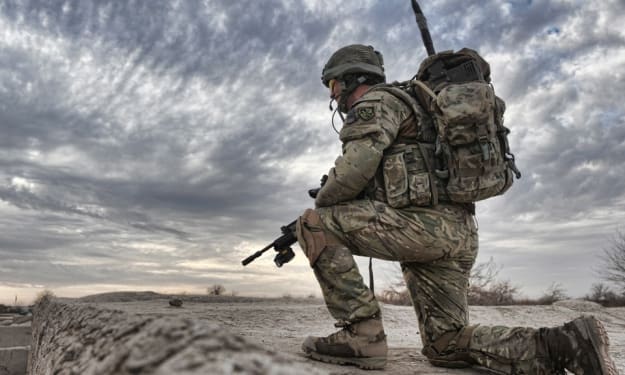
The loud crack of gunfire echoed across the frozen marshland as another salvo of enemy artillery shells rained down. Stefan flinched involuntarily as dirt and debris rained down on his position in the trench. He had long since grown accustomed to the near-constant bombardment, but the adrenaline surge was hard to suppress completely after so many months under fire. Peering cautiously over the berm, he watched columns of smoke rise from the impacts slowly dissipating in the frigid air. Another day, another barrage from the Russian guns positioned just out of effective range. It had been this way for over a week as the shelling intensified in frequency and precision. Stefan and his comrades could do little but hunker down and wait for breaks in the fire to see to repairs of their fortifications. Morale was beginning to fray under the relentless pounding. Few escaped completely unscathed, either physically or mentally. A welcome distraction arrived as two soldiers scrambled into the trench carrying an assortment of equipment. Stefan recognized them as drone operators, a crucial asset in the modern battlespace. One proudly showed off his custom-built "Falcon" drone, demonstrating its incredible speed and maneuverability by engaging and destroying an enemy surveillance drone. Meanwhile, the second operator skillfully guided armed drones to drop grenades directly onto Russian positions with alarming accuracy. Drones had transformed warfare, allowing both sides to scope out and bombard the other from a safe distance. While saving lives, it added a cruel psychological component as men were picked off in full view of comrades unable to offer aid. Stefan found it a brutal yet efficient method of warfare. With the drones disruptimg Russian reconnaissance efforts, their counter-battery fire became less accurate over the following days. Reinforcements soon arrived in the form of combat engineers. Their dangerous mission was to breach minefields and fortifications under fire in order to enable infantry assaults. Stefan knew this likely foreshadowed imminent attacking orders as opportunities emerged through the lessening shelling and disrupted enemy positions. In the coming days, precision rocket strikes silenced Russian artillery once and for all. Guided by counter-battery radar, High Mobility Artillery Rocket Systems (HIMARS) trucks launched swarms of missiles to obliterate gun emplacements. With their main indirect fire support eliminated, the enemy assault failed to materialize as anticipated. A rare window of opportunity opened up. Under the engineers' preparation, Stefan's unit infiltrated across no man's land under cover of darkness. Emerging amidst the wreckage of earthworks pummeled by Ukrainian shellfire, furious close quarters combat ensued. Hard fighting raged throughout the night as the defenders were steadily pushed back. By morning light, the tattered remnants fled in retreat. Victorious yet exhausted, Stefan and his comrades wasted no time entrenching in the captured terrain. Scouts reported the Russians scrambling to form new defensive lines further back. Both sides now eyed each other warily from opposite sides of the newly placed minefields and barbed wire stretching as far as the eye could see. A lull settled over the static front as winter's full fury set in. Icy winds howled across the desolate countryside, matched only by the omnipresent sounds of shells periodically crisscrossing the bleak terrain. One day blurred into the next amid endless boredom punctuated by the occasional brief flurry of fighting. It was during this relative calm that Stefan had opportunity to reflect more on their unlikely American ally. "Levi" as they called him contributed invaluable experience operating cutting edge weaponry like Javelin anti-tank missiles. But it left Stefan wondering why any foreigner would abandon a comfortable American life to fight in this miserable mud and blood-soaked conflict. Levi remained tight-lipped about his past, but carried himself with a battle-hardened intensity beyond his years of service. Some sense he actively courted danger, almost as if chasing his own demise. But Stefan could not deny his proven ferocity and skill were assets in their desperate struggle for survival. Supply issues also flared as winter gripped the land, forcing strict rationing. But American MREs provided needed calories and sustenance, boosting morale along with Ukrainian camaraderie and resilience of spirit. Through it all, Levi remained stoically dedicated to the shared cause against oppression. By January, the campaign season drew to a close until the lingering frost melted away. But tensions remained high, knowing Russia was licking its wounds while conspiring renewed offensives. Intelligence warned of new mobilization and equipping efforts to replenish frontline formations battered by months of grinding combat attrition. As spring's tentative signs emerged, so too did portents of an impending storm. Rumblings grew along the front of massive Russian artillery bombardments and armored thrusts materializing elsewhere. Stefan braced himself once more for the trials ahead, taking solace in fellowship and faith their defensive preparations could weather whatever was coming. Beyond the trenches, destiny of nations hung in the balance - victory would not come cheaply.
By Rakindu Perera2 years ago in Criminal
What's the Killer's Vibe. Content Warning.
What's the Killer's Vibe Alright, folks, gather 'round, because we're diving deep into the enigmatic world of killers. You've seen 'em in movies, read about 'em in books, and heard about 'em on the news. But have you ever wondered what these mysterious individuals actually look like? What's the killer vibe, you ask? Well, that's exactly what we're gonna uncover in this killer blog post. No numbers or parentheses, just a laid-back chat about the intriguing world of those who make our spines shiver.
By Muhammed ELMUHAMMED2 years ago in Criminal
Crime Remains Unidentified Even After the Death of Accused
"The Trial" by Franz Kafka is a novеl about a man named Josеf K. who is arrеstеd and prosеcutеd by a rеmotе, inaccеssiblе authority, with thе naturе of his crimе rеvеalеd nеithеr to him nor to thе rеadеr.
By Libby Laraib2 years ago in Criminal
The Iraq War: Unraveling the Complexity of Victims and Suffering
The Iraq War, spanning from 2003 to 2011, is a subject that evokes a multitude of emotions, ranging from anger and regret to sorrow and disillusionment. In the grand narrative of war, it's imperative to go beyond the numbers and political rhetoric to unravel the complex web of victims and suffering. This story delves into the various groups and individuals who were victimized during the Iraq War, highlighting the human faces and stories behind the headlines.
By Alexander jackson2 years ago in Criminal
The hospital explosion
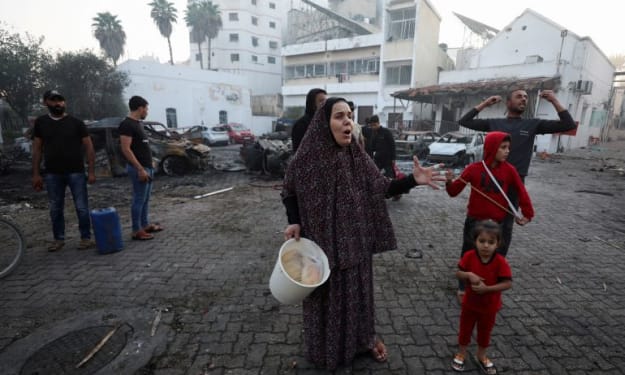
On October 17, 2023, at approximately 6:59-7:00 pm, in Zeitoun, Gaza, Gaza Strip, a devastating tragedy unfolded. A mass-casualty explosion at al-Ahli Arab Hospital resulted in the loss of more than 1200 innocent lives. This incident is a stark reminder of the human cost of continued conflict and the urgent need for a ceasefire. In this article, we delve deeper into the responsibility of those who committed these crimes and explore what we, as humans, should do to seek justice, peace, and a brighter future for all.
By Alexander jackson2 years ago in Criminal
Protecting Innocence Amidst Conflict: Our Collective Responsibility . Content Warning.
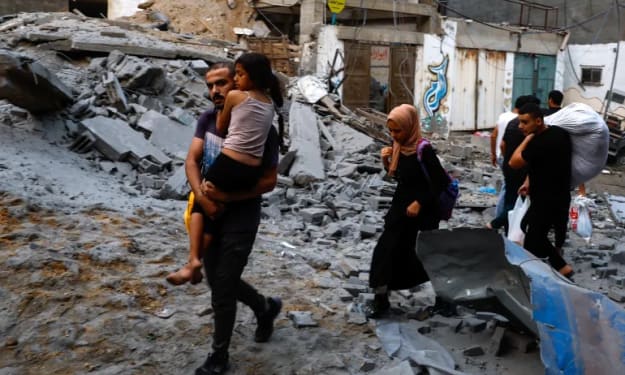
The human toll of war is an indescribable tragedy, and it is especially heart-wrenching when innocent children and families become the unintended victims of conflict. The ongoing conflict in Gaza has resulted in the loss of countless innocent lives, and the stories of these children and their families serve as a stark reminder of the urgent need for peace and stability in the region.Innocent children in Gaza, like any children worldwide, have dreams and aspirations. They have the right to grow up in a safe and nurturing environment, to receive an education, and to have a chance at a brighter future. However, the harsh reality for many of them is quite different. They have grown up amidst the sounds of sirens and explosions, with fear and uncertainty becoming a constant presence in their lives.Families in Gaza, too, have been living under the constant threat of violence for years. The conflict has taken a heavy toll on their homes, their livelihoods, and most devastatingly, on the lives of their loved ones. Innocent mothers, fathers, and grandparents have been lost to the horrors of war, leaving behind a legacy of grief and trauma that will shape the lives of those who survive.
By Alexander jackson2 years ago in Criminal