
Seniors Targeted by Threatening Scam Calls
Verizon’s Inaction Raises Concerns


Updated 1750 HRS, 10 July 2025 — Verizon has responded and indicated they have disconnected the number in question:
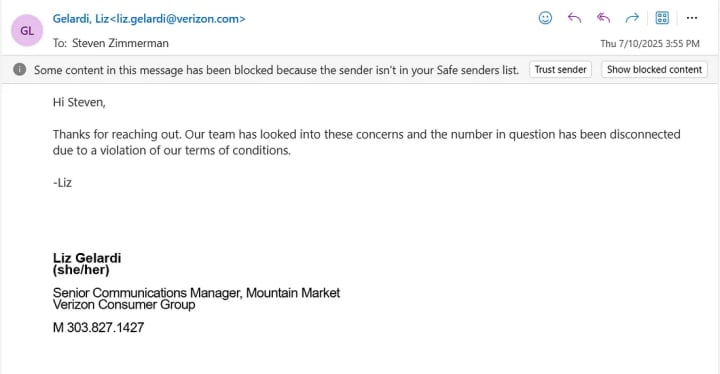
Across the country, individuals, particularly seniors, are falling victim to a surge of menacing scam calls and text messages demanding money under threats of violence. These fraudulent schemes, often originating from numbers linked to known scam activities, are leaving victims like Avi Greenburg and Hannah Abraham terrified and frustrated.
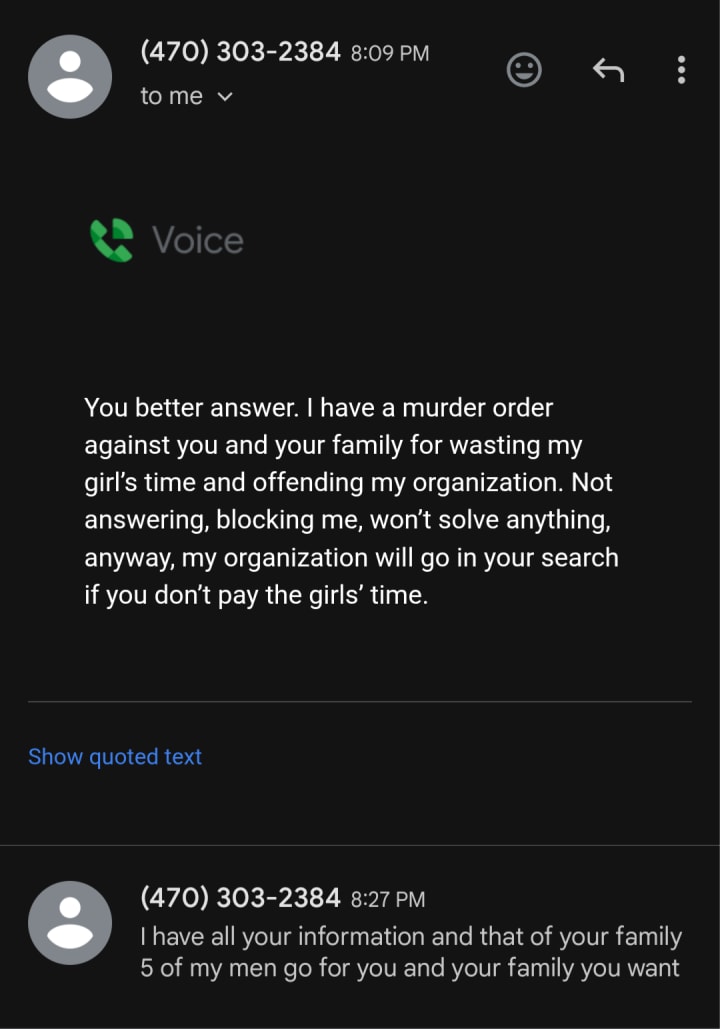
“I don’t know from dating sights,” says Avi Greenburg, a man in his 80s, who has been bombarded with threatening text messages. “They say must give to them $1,500 or they will kill me.” Similarly, Hannah Abraham recounts her ordeal: “These phone calls started after dinner. They said they will put this murder order on me if I choose not to pay them.”
Avi and Hannah are among many who have reported receiving calls and texts from the number 470–303–2384, a Georgia-based phone number tied to scams, according to online reports. Scammers using this number often pose as government officials or debt collectors, employing intimidation tactics such as threatening arrest or claiming victims are targets of identity theft. Their goal: extort money or extract sensitive personal information. These fraudsters frequently demand payments through untraceable methods like gift cards, wire transfers, or apps like CashApp, preying on fear to coerce compliance.
The Growing Threat of Scam Calls
According to the Federal Trade Commission (FTC), scam calls resulted in over $3.7 billion in losses in 2022 alone, with seniors being disproportionately targeted due to their perceived vulnerability. The FTC notes that scammers often use “spoofing” to falsify caller ID information, making calls appear to come from legitimate sources like banks or government agencies. This tactic was evident in Hannah’s case: “The lady I spoke to said that they were helpless in doing anything as the number showing on the caller ID, or with the text messages, was not the real number sending the messages or making the calls,” she explains. “I told them it has to be as they said I needed to use that number to look them up on the CashApp and pay them the $1500 they lost or they would send five men to my home.”
However, not all victims are convinced by claims of spoofing. Ari Cohen, an attorney whose grandmother received similar threats, challenges this explanation: “I made the attempt to explain, if these calls were coming from a different number and the Caller ID was spoofed to show a different number, then why was I able to call and speak to the individual who phoned my grandmother?”
Verizon’s Response — or Lack Thereof
Victims and their families have repeatedly reached out to Verizon, the carrier associated with the 470–303–2384 number, only to face indifference. Yisrael Friedman, whose grandfather received threatening texts, used FreeCarrierLookup.com to confirm the number was registered with Verizon. “I make a call to Verizon to report the calls, and the person I spoke to didn’t care at all. They said there was nothing they could do,” he says.
This sentiment is echoed by others. When a reporter contacted Verizon, a customer service representative stated, “We appreciate you wanting to bring this to our attention, but there is nothing we can do as they are our current customer.” Shockingly, when asked to speak with a supervisor, the representative responded, “I am the highest authority you may speak with, we are not allowed to transfer anyone to our supervisors as they are only for our needs and not customer needs.”
Even law enforcement faced resistance. Hannah noted that police, while at her home, attempted to contact Verizon but were unable to compel action. “What is happening, what Verizon is doing,” says Ari Cohen, “is burying their head in the sand.”
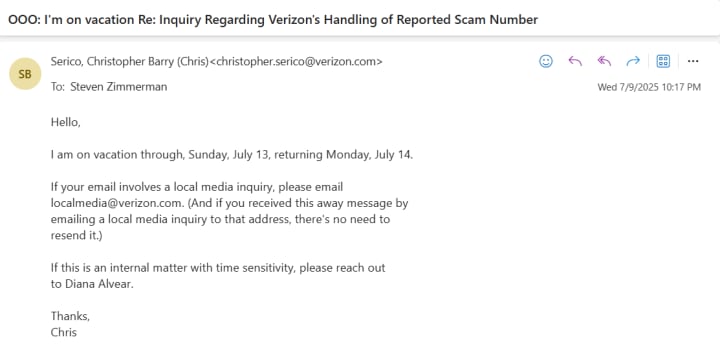
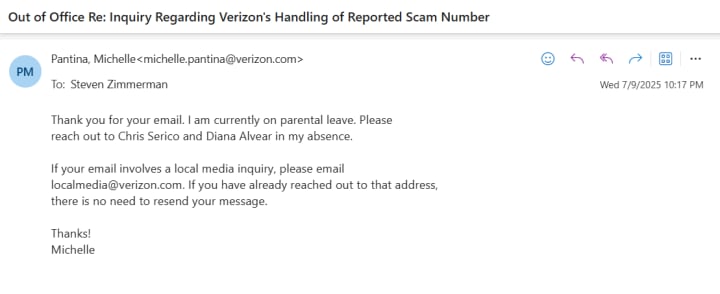
Efforts to seek answers from Verizon’s public information officer, Mariana Agathoklis, via emails to [email protected] and [email protected], were met with automated vacation responses and no further follow-up. Questions about Verizon’s policies on handling scam numbers, why reports go unaddressed, and why customer service cannot escalate issues remain unanswered.
Protecting Yourself from Scam Calls
The FTC and local police departments offer clear guidance for handling threatening scam calls:
- Hang up immediately: Do not engage with the caller.
- Do not call back: This confirms your number is active, inviting more calls.
- Verify independently: Contact the agency or organization the caller claims to represent using a verified number, not the one provided.
- Report the scam: File complaints with local police and the FTC at ReportFraud.ftc.gov.
- Be skeptical of caller ID: Spoofing can make fraudulent calls appear legitimate.
- Resist intimidation: Legitimate agencies do not demand payments or issue threats over the phone.
- Document threats: If threats are made, report them to local law enforcement immediately.
A Call for Accountability
As scam calls continue to target vulnerable individuals, the inaction of telecom giants like Verizon raises serious questions about their responsibility to protect consumers. With fraudsters leveraging their networks to perpetrate crimes, victims like Avi, Hannah, and countless others are left to fend for themselves. Until carriers take decisive action to disconnect known scam numbers and cooperate with law enforcement, these predatory schemes will persist, leaving a trail of fear and financial devastation in their wake.
About the Creator
Steven Zimmerman
Reporter and photojounalist. I cover the Catholic Church, police departments, and human interest.
Keep reading
More stories from Steven Zimmerman and writers in Criminal and other communities.
The El Paso Police Department's Complaint System
A severe problem exists within the El Paso Police Department (EPPD). The problem goes beyond officers who choose off-duty jobs over their police responsibilities. The system stands as a dysfunctional mess which maintains such deep-seated indifference and protective instincts that filing an officer complaint becomes futile. Throughout my experience as a journalist who investigates public officials I have encountered multiple institutional breakdowns but the EPPD remains uniquely incapable of handling misconduct complaints. The refusal of the EPPD to address misconduct issues proves such profound incompetence that it sets a new standard for institutional failure. The issue is not anti-police but anti-injustice and anti-negligence and anti-the absurd runaround that victims experience when they ask for accountability.
By Steven Zimmerman7 months ago in Criminal
Multinational Crisis
Part One: Nigeria You have all heard about Nigerians, Nigeria in general. The infamous scammer country. But let’s have a real conversation. Let me give you some extremely boring stats, so we are on a level playing field, on my thoughts. I’ll be as brief as possible considering, no one wants an hour long dissertation on economic issues.
By Alexandra Grant3 days ago in Criminal
Oklahoma Murder for Hire
Murder for hire in 1988 must have been a real monster of a time to find for a woman who was bored, and just lazy. A woman that claimed she was abused, knew how to work a young man up, back in those days it was much easier to find “a knight in shining armor”. Men all over wanted to be one, no man how scuzzy they really were.
By Cassie Moore5 days ago in Criminal


Comments
There are no comments for this story
Be the first to respond and start the conversation.