

I could feel it looking at me. I’d set it on top of my phone on the nightstand, and in the dark it caught the glow from my phone and the lights of the street below. It looked asleep, the bookmark ribbon lolling like a tongue out the side of its mouth. But I swear it slept with one eye open.
I could smell it; each feeble breeze through the window carried the faintest whiff of dirt and sweat and age across my damp pillow. The night was dead-summer, suffocating hot. The window didn’t do much but amplify the noise of the city. I’d become a connoisseur; by the sound of the delivery trucks beeping, it was the dark hours of the morning, four maybe. I sat up, rubbed my eyes and slid my phone out from under the little black notebook. Tried to scroll my way back into the world.
Still, I could feel it looking at me.
I sighed, took the three steps across to the sink. Put the kettle on the burner ring for coffee. An envelope had been stuck under my door; rent past due, I knew without looking. Didn’t they sleep? I put it in the pile on the countertop: water, heat, electric, credit card, hospital, phone, rent. I’d once thought to keep them organized, prioritized somehow – by amount, months overdue, color of envelope, something. Now, when they slid off the counter and onto the floor, I scooped them up and threw them in the trash. The stack would rise again.
I grabbed my key and headed for the door – this hour, at least the bathroom would be empty.
Back in my room, I sat with my coffee and looked out the window. I couldn’t see much besides other brown buildings towering overhead. At least I faced the street. The night sky was turning gray. I picked up the notebook again.
The black cover was worn, but not cracked – smooth, like it had been oiled. The pages inside were brittle, weathered, tinged with red-brown dirt. The writing looked like black quill ink, a long-ago, almost floral penmanship. Pages had been torn out, more than were left, it looked like. “Julian Spring Road, Julian, Georgia,” it said in the middle of the first page. I stared at it for a long minute. The notebook stared back. I swear it implied, as if in invisible ink, a question: “Well?”
“What,” I said. “That’s not my people. Not anymore.” But I already knew I was going. I got up, dug in the tiny closet, pulled out an old canvas duffel, faded military green. I stuffed in some clothes, toiletries, a couple books to read: Mosley for fun, Frankl because I needed it, Sun Tzu to keep my mind sharp. I reached into the cupboard for the chipped devil jug, and worked my fingers inside. There wasn’t much: maybe $200. I checked the bus schedule on my phone. I could get there, and back. But that would be about it. I shouldered the duffel, put the notebook in my breast pocket, and locked the door behind me.
The bus pulled into Atlanta past midnight – not the best time to land in a strange city. Two transit cops shared a joke with the guy at the newsstand, had a good long laugh that echoed across the terminal. I got some coffee, sat down, and stayed awake. I tried to read Frankl. Kept half an eye on the cops. The notebook sat up in my breast pocket, like a sentry. “If shit goes bad it’s your fault,” I whispered to it.
There was an early morning bus down to Julian. From there, I was walking. The heat never really lifted this time of year, but as I got out of town, toward the hills, there was shade. Nothing passed by me on the dirt road – dead silent, even the birds. I saw a couple old shacks back in the woods, overgrown, half-collapsed. I could feel them groaning.
The map said this was Julian Spring Road, and I had a pretty good idea where I was. Grandad’s stories had painted vivid pictures. When I was young, he made it sound like paradise – how he roamed the green hills, splashed in cool brooks, dug the red earth, how he knew the names of every tree and bush and flower.
Why’d you leave, I’d asked. He just smiled.
He’d taken to retelling those stories when he had the strength these last couple months. I hadn’t wanted to hear it, but I sat and listened – wasn’t much else I could do. His death had been a long time coming – we bounced between the hospital and the nursing home, and it seemed like they only let him pass over when the money ran out, like they had to bleed him dry first. I carried his personal effects home in a single box – clothes, one pair of shoes, one old photo of his wife. A day later, one of the nurses, the only other guy who spent time in Grandad’s room – they’d share a joke or two, and I’m sure he snuck Grandad cigarettes when he wheeled him outside – called me up to say there was one other thing “I had to take possession of.” I met him out front of the home, and into my hand he pressed the notebook, wrapped in a torn strip of white sheet and tied off with red ribbon.
Now, walking down the road, I didn’t feel lost. Somehow I knew – knew the gravel and dust under my feet, the way the road would bend up ahead, knew what I was looking for.
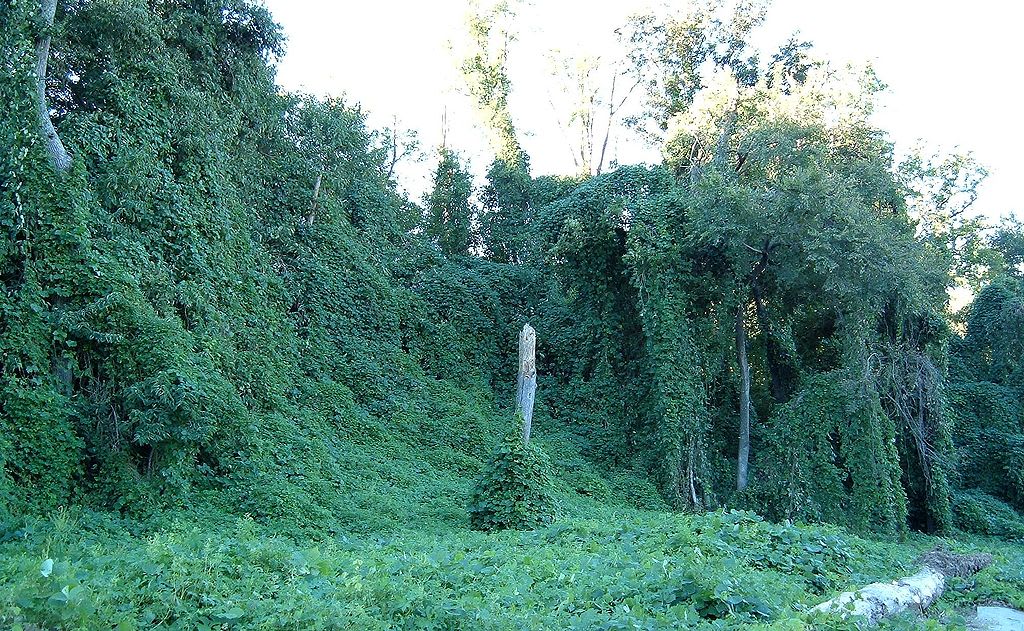
Still, I might’ve missed the gates, but I swear I felt a rustling in my breast pocket when I passed them. Thick Akebia vines covered the posts and wrapped up over the archway. One gate hung, twisted, on a single hinge, dragging in the dirt. The gravel drive was barely visible under a forest of bull thistle, and black walnut trees grew so close overhead it was like a mineshaft. I could barely see the house, set back up the drive.
The lawn was well-clipped around the house, but grew wild and tangled the farther away it got – as if someone had lost interest in the job. The house itself was pristine, the massive columns bright white, the wide steps and porch sturdy. No creeping vines here. I pushed open the front door. In the foyer, I turned to my right, passed through sliding doors into a large library. Dark wooden shelves lined three of the walls. On the opposite wall, thick wine-red curtains were drawn against tall floor-to-ceiling windows. The room felt like midnight. And framed between two of the windows was a large desk, covered by a dusty white sheet.
I snapped the sheet off. The desk was oak, with intricately carved edges and trim, and stood like a ship at rest in the harbor. Centered on it was an old wooden pen box, ebony, polished smooth like glass. I stared at it. Felt a flutter from my breast pocket. I drew back one of the curtains to let in some light; dust swirled lazily around me.
The box needed no key; its latch sprung easily at my touch. I felt the glint almost before I could see inside. The box had black felt lining, and nestled in it were eight large, deep-crimson rubies, surrounded by dozens of diamonds – pure white, cut so fine it seemed they could float away.
I know my mouth hung open. I don’t know how long I stood there. I might still be there, but for the creak I heard from the hallway.
He looked old, but given where we were, younger than I thought he’d be. He carried a thick walking stick, and he limped slightly as he came toward me, but his bearing was upright. “Titus? Titus Julian?”
“I don’t go by that name.”
“Been ages since you left.”
“You’re thinking of someone else.” He walked into the light. His hair was tied back in a black ribbon, his salt-and-pepper beard was full and well-trimmed. His right hand gripped the stick tight, his knuckles white, his nails cracked, two of them blackened. His face was lined, faint traces of red dirt ground into the creases like a fading tattoo. His eyes were grey, milked over like cataracts.
But he saw well enough.
He looked at the open box, and stiffened. “Those don’t belong to you.”
“I hadn’t taken any.”
His stick rapped the top of the desk, between my two hands. The report hung like a gunshot in the silence.
“Those don’t belong to you!” he said again, and again the stick crashed down. The milk grey eyes had gone wild, and I’d like to say I stood my ground, but I felt his fury push me away from the desk.
He shouted it again, and raised the stick, this time charging toward me. I fell back toward the window, and I half-cowered, my eyes shut tight, hands up protecting my head. The the stick cracked against my shoulder, and pain shot down my fingertips and across my chest. He kept coming and his weight pressed into me, and I could feel the hot stink of his breath and I staggered. But I did not fall, and my hands found purchase on him and I shoved back blindly.
I heard the crashing of the window. Then nothing. I opened my eyes.
I looked through the jagged remnants of the pane. Saw red blood spurting into the fresh green grass, one empty grey milky eye staring back up at me. I should’ve been horrified. Or on my knees praying – or at least, out of a sense of self-preservation, running away. But I was calm. Breathing heavy, but calm. Somehow I knew no visitors would come out this way. He’d be lying there until coyotes picked at his bones. I picked up the box, ran my fingers along the mirror-black polish. It was heavier than it looked.
I walked back down the drive into the late afternoon, a long late afternoon in summer. I had plenty of time to make the evening bus to Atlanta.
In Atlanta, I caught the overnight bus back home. It filled up more and more at each stop, but folks seemed content to avoid me. My feet rested on the duffel. The box sat on the empty seat next to me.
The driver had the air conditioning going full blast, but there was a bright line of sweat running down my back. I needed to do some thinking, but there’d be time for that later. I hadn’t slept in three days, and I sure wasn’t about to on the bus. I opened the notebook and turned each cracked, red-brown page again. Each page, another address; none of the rest were familiar to me. I closed it, tied the leather strap around it tight, and put it back in my breast pocket. My hands shook just a little. I rested one on the box. “You knew that was going to happen, didn’t you,” I whispered in the dark. I swear the notebook thrummed against my chest.
About the Creator
Stephen S Lane
Mostly Harmless.
Keep reading
More stories from Stephen S Lane and writers in Criminal and other communities.
Who over what
Long ago, when DVD’s and VHS tapes roamed the earth and Netflix was still a mail-order service, I moved to a new city for a job doing something I really loved. I was just starting out on the journey we call adulthood – which at the time, I thought of as a destination – and I was determined to make the most of what I believed adulthood should be: A life propelled by the thrill of charting my own course, by the near-certainty that great things were just around the corner and the endless possibility of a city and its millions of people.
By Stephen S Lane5 years ago in Geeks
Donald Trump and the Iranian File: Policies, Tensions, and Public Questions
Donald Trump and the Iranian File: Policies, Tensions, and Public Questions Donald Trump’s approach to the Iranian file marked one of the most controversial chapters in modern US foreign policy. During his presidency, relations between the United States and Iran shifted dramatically, moving away from diplomacy toward pressure and confrontation. Trump’s decisions reshaped the Middle East landscape, affected global energy markets, and sparked intense debate both inside and outside the United States. Understanding Trump and the Iranian file requires examining his strategy, its consequences, and the questions people most frequently ask.
By America today 5 days ago in Criminal



Comments
There are no comments for this story
Be the first to respond and start the conversation.