
One Mile Away: Why the Yeadon Police Department had to drive an hour to do Ephrata’s Job
Chapter 14: The Ephrata Police Department is a 3-minute drive from the 'House of Skulls.' Yet it took a detective squad from Delaware County—60 miles away—to finally knock on the door.

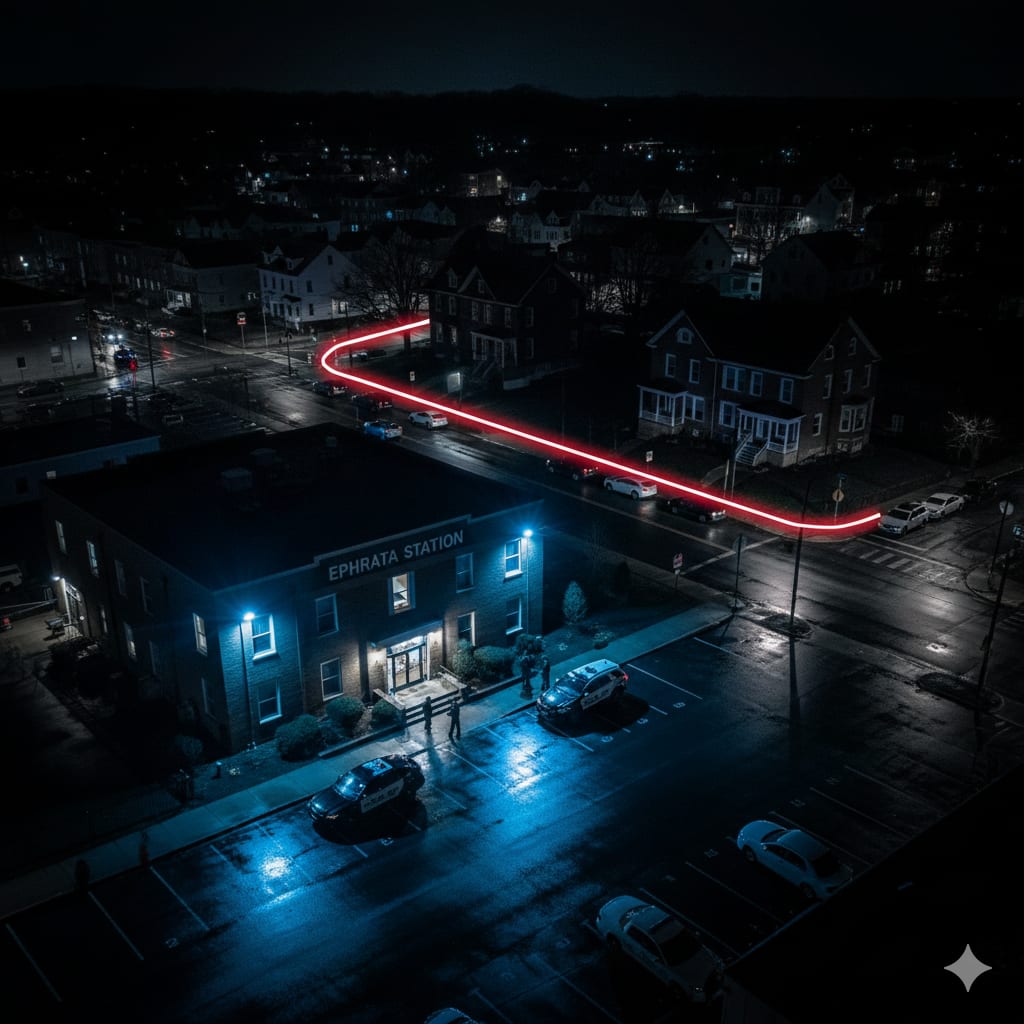
The Commute to Justice
On the morning of January 7, 2026, a convoy of unmarked police vehicles merged onto the Pennsylvania Turnpike. They were driving West, away from Philadelphia. They were detectives from the Yeadon Police Department (Delaware County).
Their destination was 100 Washington Avenue, Ephrata. They were coming to execute a search warrant for a man who had been terrorizing their local cemetery, Mount Moriah. They had tracked him through cell phone pings, surveillance, and old-fashioned detective work.
They drove 65 miles. They paid tolls. They sat in traffic. Meanwhile, the Ephrata Police Department (EPD) sat in their headquarters at 124 South State Street. Distance from headquarters to the House of Skulls: 0.6 miles. Driving time: 3 minutes.
The "3-Minute" Hypocrisy
In August 2023, Ephrata Police Chief Chris McKim publicly defended his department’s budget to Ephrata Township supervisors. His selling point was speed.
"There were three cops on scene in less than three minutes," McKim boasted about a stabbing response, claiming his department provides "exceptional service" because of their proximity.
If Chief McKim’s officers can respond to a violent crime in 3 minutes, why did it take them two years to notice a man stockpiling human remains just three blocks away?
- The Promise: "Three minutes to safety."
- The Reality: The Yeadon Police had to drive 90 minutes to do the job for them.
The "Open Secret" Ignored
How does a man store over 100 sets of human remains, generate swarms of blow flies, and emit the odor of decomposition in a dense rowhome neighborhood without the local police noticing? The answer is not that they couldn't know. It is that they didn't look.
We know this department’s playbook intimately. The Ephrata Police Department does not lack resources; they lack priorities. While Yeadon detectives were building a felony case, Ephrata officers were likely doing what they are famous for:
- Weaponized Loitering: Parking cruisers in front of the homes of "problematic" citizens (critics and activists) to intimidate them, rather than patrolling for actual threats.
- Revenue Generation: Obsessively writing parking tickets on Main Street to fund the borough's coffers.
- Selective Enforcement: Responding instantly to "disorderly conduct" calls when they want to silence a dissenter, but ignoring the stench of death wafting from a "quiet" neighbor's basement.
The "Safe, Clean, and Green" Distraction
We dug into the Ephrata Borough Council Minutes to see what the police were actually focusing on while Gerlach was robbing graves. The records from November 13, 2023—just a month after Gerlach bought the house—show the Council obsessed with Mainspring’s "Safe, Clean, and Green" initiative.
But "Safe" didn't mean "catching criminals." It meant "Traffic Calming." In the 2024-2025 Budget Sessions, Council approved massive spending on:
- Body Worn Cameras ($5,000 reallocation): Good for liability protection, useless for crime detection.
- New Vehicles ($400,000 transfer to Mobile Equipment Fund): Shiny new cruisers to drive past the crime scene.
- Pension Increases: Ensuring the officers are comfortable while the community is at risk.
While they were approving funds to police "quality of life" issues like noise complaints and tall grass, they missed the ultimate quality of life violation: Death.
The Surveillance Lie
This is a department that has invested heavily in License Plate Readers (LPRs) and high-definition cameras at major intersections. If you have an expired inspection sticker or a suspended license, their system flags you the moment you cross the borough line. They use this technology to hunt low-level offenders and generate fines.
Yet, Jonathan Gerlach—driving an SUV likely loaded with shovel tools and human remains—passed through this digital dragnet for two years without raising a single red flag. It proves what many of us have known for years: The surveillance isn't for safety. It's for control. And it failed the moment a real criminal came to town.
The 3-Minute Radius: What Were They Doing Instead?
To understand the magnitude of this failure, we must look at what the EPD was prioritizing within the 0.6-mile radius of the "House of Skulls." Based on their own Annual Reports, the EPD issued hundreds of summary citations for:
- Disorderly Conduct (often used against homeless or teenagers).
- Parking Violations (Revenue generation).
- Traffic Stops (Over 1,500 stops in 2024 alone).
They were everywhere. They were watching the streets, the sidewalks, and the parking meters. They were so busy policing the citizens for revenue that they completely missed the criminal collecting bones.
The Jurisdiction Excuse
Defenders of the Borough will argue: "The crimes happened in Yeadon (the theft), so Yeadon had to investigate." This is legally true, but practically nonsense. Receiving Stolen Property and Abuse of Corpse are continuing crimes. Every second those bones sat in that basement in Ephrata, a felony was being committed in Ephrata. Ephrata PD didn't need a warrant from Yeadon to investigate a smell. They didn't need permission to knock on a door. They simply didn't care.
The Humiliation of the Raid
When the Yeadon team arrived in our borough on Jan 7, they had to notify the local jurisdiction as a professional courtesy. Imagine that phone call. "Hello, Chief McKim? This is Yeadon. We're in your town. We're about to raid a house three blocks from your station because a guy has been stockpiling skeletons under your nose for two years."
The EPD officers who assisted in the raid were reduced to glorified security guards. Photos from the scene show local officers holding the perimeter tape while out-of-town detectives carried out the evidence boxes. It was a visual representation of a systemic failure:
- Yeadon did the work.
- Ephrata took the embarrassment.
The Price of Incompetence
As taxpayers, we are funding a police department that operates with a multi-million dollar budget. We pay for the cruisers, the LPR cameras, the pensions, and the salaries. What was the Return on Investment (ROI) for that funding in the Gerlach case? Zero.
- Cost of Ephrata Police Detection: Millions annually. Result: Missed the serial offender living 3 blocks away.
- Cost of Yeadon Police Detection: Funded by a different county. Result: Solved the case.
We are paying premium prices for a police force that functions more like a revenue-collection agency than a crime-fighting unit.
Who is Watching the Watchmen?
This raid proves that we cannot rely on the Ephrata Police Department to keep us safe from actual, complex threats. If the threat isn't speeding on State Street or a citizen documenting public officials, it seems to fall into the "Blind Spot."
We owe the Yeadon Police Department a debt of gratitude. They cleaned up our streets when our own officers wouldn't. But as the lawsuits begin to fly, we have to ask Chief McKim: You said EPD is "worth every penny." So why did we have to import justice from 65 miles away?
🚨 Continue the Investigation
The police failed. The borough failed. The cost to taxpayers?
⬅️ Previous: Chapter 13: The "Revitalization" Lie (Mainspring's Failure)
➡️ Next: Chapter 15: The $23,000-a-Day Question
More on Vocal from Sunshine Firecracker☀️🧨:
- Inside the House of Skulls: The Complete Investigation (Master Hub)
- The Man Who Collected Death: A Profile of Jonathan Gerlach
- Is Your Town Hall Breaking the Law? A Citizen's Guide to Official Oppression in Pennsylvania
COPYRIGHT & TRADEMARK NOTICE © 2026 Sunshine Firecracker / Dr. Jennifer Gayle Sappington, J.D. All Rights Reserved.
LEGAL DISCLAIMER The content provided in this article is for informational, educational, and advocacy purposes only.
EDITORIAL NOTE Quotes from Chief McKim sourced from public meetings (August 3, 2023). Distance calculations: Yeadon PD to Ephrata (64.8 miles) vs. Ephrata PD to 100 Washington Ave (0.6 miles). Budgetary figures cited from 2024-2025 Borough Council Minutes.
About the Creator
Reader insights
Outstanding
Excellent work. Looking forward to reading more!
Top insights
Compelling and original writing
Creative use of language & vocab
Easy to read and follow
Well-structured & engaging content
Excellent storytelling
Original narrative & well developed characters
Expert insights and opinions
Arguments were carefully researched and presented
Eye opening
Niche topic & fresh perspectives
Masterful proofreading
Zero grammar & spelling mistakes
On-point and relevant
Writing reflected the title & theme
Keep reading
More stories from Sunshine Firecracker and writers in Criminal and other communities.
The "Revitalization" Lie: How Ephrata’s Obsession with 'Curb Appeal' Hid a House of Horrors
The Brand vs. The Bodies If you walk down Main Street today, you will see the banners. You will see the matching flower pots. You will see the "Welcome to Ephrata" signs designed to project an image of quaint, small-town prosperity.
By Sunshine Firecracker4 days ago in Criminal
A $600 Car That Became a Trap
A $600 used Chevrolet Monte Carlo sat in a parking lot at Chicago O’Hare International Airport long enough to turn into a six figure problem. By the time the situation became public, the car had been cited a record 678 times and the balance attached to it was reported at more than $106,000. The person whose life was upended was not the person accused of abandoning the vehicle, but the woman whose name was on the registration: Jennifer Fitzgerald.
By Rare Stories6 days ago in Criminal



Comments (1)
What stays with me most about this story isn’t the distance on the map — it’s the distance between what a community pays for and what it actually receives. A police department is not a symbol. It is a service. And services are measured not by their budgets, slogans, or surveillance toys, but by whether they notice real danger when it is close, quiet, and inconvenient. This case exposes something uncomfortable: when policing is optimized for revenue, control, and optics, it becomes blind to crimes that require patience, curiosity, and moral seriousness. The systems worked perfectly — just not for justice. License plate readers flagged the wrong risks. Patrols circled the wrong streets. Resources flowed toward enforcement that produces numbers, not toward investigation that prevents harm. Yeadon didn’t succeed because they had more power. They succeeded because they did the work — followed patterns, asked questions, stayed with the case, and acted when the facts led somewhere difficult. That shouldn’t be exceptional. That should be the baseline. What failed here was not proximity, funding, or technology. What failed was attention. This isn’t an anti-police story. It’s an accountability story. Taxpayers deserve to ask hard questions about return on investment — not in dollars, but in safety, discernment, and trust. When justice has to be imported from 65 miles away, something is broken locally, and embarrassment is the least of the cost. Sunshine Firecracker doesn’t sensationalize this failure. She documents it. And documentation is an act of civic care. It asks us not just to be outraged, but to stay awake long enough to demand better — from systems, from leadership, and from ourselves as citizens. If no one is watching the watchmen, the price isn’t just incompetence. It’s silence where vigilance should have been.