
Military robbery | The most dangerous armed operation in the world (the reason for arming the police)
"44 Minutes of Hell in the Heart of Los Angeles" On a quiet morning in 1997, a peaceful neighborhood turned into a real war zone… Two men, armed to the teeth and protected by heavy body armor, went head-to-head with an entire city’s police force. Thousands of bullets, dozens of injuries, and one of the bloodiest scenes in modern American history. What drove them? And how did the police find themselves powerless? A bank robbery that spiraled into a live-broadcast nightmare… Get ready for one of the most violent standoffs that forever changed the face of American law enforcement.

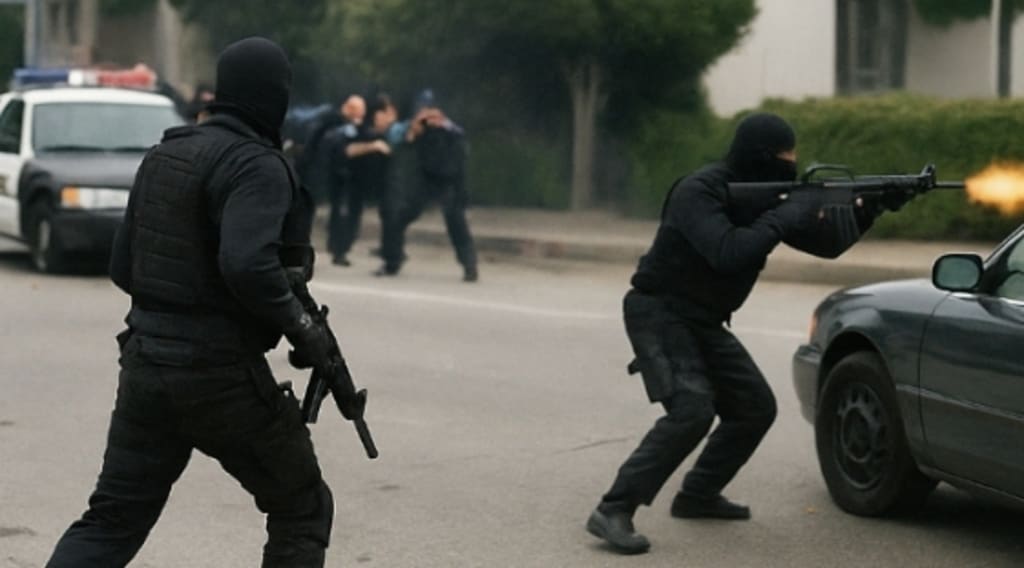
On the morning of February 28, 1997, a fleet of news helicopters flew toward a bank in a quiet neighborhood in North Los Angeles. When they arrived, they pointed their cameras at the bank’s parking lot and began broadcasting live. What appeared on the screens was a bank robbery—expected to be routine, like thousands before it—but this time, it was completely different.
In a matter of moments, the robbery turned into one of the most violent shootouts in American police history. Two armed men engaged in a massive firefight with dozens of LAPD officers. The scene resembled a war zone: two men, fearless, firing nonstop, armed with automatic weapons, thousands of rounds of ammunition, and body armor impervious to standard police bullets.
The police were outnumbered and under-equipped. Their handguns were useless against the robbers’ heavy armor and high-powered rifles. The streets of the city turned into a battlefield, broadcast live to millions around the world.
One of the robbers was Larry Phillips Jr., a man who came from a long line of criminals—his grandfather robbed trains, and his father dug up graves. In 1984, he turned to bodybuilding and joined Gold's Gym in Pasadena. His goal was to build an impressive physique, but when he realized his body couldn't compete professionally, he chose a different path.
He tried to appear as a businessman, even stealing a suit from a store—but was caught and jailed for a short time. After his release, he became a real estate agent, but the income didn’t meet his expectations. He turned to scams and fraud, and eventually to bank robbery. But he needed a partner—Enter Emil Mătăsăreanu, a Romanian immigrant who moved to the U.S. in 1976.
Emil had health issues, was overweight, and suffered from bullying. But determined to change, he too joined the same gym as Larry. That’s where they met. What brought them together was their mutual love for guns. Larry was experienced, and Emil was a passionate hobbyist—soon that interest evolved into crime.
Between 1990 and 1992, they carried out a series of minor robberies: hitting convenience stores and ambushing money transport vans. In 1993, they executed their first major heist—ambushing an armored truck and stealing tens of thousands of dollars.
Later, they were stopped by police for speeding. A search of their car revealed an arsenal of weapons, ammo, smoke grenades, body armor, fake IDs, and even listening devices. However, since they weren’t caught in the act of robbery, they were only charged with illegal possession of weapons. Larry was sentenced to 99 days, Emil to 71.
Upon release, they resumed preparations. In 1995, they ambushed another armored truck and killed the guard. In 1996, they hit two Bank of America branches, stealing hundreds of thousands of dollars each time—fast, efficient, and undetected.
But the money ran out quickly. Their lifestyle didn’t allow for saving. So in 1997, they planned another robbery: the Bank of America branch on Laurel Canyon Boulevard, the largest in North Hollywood. It was strategically located—next to a mall, surrounded by open parking lots, with multiple escape routes.
They stocked up on military-grade weapons: AK-47s, a Bushmaster XM15, an HK91 sniper rifle, and over 3,000 rounds of ammunition. Their armor was homemade—Kevlar vests reinforced with steel plates, and Larry even wrapped himself in industrial protective blankets.
On the morning of Friday, February 28, at 9:16 a.m., they stepped out of a white Chevrolet, took Phenobarbital (a sedative to calm their nerves), and entered the bank. Their plan: take control, open the vault, fill their bags, and escape within 8 minutes.
But something went wrong…
The money they expected hadn’t arrived yet. The vault had individual safety deposit boxes, each needing a key. Meanwhile, a patrolling police car noticed them and reported a suspicious situation, requesting backup.
Within minutes, the police surrounded the bank. Larry began shooting to intimidate civilians, then turned his gun toward the officers. Emil came out minutes later with a bag holding $33,000, not realizing it contained dye packs that exploded after being hit by a bullet, staining the cash red.
The standoff escalated. The police were under-armed—some had to borrow high-powered rifles from nearby gun stores to match the robbers’ firepower. Larry and Emil moved in military formation, covering each other, taking turns firing, like trained soldiers.
When they ran low on ammo, they tried to flee in their car. Police shot out the tires. Larry walked behind the vehicle, using it as a shield, still firing, while Emil drove slowly beside him.
Eventually, they reached a residential neighborhood, where they split up. Larry hid behind an abandoned truck and was shot multiple times, dying on the spot. Emil tried to hijack another car, but the driver fled with the keys. Surrounded, Emil continued firing, even after taking over 20 bullets to the legs.
In the end, he surrendered, was handcuffed, and left bleeding on the street for over 56 minutes, while paramedics were kept away in fear of hidden explosives. He died on the scene from blood loss.
The shootout lasted 44 minutes, with over 2,000 rounds exchanged. Twelve police officers and eight civilians were injured. Over 300 officers and SWAT teams responded.
Investigators later discovered more weapons, ammunition, body armor, and even a makeshift bomb factory. At the time, LAPD officers were equipped with 9mm pistols or .38 revolvers, ineffective against armored assailants. The incident revealed a major gap in police preparedness.
In response, police departments across the U.S. upgraded their weapons and tactics. The AR-15 became standard issue, as did armor-piercing rounds, improved vests, and military-style helmets. Though this wasn’t the only reason for police militarization, it was a critical turning point.
The North Hollywood shootout remains one of the most violent criminal encounters in American history—and it changed law enforcement forever.
About the Creator
Ink pulse(different angle)
Storyteller of truth and mystery. I write gripping true crime stories, documentaries, and fascinating facts that reveal the unusual and the unknown. Dive into the world where reality meets suspense and curiosity.
Keep reading
More stories from Ink pulse(different angle) and writers in Criminal and other communities.
A genius robbery when determination surpasses the state. The Bank of Britain robbery.
On Sunday, 19/12, 2004, Kevin McCarlin, the branch manager of Northern Bank in Northern Ireland, was sitting at home with his wife watching TV. Suddenly, there was a knock on the door, and when he opened it, he was surprised by two men in police uniforms who told him: "Unfortunately, there has been an accident involving one of your family members, and you need to come with us to identify the body." But this was a lie; they were not police officers at all.
By Ink pulse(different angle)6 months ago in Criminal
The Ephrata Man Who Collected Death: A Profile of Jonathan Gerlach
The Mask of Normalcy To the residents of Ephrata Borough, Jonathan Christ Gerlach was just the guy at 100 Washington Avenue. He was 34 years old. He drove a silver Toyota RAV4. He paid his taxes. There were no red flags on the exterior of his property. The lawn was cut. The siding was clean. In a town obsessed with "curb appeal," Gerlach was a model citizen.
By Sunshine Firecracker5 days ago in Criminal
For Survivors of Assault and Battery: When to Call the Police and Why It Matters
Calling the police in a moment of danger can be one of the most important decisions a person makes. Although it doesn't solve every problem and may not be the right choice in every situation, when safety is at risk, involving law enforcement can be the most effective way to prevent further harm and create the legal foundation needed for restraining orders, criminal charges, and civil claims.
By jason escoto2 days ago in Criminal



Comments
There are no comments for this story
Be the first to respond and start the conversation.