


How many years of metamorphic perfection separated God from man? Michael had long pondered this question as though it had an answer. Through his lowly years of learning, Michael had become certain in his affliction: To mould thyself in thine own image through some ideal of divine affinity, is seldom a miracle and a curse upon man. If power was the key to prosperity, it was absolute that he had dawdled beyond the peril of disillusionment.
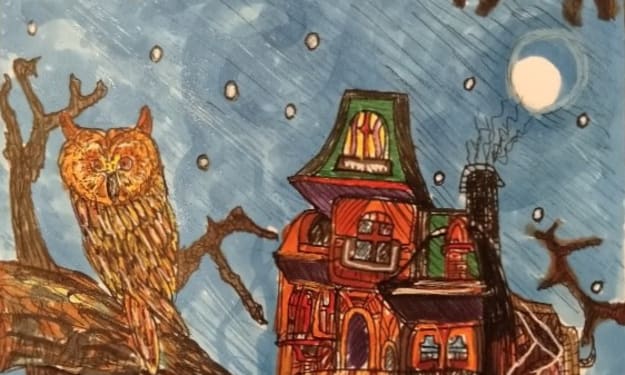
Michael, for as long as he could remember — unlike most who shared in his dainty world of dreamers and drug addicts — had learned, or rather unlearned, to strive for anything further than a life of almost ethereal existence. So when he had met Mr Xin, nothing more could have deterred him from a path of folly forgetfulness. He had been extraordinarily lucky to inherit, apart from an undying optimism, a small estate, built in the 19th century and dilapidated to the point of being a burden. The pipes had been constantly blocked by the roots of a large Camphor Laurel tree which worked almost like clockwork. Every few months or so, he would have to cut the roots and unblock the pipes. He could have sold the B.M.W just to replace the pipes, but it didn't suit him. His guide and saviour, Hugo Xin who was a militant old man of Austrian-Chinese descent, had tried every manner of poison and chainsaw, but could not prevent the wretch from growing, as the tree spread from his neighbours who were entirely indifferent, and often acted indignantly when the poison spread to their garden. Hugo wasn't without faults, but he was deeply revered by his young apprentice whom he taught to master music and machinery, but most importantly a philosophy of life. It wasn't until he perished at the ripe old age of ninety-seven, that he grasped the purpose of this philosophy — pride and joy over himself and others in every regard. One couldn't have known he was any older than eighty-five, it was the final year where he deteriorated drastically into disrepair.
At the age of seventeen, Michael would go on to be a welder, and with his violin, audition at the local Conservatorium of Music, as well as satisfy the odd job of fixing or ‘tweaking’ someone’s car. He had held many jobs, some more fruitful than others, earning a small fortune of 100,000 dollars by no less than the age of twenty. In all his years, he never left his small town, it had a charm about it, the kind one might only understand from learning its history. He had done well for himself; to know a score of people in a small community allowed him to wield influence over his estate, and though it was not Los Angeles or Paris, it was home. With the money, he erected a small shop of his own, fixing string instruments, giving refuge and music lessons to the young. A few months after its establishment, on his twenty-first birthday, he went to have breakfast with some friends. It was a summer morning, Michael sat at a Moldovan cafe with his companions, Mario and Horst— who were both about a decade older than himself — jabbering about Schumann, Japanese bands and subjects which he was only vaguely contributing to, all-the-while sensing the gaze of a woman who sipped her coffee almost feverishly. Eyeing her in his periphery, it was curious to know she was as skilled in surveillance as himself; she might have even understood German. It was indeed probable from that distance if her ears were sharp. “Komm zu mir,” he uttered in his head, not half expecting a reaction. It wasn’t as though he didn’t put effort into attracting women; he usually preferred it to be hard. It reassured him to know that he had the luxury of being young and overall, free. It was rare, in a small town, to meet a beautiful woman who was as free and young as himself. He had on occasion met young girls, beautiful, but lost in problems of which he knew nothing. He had no family, no rent, no drama; his friends were almost all either musicians or tradesmen which were two worlds enough in themselves which usually never collided; though some of the factory workers had grouped to make a formidable death metal band.
“Michael! Are you even listening?”
Good question — had he? He recounted the conversation, the way you might reverse a recording on a cassette, he had possessed this ability since he was a child; it was only offensive to those who noticed.
“Ahh — of course, Schubert’s Winterreise, a year after Beethoven beat the dust. — So what?”
“What did I say?” spouted Mario.
Michael could talk about almost anything, to a point.
It was unmistakable, the woman with suspiciously false blonde hair had winked at him. Was this a test, a threat? He felt his insides churn over, bearing his fanaticism; broke his gaze and scoffed down the rest of his cheese-stuffed Invârtită. “What’s gotten into you?” asked Horst sardonically.
“Nothing,” Replied Michael dryly, clearing his throat. He got up out of his chair, turned, and there she was holding up a tall glass of water. He looked straight at her now without perversity. Her eyes were sharp, blue and calm like her dress and hat. He accepted the glass with gratitude, twisting his face into a smile, brought it to his lips and then froze. She looked mournful, turned and sped away. Michael, besieged with anger, raced to the bathroom and forced himself to puke, whatever was in that water meant bittersweet death. He hadn’t the faintest idea why he was being made to die, but it could not be, not yet. He took out a black notebook and scribbled his will and testament along with a drawing of a faint tattoo from the woman’s arm as best he could. He then tore the pages, rolled and stuffed them into a crack between the window seal. Horst came in to find his friend unconscious, but alive and as he bent down to carry him, he was incapacitated from behind. After some untold hours, Michael awoke, feeling hot blood trickle down his neck; it was not his own. Tied to his back was Horst, his head-wound untreated, a pool of thick blood gathering at his feet. They were strapped to a stool which was bolted to the ground, Michael’s arms extended, nailed flat to a wooden table.
“Oh good, sunshine’s awake,” snapped a man with a cockney accent, approaching from the end of the dimly lit cellar. Another man, shorter, but bulkier entered through a doorway with a look of sorrow.
“Do you know why you’re here?” he spoke slowly, with an Italian accent.
“No,”
“Oh but surely you do, you’re a smart man, a very smart man. — No? Well then, I should apologise and tell you this is not personal, not in the natural sense, this is business.”
“Please, there must be some mistake, I own a music shop, I just fix things, I have no business with you.”
“Ha! Ma mi pigli per culo? Che figlio di merda. — You hear that Jim, a humble musician making his way. — We were gonna recruit you you know, but that old bastard snatched you up, and now you think you can do the same?” — “The children are ours! — Now I’m a man of patience, and I’ve heard you play — beautiful — which is why it would be a real shame if you lost your fingers, or more.” — “Ey! Dove vai giovanotto, dove vai?”
The man lunged and kicked him square in the balls, smashing the back of his head into Horst’s. It took an abundance of willpower to keep his eyes attentive.
“Now you hear me, good. This can play out in your favour if you listen, and make me a promise: That you will end your conquest of thievery before I make you a martyr, and repent. We will take your shop, your house, and you can leave this town which has blinded you. — If I believe you, I will take your fingers, if I don’t, I will take your life.” — “Do you understand?” less a question than a command.
Michael pleaded, “You don’t have to do this!” How could he not have foreseen this?
“Please, Signore. I will leave everything! You can have it all, only don’t take my hands, please. I’m not a literary man, I can play at your daughter’s wedding, anything you like. — This isn’t necessary.”
“What did I say — smart right? Except I don’t want to see you, ever. So you can keep your filthy hands to yourself. I’ll not let you anywhere near my daughter ever again. — Aaah… So you’ve made your choice.” He reached behind his back and grabbed a revolver.
— “Fingers! — I choose fingers” he screamed.
“All yours Jimbo,” handing his subordinate a large cleaver, and proceeded to leave the room, calling, “Kill the other one.” brushing past the vinyl Fly strips.
The skinny man made a sort of contorted smile to show his appreciation. Gripping it smartly, he lunged forward, slapped Michael’s hands, and brought the blade up.
— “Non devi, non devi! Per favore!” He began cursing in German, Russian and in his native tongue, Hindu which he thought long forgotten; sobbing violently.
“Squirmy little runt aren’t ya. Why don’t I take your tongue you jumped up—.”
He had done it, with all his strength he leapt, pivoting from his bolted hands, like Rene Higuita’s scorpion, the stool broke free, snapping, knocking the chap into the ground. Horst opened his eyes, he was floating under Michael’s weight. Taking the table with him, above his head, — his hands were in excruciating pain — Michael managed to land on his feet and rushed weakly with all his force. Using his boot, which possessed a small knife, before the fellow could get up, he kicked the man straight in the cervical artery, and then promptly collapsed backwards under his weight, squishing poor Horst, and smashing the desk.
It had not been in vain. He freed his foot, unbolting one screw was all it took, and it was only possible because of Mr Xin.
“Horsty, are you okay, are you awake? Quickly!”
“Yes,” he croaked.
“It’s up to you now. Roll over, use the knife to free yourself! And then check for a gun.”
He did so with some difficulty, using the bleeding carcass as leverage. Horst turned the man over and tore from his waist a Walther LP53. Unsure of what to do with it, he pocketed it in his coat.
Michael, who had used every ounce of strength, had gone quite pale. Horst used the curved groove of the cleaver to remove the nails from the desk panel. As he struggled to free Michael from the stool, he heard footsteps coming from a staircase. His whole body shook uncontrollably, his head pounding with blood and fear. He drew the gun in apprehension. “Come on Jim, the boys want you on this game. Hurry up.” a voice called jeeringly.
“Coming! Sorry, got a sore throat.” — Dead silence, he’d been made.
“Don’t let him get away!” rasped Michael.
Horst sped through the door, up the staircase — he was not a young man and felt close to death himself — he was too late, he reached the top, and peered inconspicuously with his gun drawn. There were five men around a poker table, all wearing grey suits. It couldn’t be, It was Mario, he was speaking to the stout boss fervently. Horst was furious, he raised the gun.
*BANG*
Horst’s body fell backwards, rolling down the stairs, the gun clasped tightly fell out smacking concrete. Michael gasped and hobbled towards the gun. He was out of tricks, he was sure to die here, alone.
About the Creator
Lorenzo P
I am a man of simple pleasures, my passion is in Science and Technology. My hobbies include Soccer, basket-ball and playing Trumpet. I suck at skateboarding, piano and writing, but I do it anyway.
The Duelist
The rays of a dying red sun flashed against the onrushing blade. The grey beards say the key to dueling lies in size, speed, reach, righteous fury, whatever the person in front of them pays them to say. Matteo knew better than any it was none of these and had an undefeated record on these sands to prove it.
By Matthew J. Fromm4 days ago in Fiction


Comments
There are no comments for this story
Be the first to respond and start the conversation.