
Bentong Kali: Malaysia’s Deadliest Gangster Who Turned Streets into a Hunting Ground
He killed without warning, struck fear into gangs and innocents alike, taunted the police as if untouchable, and left a trail of terror across Kuala Lumpur that no one would ever forget.

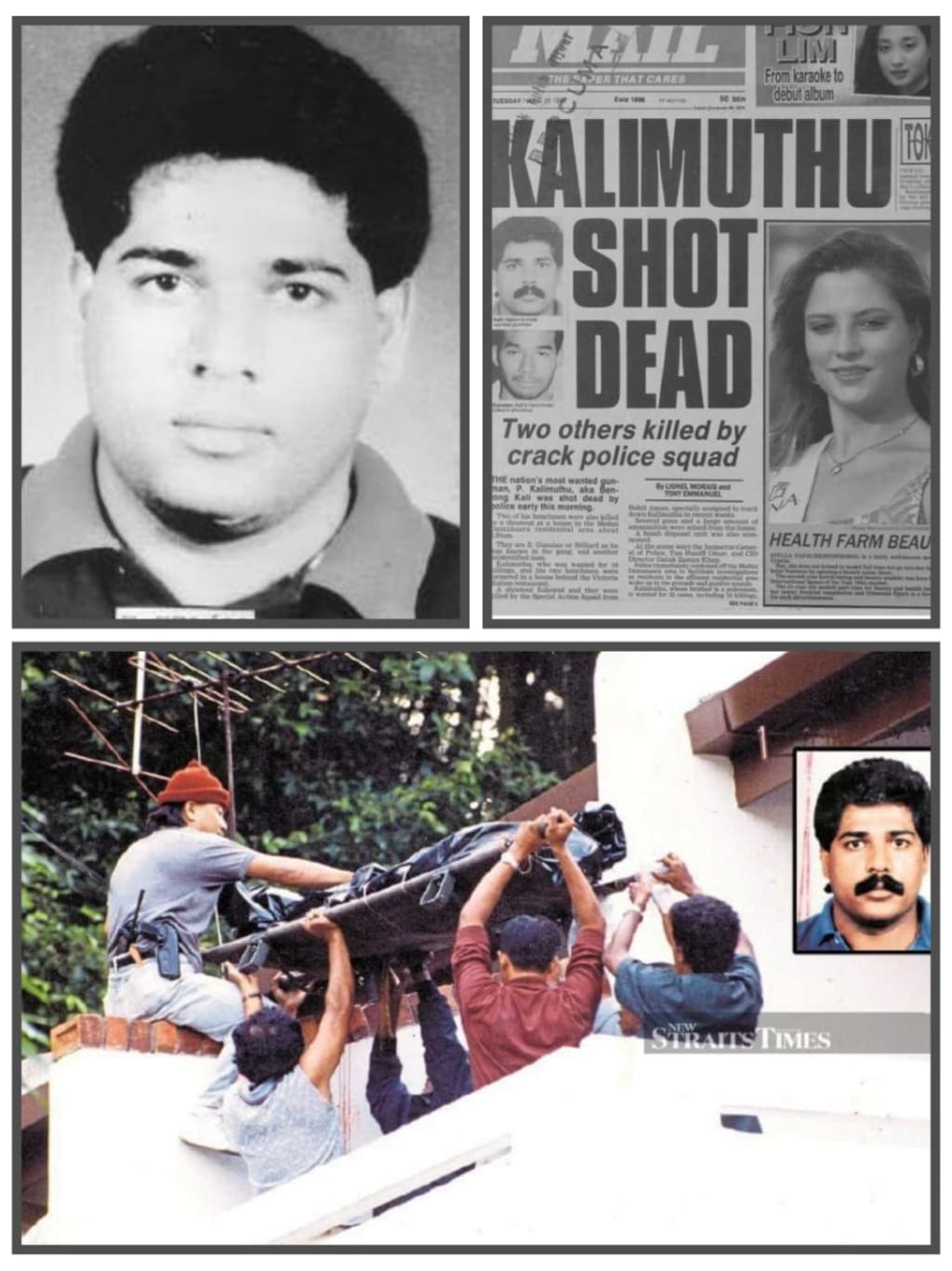
Kalimuthu s/o Pakirisamy, better known on the streets as Bentong Kali, was more than a criminal; he was an embodiment of fear, a force that seemed to pulse through Kuala Lumpur itself. Born on January 22, 1961, in the small town of Bentong, Pahang, he was the eighth of eleven children in a household stretched to its breaking point by poverty and hardship. Life taught him harsh lessons early: survival mattered more than rules, and strength mattered more than kindness. School offered little refuge; authority felt alien and ineffective. By fourteen, he had already been arrested, briefly confined in detention, yet that brief encounter with the law did nothing to instill obedience—it lit a fire. He realized quickly that the world respected only what it feared, and he intended to be feared.
As a teenager, Kalimuthu drifted into the embrace of street gangs, initially as a low-level enforcer, running errands, collecting debts, and learning the brutal hierarchy of Kuala Lumpur’s underworld. Yet, even among seasoned criminals, his presence was unmistakable. Violence seemed almost instinctive, precision in chaos natural. He rose fast, breaking from his original gang to carve his own empire. From Jalan Klang Lama to Brickfields, Segambut, Sungei Way, and Ampang, Bentong Kali ruled the streets. He oversaw drug trades, extorted local businesses, ran illegal weapons operations, and enforced his will with a gun in hand and a temper that could ignite at the slightest provocation. His name alone commanded obedience; rivals whispered it, civilians feared it, and even the police approached him with caution.
By the early 1990s, Bentong Kali’s notoriety had reached a terrifying peak. Police records indicate at least seventeen murders between 1991 and 1993, but the numbers failed to capture the psychological impact of his presence. He could appear suddenly, sometimes in broad daylight, on motorcycles roaring through narrow streets, bullets tearing through darkness, puncturing walls, and shattering lives in moments. In restaurants, diners often froze mid-bite as a gun appeared at the edge of a table. Alleyways became hunting grounds; rival gang members disappeared with no warning, leaving only whispered rumors of Bentong Kali’s signature brutality. He was unpredictable, explosive, yet frighteningly calculated, capable of reading people’s reactions in seconds and exploiting fear as both weapon and armor.
His aura was as lethal as his weapons. He radiated confidence bordering on arrogance, a cold intelligence paired with a shocking lack of empathy. Those who pursued him found themselves outwitted, outmaneuvered, or simply paralyzed by the aura of menace he carried. Stories abound of him contacting police directly, his voice a mocking challenge: “Come catch me if you can.” Fear was not just an effect—it was his strategy, his language, the way he spoke to the world.
Authorities could not ignore him. Ops Buncit, a nationwide manhunt, was launched, deploying over two hundred officers, including elite UTK units. Billboards, checkpoints, and police stations displayed his image, offering RM100,000 for information that could lead to his capture. Despite the massive operation, Bentong Kali moved like a ghost, appearing where least expected, vanishing before the law could reach him. Citizens, shopkeepers, and even fellow criminals learned to sense his presence: the hum of a motorcycle engine, the shadow slipping across a doorway, a silence too long in a street normally alive with noise—all became premonitions of his arrival. Fear was woven into daily life, and his legend grew with every whispered warning.
Night after night, the city held its breath. Gunshots echoed in empty alleyways, a prelude to the terror he could unleash. He struck quickly, decisively, and disappeared as abruptly as he came. People spoke in hushed tones, recalling his ability to vanish into darkness, leaving only chaos and a sense of inevitability behind. Rivals learned that survival often depended not on confrontation but on caution, stealth, and avoidance. Bentong Kali had made the city itself his weapon, a living extension of his unpredictability.
The end came on June 29, 1993, in Medan Damansara, a quiet suburb of Kuala Lumpur where the city’s wealthy and unaware slept. Police had tracked him to a townhouse, and in the pre-dawn hours, a raid erupted. Bullets tore through the morning calm as elite officers moved with lethal precision. The firefight was short but ferocious, chaos compressing time into terrifying intensity. And then, a sniper’s shot rang out. Kalimuthu fell. His reign of terror was over. Two accomplices died alongside him, and the city exhaled a collective sigh of relief, yet his story did not vanish with his death.
Even in death, Bentong Kali’s legend persisted, whispered in the corridors of police stations, remembered in the wary eyes of shopkeepers, and recounted in hushed tones by the young men who walked the streets he once dominated. His life is a study in extremes: a childhood of neglect and poverty, choices made at society’s edges, and the terrifying power of fear wielded as a weapon. He was a man who turned the ordinary into chaos, who transformed fear into authority, and whose name alone could command silence. Reading about Bentong Kali is more than a lesson in criminal history—it is a visceral experience of power, danger, and the fragile line between order and anarchy. Walking the streets of Kuala Lumpur in the 1990s, one could almost hear his footsteps echoing in alleyways, smell the smoke from gunfire, and feel the weight of a presence that transformed an entire city into a hunting ground. His life, violent and brilliant in its own dark way, remains a chilling reminder that fear, once unleashed, leaves a mark far beyond the man who wields it.
About the Creator
Dicson Ho
I craft stories that bring complex ideas to life, from travel and finance to technology and the animal world, making information engaging and relatable.
Ken Childs and the Shadow Network Behind Celebrity Surveillance
Hollywood is no stranger to intrigue. Behind the red carpets, blockbuster premieres, and glamorous headlines lies a parallel world where privacy is fragile and information can be extremely valuable. Over the years, celebrities have faced stalkers, hackers, and fraud schemes designed to exploit their wealth and visibility. Recently, reports circulating online have drawn attention to a controversial narrative involving private investigator Ken Childs and allegations that place him near the center of a disturbing story about celebrity surveillance.
By Shane Smith7 days ago in Criminal
Murdering the love of Sarah Maguire
January 2022, it was a cold winter in Tulsa, Oklahoma, one that felt colder than most for some of us in the city. If one were to be out in the evening air of the cold, it was bone chilling to the soul. On an evening like this one who wouldn’t enjoy a good home cooked meal by someone who seemed to care about them? Right, Folks?
By Cassie Moore4 days ago in Criminal



Comments
There are no comments for this story
Be the first to respond and start the conversation.