
Linguistics vs. the Unabomber: The Words That Solved the Case
The Science of Syntax: Decoding a Criminal Mind Through Language

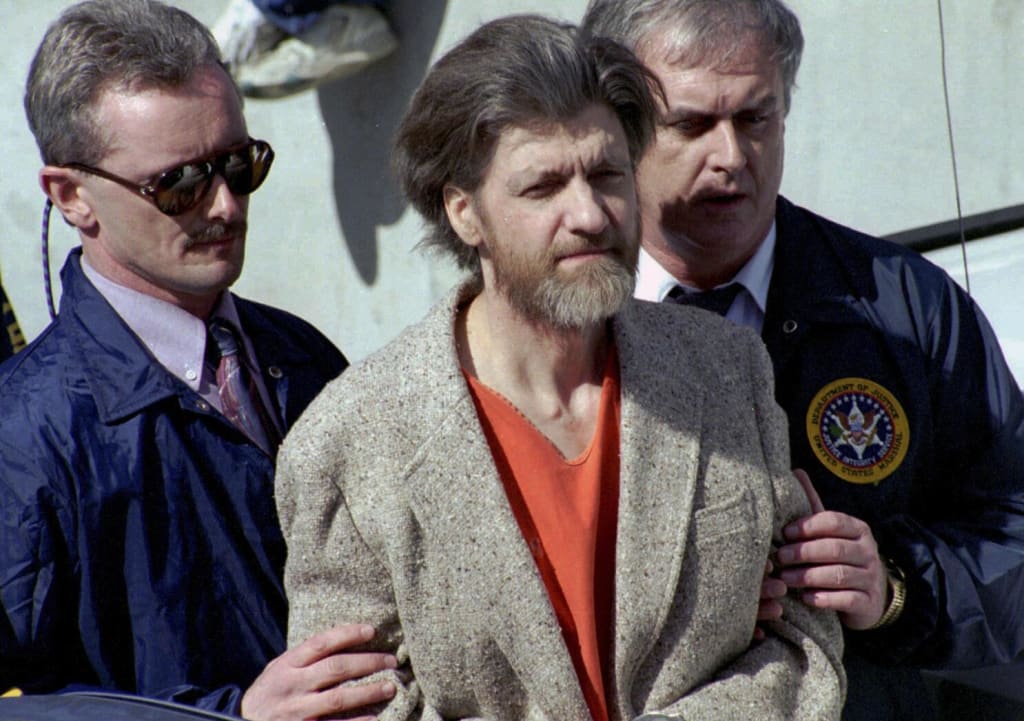
The Unabomber case is one of American history’s most intriguing and complex criminal investigations. For nearly two decades, a mysterious figure known as the Unabomber terrorized the nation with a series of mail bombings that killed three people and injured 23 others. This case study examines the critical role of linguistic analysis in identifying and capturing Theodore “Ted” Kaczynski, the man behind the Unabomber attacks. By exploring the FBI’s innovative use of language analysis techniques, we will examine the fascinating science of forensic linguistics in criminal investigations and its applications in modern law enforcement.
Background
The Unabomber’s reign of terror began in 1978 with the first of a series of homemade bombs sent to universities and airlines, earning him the FBI code name “UNABOM” (University and Airline Bomber). For 17 years, the Unabomber eluded capture, leaving a trail of destruction and fear in his wake. The case took a significant turn in 1995 when the New York Times and Washington Post published the Unabomber’s 35,000-word manifesto, “Industrial Society and Its Future,” under the threat of continued violence. This manifesto, a detailed critique of modern industrial society and a call for a return to a more primitive way of life was a key piece of evidence in the investigation. It provided insights into the Unabomber’s motivations and beliefs. It presented a unique opportunity for linguistic analysis, as it offered a substantial sample of the Unabomber’s writing style and language use.
This manifesto is a crucial turning point in the investigation. After exhausting traditional investigative methods, the FBI turned to this unconventional approach to get into the mind and psyche of the elusive Unabomber. This decision would ultimately lead to the identification and arrest of Ted Kaczynski, a former mathematics professor turned recluse living in a remote cabin in Montana.
Linguistic Analysis Process
The FBI’s approach to analyzing the Unabomber’s manifesto was groundbreaking in its scope and methodology. A team of expert linguists, led by FBI Supervisory Special Agent James Fitzgerald, meticulously examined every aspect of the document’s language. Their thorough process involved several key steps that would prove instrumental in creating a linguistic profile of the Unabomber.
First, the team conducted a thorough linguistic analysis, examining the author’s vocabulary choices and distinctive use of certain words and phrases. They noted the Unabomber’s preference for unusual terms like “surrogate activities” and “oversocialization,” as well as his consistent use of specific linguistic constructions in his writing. This analysis helped create a unique linguistic fingerprint that could identify the author.
Next, the linguists focused on syntactical patterns within the manifesto. They observed the writer’s tendency to use specific sentence structures repeatedly, such as starting sentences with “We” followed by a present tense verb. These patterns, while subtle, provided valuable insights into the author’s thought processes and writing style.
The team also thoroughly analyzed the document’s punctuation and formatting. They noticed the Unabomber’s consistent use of double spaces after periods and his preference for single quotation marks over double quotation marks. These seemingly minor details would later prove crucial in confirming Kaczynski’s authorship.
Perhaps most importantly, the linguistic analysis revealed key details about the author’s background and education. The manifesto’s sophisticated vocabulary and complex sentence structures suggested a high level of education, likely including advanced studies in the sciences or mathematics. The frequent academic jargon and references to scientific concepts further supported this conclusion.
Key Findings
Beyond the linguistic determination that the manifesto’s writer was highly educated, the analysis revealed other key findings.
Another significant finding was the author’s apparent familiarity with the Chicago area. The manifesto contained several references to locations and events specific to Chicago, suggesting that the author had spent considerable time in the region. This geographical connection would later prove crucial in narrowing the list of potential suspects.
The linguistic analysis also revealed that the author likely came of age in the 1960s. This conclusion was based on cultural references and language use that seemed particularly relevant to that era. For instance, the manifesto’s critique of leftist politics and environmentalism appeared to be rooted in a deep understanding of the social movements of the 1960s.
Perhaps most intriguingly, the analysis uncovered several unusual phrases and unique linguistic constructions by the author. These included the use of “cool-headed logicians” and “eat their cake and have it too” (a reversal of the common phrase). Such idiosyncratic language use would later serve as a crucial point of comparison when examining Kaczynski’s known writings.
Capture and Trial
The linguistic profile created by the FBI played a pivotal role in identifying and capturing Ted Kaczynski. In 1996, Kaczynski’s brother, David, recognized similarities between the published manifesto and letters he had received from Ted. After much soul-searching, David and his wife provided these letters to the FBI.
The FBI’s linguistic experts, including James Fitzgerald, compared these letters to the Unabomber manifesto. They found striking similarities in vocabulary, syntax, and distinctive language use. For instance, the reversal of “have your cake and eat it too” to “eat their cake and have it too” appeared in both the manifesto and Kaczynski’s personal writings. This linguistic evidence and other investigative findings led to a search warrant for Kaczynski’s cabin in Montana.
On April 3, 1996, FBI agents arrested Ted Kaczynski at his remote cabin. The subsequent search of his living quarters uncovered a wealth of evidence, including bomb-making materials and a carbon copy of the manifesto. Linguistic analysis, a key factor in the investigation, led investigators directly to the Unabomber.
During Kaczynski’s trial, the linguistic evidence played a crucial role. The prosecution used the findings from the FBI’s analysis to demonstrate the undeniable similarities between Kaczynski’s known writings and the Unabomber manifesto. This linguistic evidence, combined with the physical evidence in his cabin, was instrumental in Kaczynski’s conviction. He was sentenced to life in prison without the possibility of parole.
Conclusion
The Unabomber case is a testament to linguistic analysis’s power in criminal investigations. The FBI’s innovative use of forensic linguistics led to the capture of a dangerous criminal and opened new avenues for law enforcement in the digital age. The success of this approach has since influenced how investigators tackle complex cases, particularly those involving written communications.
The case underscores the importance of interdisciplinary approaches in modern law enforcement. Combining traditional investigative techniques with advanced linguistic analysis, the FBI solved a case that baffled investigators for nearly two decades. This success has increased interest and investment in forensic linguistics for criminal profiling and suspect identification.
Moreover, the Unabomber case highlights the potential of written language to reveal profound insights about an individual’s background, education, and thought processes. In an era where digital communication is ubiquitous, the ability to analyze and interpret written text has become more crucial than ever for law enforcement agencies worldwide.
The lessons learned from the Unabomber case continue to influence criminal investigations and forensic science as we move forward. The case is a powerful reminder of the value of innovative, outside-the-box thinking and leveraging all available tools and expertise to pursue justice. The capture of Ted Kaczynski through linguistic analysis ended a reign of terror. It helped usher in a new era of forensic investigation, one where the power of language can be harnessed to unravel even the most complex criminal cases.
About the Creator
MJonCrime
My 30-year law enforcement career fuels my interest in true crime writing. My writing extends my investigative mindset, offers comprehensive case overviews, and invites you, my readers, to engage in pursuing truth and resolution.
The Silence Behind Room 307
M Mehran The rain fell heavily over the quiet town of Ravenshade, turning the narrow streets into rivers of shimmering reflections. Most people had already gone home, locking their doors against the stormy night. But inside the old Hawthorne Hotel, the lights of Room 307 still glowed faintly. That room would soon become the center of one of the most chilling criminal mysteries the town had ever known. A Crime That Shocked the Town At 11:42 PM, the hotel receptionist heard a loud crash echo from the third floor. At first, she assumed a guest had dropped something. But minutes later, a terrified scream shattered the silence. When the police arrived, they found the door to Room 307 half open. Inside, the scene was disturbing. A wealthy businessman named Daniel Mercer lay lifeless on the floor beside a broken glass table. The room looked untouched—no signs of forced entry, no robbery, no struggle. Yet Mercer was clearly murdered. Detective Aaron Cole, a veteran investigator known for solving impossible cases, stepped into the room carefully. Years of experience had taught him that the smallest detail could expose the biggest lie. But this case felt different from the beginning. The Impossible Mystery The first strange detail was the door. It had been locked from the inside. The second strange detail was the window. Closed. Sealed. Impossible for anyone to escape through. This meant one thing: whoever killed Mercer had either vanished into thin air… or was still in the hotel. Cole began questioning the staff and guests. Mercer had checked in earlier that evening, arriving alone and carrying only a black leather briefcase. According to hotel records, he had ordered dinner to his room and made two phone calls. After that, nothing. But one witness changed everything. A young waitress named Clara said she saw someone leaving the hallway near Room 307 shortly before the scream. “A man in a gray coat,” she told police. “Tall. Wearing a hat. I didn’t see his face.” The problem? No guest registered at the hotel matched that description. A Secret Hidden in Plain Sight Detective Cole examined Mercer’s belongings carefully. Inside the briefcase were documents related to a major financial investigation. Mercer had been working with authorities to expose a massive corporate fraud operation involving millions of dollars. Someone powerful clearly had a reason to silence him. But how did the killer enter and leave the locked room? That question haunted Cole. Until he noticed something unusual. The bathroom mirror. It wasn’t aligned with the wall like normal hotel mirrors. When Cole touched its edge, it shifted slightly. Behind it was a hidden service panel used by hotel maintenance workers decades ago. A narrow passage ran between the walls of the building. Suddenly, the “impossible crime” wasn’t impossible anymore. The Killer Revealed The passage led to a storage room on the same floor. Inside, detectives discovered a gray coat hanging on a hook. And inside the pocket was a hotel keycard. The card belonged to Victor Hale—the hotel’s night manager. When police confronted him, Hale tried to stay calm. But the evidence was overwhelming. Hale had once worked for the same corporation Mercer was investigating. If Mercer exposed the fraud scheme, several powerful executives—and their accomplices—would face prison. Hale was paid to ensure that never happened. Using the old maintenance passage, he entered Mercer’s room through the hidden panel, confronted him, and killed him before escaping back through the wall. He then locked the door from the inside using a simple wire trick through the gap under the door. A perfect crime. Or so he thought. Justice in the Darkness When Hale finally confessed, he revealed something chilling. Mercer had refused to stay silent even when threatened. “He said the truth was worth dying for,” Hale admitted quietly. The investigation that followed exposed the entire fraud network Mercer had been trying to reveal. Several high-ranking executives were arrested, and millions of dollars in stolen funds were recovered. But for Detective Cole, the victory felt incomplete. Mercer had paid the ultimate price. The Lesson Behind the Crime Criminal cases like the Room 307 murder remind us that crime is rarely random. Behind every shocking act lies a chain of decisions, secrets, and motives. Sometimes the truth hides in shadows. Sometimes it hides behind a mirror. But as Detective Cole often said: “Every crime leaves a whisper of the truth. You just have to listen carefully.” And in the silent hallway of the Hawthorne Hotel, the whisper of justice had finally been heard.
By Muhammad Mehranabout 15 hours ago in Criminal



Comments
There are no comments for this story
Be the first to respond and start the conversation.