
Liberty on Trial
When justice is questioned, who defends freedom itself?

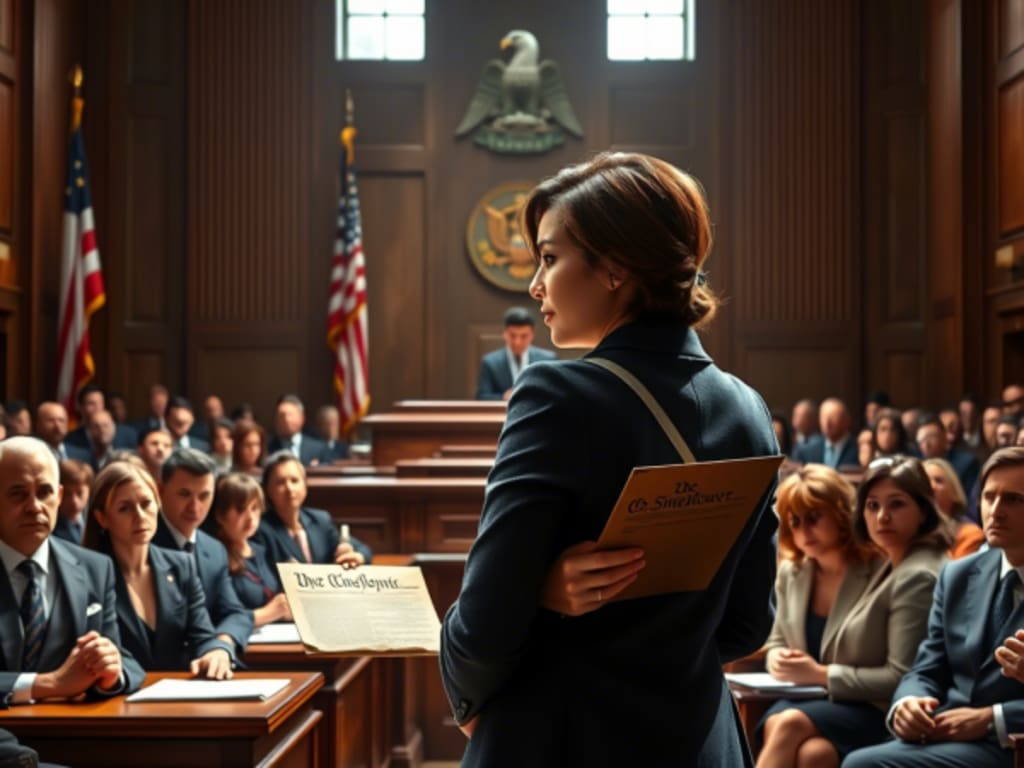
The courtroom was silent, save for the ticking of the old clock hanging above the judge’s bench. The symbol of the eagle, claws gripping arrows and olive branches, loomed high on the wall — a reminder of what the Constitution was meant to protect.
Ava Reyes stood, hands slightly trembling as she approached the jury box. The young constitutional lawyer, barely in her thirties, had never imagined she would stand at the center of a case that would shape the future of American freedom.
Her client, Julian Ward, a former cybersecurity analyst for the Department of Homeland Security, sat calmly behind her. He had leaked classified documents that proved the government had been secretly collecting personal data from millions of citizens — without warrants, without oversight, without consent.
The prosecution called him a traitor.
Ava called him a patriot.
She faced the jury.
“Ladies and gentlemen,” she began, her voice steadying, “what’s on trial here is not just Julian Ward. What’s on trial is liberty itself.”
A murmur swept through the courtroom. Judge Hendricks banged his gavel softly. Ava continued.
“For nearly 250 years, this country has stood on the principle that government power must be limited — checked by the people, guided by law, and held accountable through transparency. Julian Ward exposed a violation of that principle. He didn’t do it for money, revenge, or fame. He did it because he believed you — we — deserve to know when our rights are being trampled.”
The lead prosecutor, Thomas Grayson, stood to object, but Judge Hendricks waved him off. “She’s making her opening argument. Sit down.”
Ava walked to the defense table and picked up a thick folder. She held it in the air.
“These documents,” she said, “show unlawful mass surveillance. Phone calls, emails, search history — all gathered without warrants, without reason. And when Julian tried to raise concerns internally, he was threatened, ignored, and finally dismissed. So he turned to the press. He trusted that the truth would matter more than silence.”
A juror, an older man in a veterans' cap, leaned forward, listening carefully. A younger woman beside him nodded slightly. Ava’s words were working.
The trial stretched on for two weeks.
Government witnesses testified about national security threats and claimed lives were at stake. They said transparency could cripple defense operations. They framed Julian’s actions as dangerous, even traitorous.
But Ava brought in experts, former intelligence officers, journalists, and civil rights lawyers. They pointed to the Fourth Amendment. They cited past abuses of power. They reminded the jury that liberty must always be defended — especially when it’s inconvenient.
Julian never once denied leaking the files. When he finally took the stand, the courtroom was packed.
“I joined DHS because I believed in protecting Americans,” he said, voice calm but resolute. “But when I saw the surveillance program grow unchecked, watching everyone with no legal justification, I had a choice — stay silent or speak out. I chose the Constitution.”
The prosecutor tried to paint him as reckless. “You put lives at risk!”
Julian looked straight at him. “So did the people who broke the law and expected no one to notice.”
In her closing argument, Ava paced slowly before the jury.
“Some of you may feel torn. Maybe you think Julian should’ve gone through ‘proper channels.’ Maybe you worry about safety and terrorism. Those are fair concerns. But ask yourself this: What happens when the people in power get to define what’s ‘proper’? What happens when freedom is sacrificed, bit by bit, for the illusion of safety?”
She paused, letting the silence linger.
“Our Founding Fathers didn’t write the Bill of Rights for when it was easy. They wrote it for times like this — when it’s hard, when it’s dangerous, when speaking the truth comes with a cost.”
She turned to Julian.
“And when liberty is on trial, we need brave citizens to take a stand.”
The jury deliberated for eighteen hours. The nation watched every second.
On the third morning, the verdict came.
“On the charge of unauthorized disclosure of classified information... we find the defendant, Julian Ward — not guilty.”
Gasps filled the room. The judge called for order, but Ava couldn’t stop the tears in her eyes. Julian exhaled deeply, his shoulders finally relaxing.
Outside the courthouse, crowds had gathered. Some cheered. Some protested. Reporters shouted questions. But Julian simply walked out with Ava by his side, holding a small copy of the Constitution in his hand.
He didn’t wave. He didn’t smile. He just said one thing into the microphone:
“I did what I had to do. Now it’s your turn.”
🧠 Author’s Note:
"Liberty on Trial" is a story of modern-day courage, where a single voice challenges the machinery of silence. In an era where truth is fragile and freedom is often tested, it reminds us that laws are not just rules — they are promises. And those promises are only as strong as the people who defend them.
About the Creator
Keep reading
More stories from Sana Ullah and writers in Criminal and other communities.
The Flag on Maple Street
Every morning, without fail, Mr. Thompson raised the American flag in front of his small white house on Maple Street. He was tall, lean, and always dressed in pressed slacks, a tucked-in shirt, and his old Korean War cap. His movements were slow but deliberate. The ritual never changed: unlock the flag box, unfold the stars and stripes with reverence, attach it to the pole, and hoist it up as the sun peeked over the trees.
By Sana Ullah8 months ago in Families
The Shocking Case of Brian Stewart:
The Shocking Case of Brian Stewart: When a Father Injected His Own Son with HIV In 1992, the quiet city of St. Charles County, Missouri, became the backdrop for one of the most chilling and unsettling crimes in modern medical history. Brian Stewart, a trained phlebotomist, used his knowledge and access to medical resources to deliberately harm his infant son. The case is not only a tragic story of parental betrayal but also a cautionary tale about the vulnerabilities inherent in medical access, the motivations that drive horrifying decisions, and the resilience of the human spirit.
By Dakota Denise a day ago in Criminal
Oil at War: The Strait of Hormuz Crisis and the Rising Iran–Israel–US Conflict
Oil at War: The Strait of Hormuz Crisis and the Rising Iran–Israel–US Conflict The Middle East has once again become the center of global attention as tensions between Iran, Israel, and the United States intensify. At the heart of this crisis lies one of the world’s most strategic waterways: the Strait of Hormuz. This narrow maritime corridor carries a huge portion of the world’s oil supply, and any disruption here has the power to shake the global economy.
By Wings of Time about 5 hours ago in Criminal


Comments
There are no comments for this story
Be the first to respond and start the conversation.