
Let the World See: The Murder of Emmett Till"
The Brutal Killing of a 14-Year-Old Boy, a Mother's Courage, and the Spark That Lit the Fire of the Civil Rights Movement

Let the World See: The Story of Emmett Till
The summer of 1955 was stifling in the Mississippi Delta. In the small town of Money, the air hung heavy not just with heat, but with the unspoken laws of Jim Crow — a brutal code that dictated how Black people were to live, move, and survive in a world built to exclude them. For 14-year-old Emmett Till, visiting from Chicago, the rules were invisible. And that invisibility would cost him his life.
Emmett was full of energy, laughter, and the curiosity of youth. He loved comic books, making jokes, and had an infectious smile. Born and raised in Chicago by his single mother, Mamie Till-Mobley, Emmett was no stranger to hardship — but he was also no stranger to love. Mamie had worked hard to give her son the best life she could, raising him with dignity and courage.
When Emmett asked to go visit his great-uncle Mose Wright in Mississippi, Mamie hesitated. She knew the South was different. Dangerous. But she also knew Emmett was growing up, wanting independence, and after some thought — and a stern warning to “be careful how you speak to white people down there” — she let him go.
He would never come home.
---
A Whistle That Echoed Across Generations
On August 24, Emmett and a group of teenagers went to Bryant’s Grocery & Meat Market, a local store in Money. The store was owned by a white couple, Roy and Carolyn Bryant. Accounts differ, but it’s believed Emmett either whistled at, flirted with, or touched the hand of Carolyn — an unforgivable act in the Jim Crow South.
Word spread quickly. In the minds of many white Mississippians, Emmett had committed a grave offense. Days later, in the dead of night, Roy Bryant and his half-brother J.W. Milam forced their way into Mose Wright’s home. They took Emmett from his bed at gunpoint.
Emmett's great-uncle pleaded with them. But the men refused to listen. They drove Emmett away into the night. What happened next was beyond comprehension.
They beat the boy brutally. They crushed his face. Shot him in the head. Tied a 75-pound cotton gin fan to his neck with barbed wire. And threw his body into the Tallahatchie River.
When his bloated, unrecognizable corpse was discovered three days later, the horror of what had been done was undeniable.
---
A Mother's Unshakable Strength
Mamie Till-Mobley was devastated. But grief did not paralyze her. Instead, it fueled her resolve. When Emmett’s body was returned to Chicago, she made a decision that would alter the course of American history.
She demanded an open-casket funeral.
“I wanted the world to see what they did to my boy,” she said.
Thousands came to the church to view Emmett’s disfigured body. His eye was gouged out. His face was battered beyond recognition. The photograph of his mutilated body, published in Jet magazine and Black newspapers across the country, ignited a firestorm.
It pierced the conscience of a nation.
---
A Trial That Mocked Justice
Back in Mississippi, Bryant and Milam were arrested and charged with murder. But few believed justice would be served. The courtroom was segregated. The jury — all white, all male — barely pretended to listen.
Mose Wright, in a moment of tremendous bravery, stood in that hostile courtroom and pointed directly at the two white men who had taken his nephew. “There he is,” he said, a Black man accusing white men in a Southern court — a nearly unheard-of act of defiance at the time.
But it wasn’t enough.
The jury deliberated for just over an hour — some said they would have been faster if they hadn’t paused for sodas — and returned a verdict of “Not Guilty.”
The murderers walked free.
And then, in a shocking display of impunity, Bryant and Milam sold their story to Look magazine for $4,000. In the article, they freely confessed to the killing — protected from retrial by double jeopardy.
---
The Birth of a Movement
The injustice of Emmett Till’s murder and the acquittal of his killers stirred something deeper in the soul of America. Rosa Parks would later say she thought of Emmett Till when she refused to give up her seat on a segregated bus just a few months later.
The Civil Rights Movement was not born in that Mississippi river, but it was awakened.
Mamie Till-Mobley did not let her son’s death fade into silence. She became an activist, an educator, and a voice for justice. She spoke out for decades, telling her son’s story over and over so that people would never forget.
---
Legacy and Reckoning
Decades later, the murder of Emmett Till still echoes through America’s struggle for racial justice. In 2004, the case was reopened by the Department of Justice. In 2022, President Joe Biden signed the Emmett Till Anti-Lynching Act into law — finally making lynching a federal hate crime after more than a century of failed efforts.
Carolyn Bryant Donham, the woman whose accusation set the events in motion, lived her life in relative quiet. In 2017, she admitted in an interview that Emmett had never touched her, and that parts of her story were untrue. She died in 2023, never prosecuted.
But Emmett Till’s story did not die.
It lives in classrooms. In protests. In legislation. In art, film, and music. It lives every time someone dares to demand justice in the face of cruelty. It lives every time a mother dares to speak truth to power in the name of her child.
et the World Keep Seeing
The story of Emmett Till is not easy to tell. It is one of brutality, injustice, and profound sorrow. But it is also a story of courage — of a boy who should have lived, and a mother who refused to be silent.
It reminds us why we must never look away.
It reminds us that change often begins not with speeches or laws, but with the choice to show the world what others want hidden.
Let the world see.
Let them never forget.ectorocal'suidelinesdountoryue
Tone: Emotional, vivid, reflectiveragemiration
Message: Historical education and call for remembrance and justice
About the Creator
Hasbanullah
I write to awaken hearts, honor untold stories, and give voice to silence. From truth to fiction, every word I share is a step toward deeper connection. Welcome to my world of meaningful storytelling.
Keep reading
More stories from Hasbanullah and writers in Criminal and other communities.
America and Venezuela: How Decades of Tension Turned Into Open Confrontation
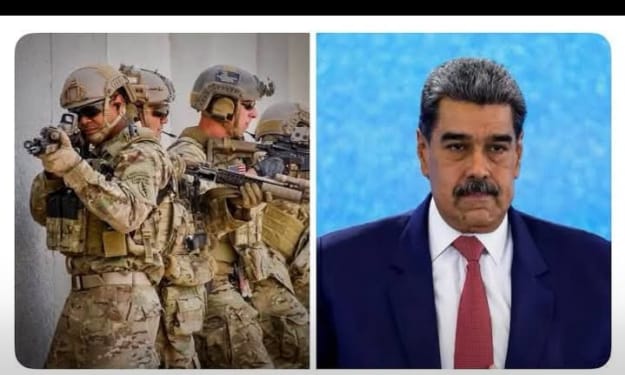
relationship between the United States and Venezuela has entered one of the most volatile periods in recent history, characterized by escalating tensions, military operations, diplomatic rupture, and international debate. What began as long-standing political and economic disagreement has now evolved into an open confrontation that carries major implications for regional stability, international law, and global geopolitics. Historical Roots of Tension The U.S.–Venezuela relationship has been fraught for decades, shaped by ideological differences, energy politics, and mutual distrust. Venezuela’s oil wealth historically made it a key partner for Washington, particularly throughout the 20th century. However, relations began cooling significantly in the late 1990s and early 2000s after Hugo Chávez rose to power with a project rooted in Bolivarian socialism and resistance to U.S. influence. Over the years, successive Venezuelan administrations under Chávez and later Nicolás Maduro adopted increasingly antagonistic foreign policies toward the United States, while the U.S. grew critical of Venezuela’s democratic backsliding and human rights record. The result was a heavily polarized bilateral relationship, with occasional cooperation overshadowed by frequent clashes, sanctions, and accusations of interference. These structural tensions widened after Venezuela’s disputed 2024 presidential election. The United States and several Western countries rejected the legitimacy of Nicolás Maduro’s victory, citing fraud and lack of transparency. Washington instead recognized opposition leader Edmundo González as interim president, deepening the diplomatic rupture at a time when both nations already had limited official channels of communication. � Encyclopedia Britannica +1 2025: From Sanctions to Military Escalation 2025 marked a dramatic escalation in the U.S.–Venezuelan conflict. Early in the year, the United States intensified pressure on Caracas through a combination of severe sanctions, economic coercion, and targeted counter-narcotics actions. The Trump administration designated Venezuela’s ruling elite and alleged criminal networks—most notably the so-called “Cartel de los Soles”—as terrorist organizations, a step that expanded U.S. legal authority to pursue punitive measures against individuals and assets linked to the Venezuelan government. � CRBC News These sanctions coincided with a significant military buildup in the Caribbean. Beginning in mid-2025, the United States deployed thousands of personnel, warships, aircraft, and surveillance assets near Venezuelan waters in an operation officially framed as a counter-narcotics and maritime security campaign. U.S. officials described these measures as necessary to disrupt smuggling networks and cartel operations alleged to be operating with Venezuelan complicity. Critics, however, interpreted the moves as coercive acts that blurred the line between counter-drug missions and preparations for conflict. � RTVE Throughout 2025, U.S. forces carried out a series of lethal maritime strikes on vessels in the Caribbean and eastern Pacific, which Washington claimed were involved in transporting drugs toward the United States. These operations reportedly resulted in dozens of deaths and drew harsh criticism from human rights organizations and foreign governments who condemned them as disproportionate and in violation of international norms. � Encyclopedia Britannica Oil Seizures and Naval Blockade Compounding the tension were dramatic economic and naval measures. In December 2025, U.S. forces seized a Venezuelan-linked oil tanker, accusing it of carrying sanctioned oil destined for unauthorized markets. Shortly afterward, President Trump announced a “total and complete blockade” of sanctioned Venezuelan tankers entering or exiting the country, a step aimed at crippling Venezuela’s oil-dependent economy and cutting off the government’s primary source of revenue. Venezuela denounced these actions as “piracy” and called on international bodies to condemn what it saw as blatant theft and aggression. � Wikipedia +1 Such measures intensified the humanitarian and economic crisis in Venezuela, where hyperinflation, shortages of basic goods, and a collapsed healthcare system already plagued the population. Critics of U.S. policy argue that the blockade’s economic impact disproportionately affects ordinary Venezuelans, exacerbating suffering without offering a clear path to political resolution. The 2026 Military Operation and Capture of Maduro The culmination of these escalating tensions occurred on January 3, 2026, when U.S. special operations forces conducted a high-profile raid in Caracas, capturing President Nicolás Maduro and his wife, Cilia Flores. The operation, described by critics as a violation of national sovereignty and international law, involved coordinated airstrikes and a covert helicopter insertion into Venezuelan territory. Maduro was transported to New York to face charges related to alleged drug trafficking and “narcoterrorism.” � AP News +1 President Trump proclaimed the raid a major victory, asserting that it would allow the United States to “run” Venezuela and stabilize the country, even opening the door for American oil companies to reenter the market. Yet, the legal basis for the operation remains fiercely disputed, and many observers liken it to the 1989 U.S. invasion of Panama. Venezuela’s vice president, Delcy Rodríguez, was appointed interim president by Caracas’s high court, but the country remains deeply divided, with ongoing protests and resistance from segments of the military. � The Guardian International Reaction and Future Prospects The global response has been sharply divided. Many Latin American countries, along with major powers like Russia and China, condemned the U.S. action as an unlawful intervention and breach of sovereignty. The United Nations has raised concerns about setting a dangerous precedent that could undermine international law and regional stability. Some European nations have called for de-escalation and respect for diplomatic solutions. � TIME As of early 2026, the future of U.S.–Venezuela relations is uncertain. Both nations stand at a crossroads: the United States insists it is acting to combat drug trafficking and restore democratic norms, while Venezuela decries foreign aggression and an attempt at regime change. The profound mistrust built up over years of political antagonism will make dialogue difficult, and the deepening humanitarian crisis adds urgency to finding pathways toward peace. In an era marked by rising geopolitical competition and domestic polarization, the U.S.–Venezuela conflict serves as a stark reminder of how historical grievances, economic interests, and ideological divides can spiral into open confrontation with ramifications far beyond their borders. If you’d like, I can tailor this further for a specific audience or format (e.g., blog style, opinion piece, or news report).
By Hasbanullah8 days ago in Criminal
Minneapolis ICE Shooting Updates
In recent weeks, Minneapolis has found itself at the center of a growing legal and political controversy following a shooting involving Immigration and Customs Enforcement (ICE) agents. What initially appeared to be a straightforward federal use-of-force investigation has evolved into a broader dispute between state authorities and federal officials, raising serious questions about transparency, jurisdiction, and accountability. The most significant development so far is the state’s claim that it has been denied access to key evidence related to the incident. As public attention intensifies, the case is no longer just about what happened during the shooting. It is increasingly about who controls the facts, who gets to investigate them, and how justice is supposed to function when federal and state systems collide. What We Know About the Minneapolis ICE Shooting The shooting occurred during a federal immigration enforcement operation in Minneapolis. ICE agents were reportedly conducting official duties when gunfire erupted, resulting in injuries and immediate emergency response. Federal authorities confirmed the incident and stated that internal protocols were activated, including an automatic review by federal oversight bodies. From the beginning, details were limited. Officials cited the ongoing nature of the investigation and concerns about officer safety. This lack of information, while not unusual in federal cases, quickly became a point of friction for Minnesota state authorities, who argued that the public deserved clarity and that the state had a legal role to play in examining the incident. State Authorities Push for Transparency Minnesota state officials, including investigators and legal representatives, formally requested access to evidence connected to the shooting. This evidence reportedly includes body camera footage, surveillance recordings, forensic reports, and internal communication logs from the operation. According to state representatives, these requests were either delayed or denied outright. The state has since gone on record stating that it cannot independently assess the legality of the shooting without full access to the materials. This denial has fueled concerns that federal agencies are operating without sufficient external oversight, especially in incidents involving potential civilian harm. State leaders emphasized that their position is not adversarial by default. Rather, they argue that cooperation between federal and state agencies is essential to maintain public trust, particularly in communities already wary of immigration enforcement. Federal Response and Jurisdictional Limits Federal officials, for their part, maintain that the investigation falls squarely under federal jurisdiction. ICE operates as a federal agency, and shootings involving federal officers are typically reviewed internally and, when appropriate, by federal prosecutors or inspectors general. In statements released following the controversy, federal representatives cited legal restrictions that limit the sharing of evidence during an active investigation. They also stressed that premature disclosure could compromise witness testimony or investigative integrity. This explanation, while legally grounded, has done little to ease state frustrations. Critics argue that “ongoing investigation” has too often been used as a blanket justification for withholding information, even in cases where transparency could prevent misinformation and public unrest. Community Reaction and Public Trust The Minneapolis community has responded with a mix of concern, anger, and fatigue. For many residents, particularly in immigrant and marginalized communities, the shooting has reopened long-standing fears about aggressive enforcement tactics and lack of accountability. Community leaders and advocacy groups have called for the immediate release of non-sensitive evidence, arguing that transparency is a prerequisite for trust. Peaceful demonstrations and public forums have highlighted a broader demand: that no law enforcement agency, federal or otherwise, should be beyond scrutiny. Local officials echoed these concerns, noting that Minneapolis has spent years attempting to rebuild trust between residents and law enforcement. The perception that evidence is being withheld threatens to undermine that progress. Legal Implications of Denied Evidence From a legal standpoint, the state’s inability to access evidence raises complex questions. While federal agencies do have authority over their operations, states also have a responsibility to investigate deaths or injuries occurring within their borders. Legal experts suggest that this dispute could set a precedent. If states are routinely blocked from reviewing evidence in federal use-of-force cases, it may limit their ability to pursue independent inquiries or bring charges under state law when applicable. Some analysts believe the issue could ultimately be resolved in court, with judges determining whether the state has a legal right to access certain materials. Such a ruling could have national implications, influencing how future federal-state conflicts are handled. Political Dimensions of the Case The Minneapolis ICE shooting has also taken on a political dimension. Immigration enforcement remains a deeply divisive issue, and incidents like this tend to amplify existing ideological divides. State officials critical of federal immigration policies view the denial of evidence as symptomatic of a larger lack of accountability. Meanwhile, supporters of strict federal enforcement argue that state interference could hinder effective operations and put officers at risk. This political tension complicates the path forward. What might otherwise be a procedural disagreement risks becoming a symbolic battle over immigration, law enforcement authority, and states’ rights. What Happens Next? As of now, the investigation continues under federal oversight, while the state explores its legal options. Negotiations between state and federal officials have reportedly not been ruled out, suggesting that a compromise could still be reached. Potential next steps include limited evidence sharing under confidentiality agreements, congressional inquiries, or judicial review. Each option carries its own risks and consequences, both legally and politically. What remains clear is that public pressure is unlikely to fade. Minneapolis residents, like many Americans, are demanding clarity, fairness, and accountability in cases involving law enforcement use of force. A Broader Conversation About Accountability The Minneapolis ICE shooting is no longer just a single incident under investigation. It has become a lens through which broader issues are being examined: the balance of power between federal and state authorities, the limits of transparency, and the role of public oversight in a democratic society. Whether or not the state ultimately gains access to the evidence, the controversy has already sparked an important conversation. How that conversation translates into policy, practice, or reform remains to be seen, but its impact will likely extend far beyond Minneapolis. In the end, accountability is not only about assigning blame. It is about ensuring that systems function openly and fairly, especially when lives are affected. The outcome of this case may help determine how well those principles are upheld in the future.
By Saboor Brohi 3 days ago in Criminal
Sabrina Carpenter Accused of Copying Tiffany A♡ Luna’s Crown Logo—While Her Federal Plagiarism Case Spirals Into Further Career Ruin
Sabrina Carpenter’s pop princess image is crumbling under the weight of what is now being described as one of the most damaging plagiarism cases in music history. The Disney-born starlet is not only battling a brutal federal lawsuit over her song Espresso, but now faces new backlash after debuting a crown into her updated logo June 6, 2025 eerily similar to Tiffany A♡ Luna’s crown, which was quietly unveiled just weeks before — the same Tiffany A♡ Luna currently suing her in federal court.
By Dena Falken Esq7 days ago in Criminal
Let's Don't Do This
"I just can't do this anymore..." "Do what?" What can't you do? Put gas in your own car? I swear to God you make me take care of everything, don't you? You know I'm on my way to work right now but that never stops you from bothering me, does it?"
By Shirley Belk6 days ago in Fiction


Comments
There are no comments for this story
Be the first to respond and start the conversation.