
How an Entire Monarchy Was Wiped Out by the Actions of Its Crown Prince
The story of how Nepal’s Crown Prince Dipendra single handedly murdered his entire family and the effects this had on the future of Nepal’s monarchy
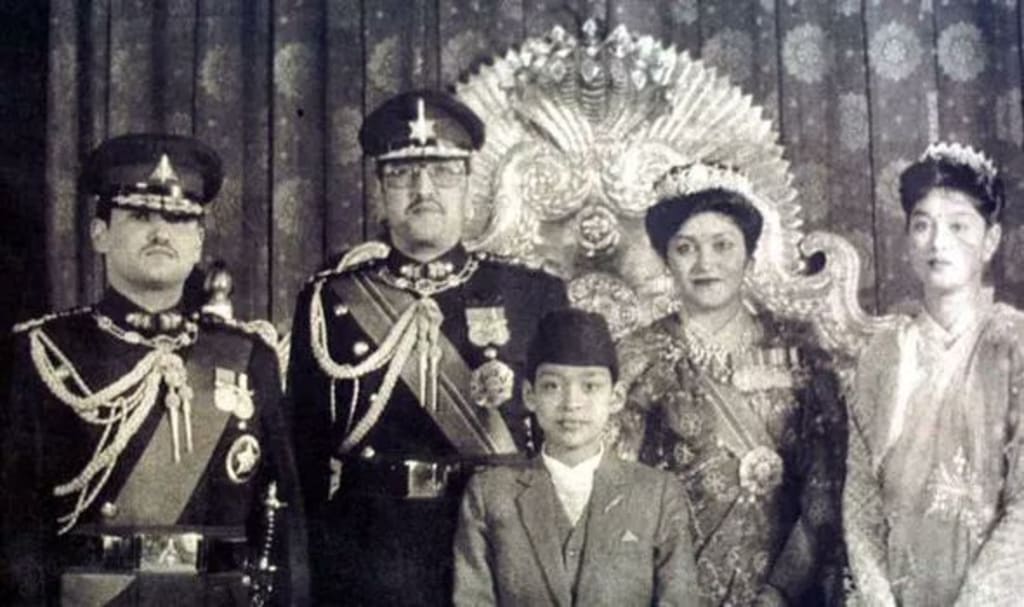
Dipendra Bir Bikram Shah Dev was born on 27 June 1971 to the then Crown Prince Birendra and Princess Aishwarya. Less than a year after he was born, Dipendra’s grandfather, King Mahendra died of a massive heart attack and Birendra soon ascended the throne. It soon became very clear that the young Crown Prince Dipendra would have very big shoes to fill.
King Birendra was said to be a kind and soft spoken man with a temperament quite unlike those of his predecessors. Described by friends in Eton College as a “very, very nice bloke who was embarrassed when his full title was read out at the school assembly,” Birendra was loved by his subjects. Although he had inherited an absolute monarchy, Birendra willingly set aside many of his powers in order to usher in democracy and transition Nepal into a constitutional monarchy in a style similar to the UK.
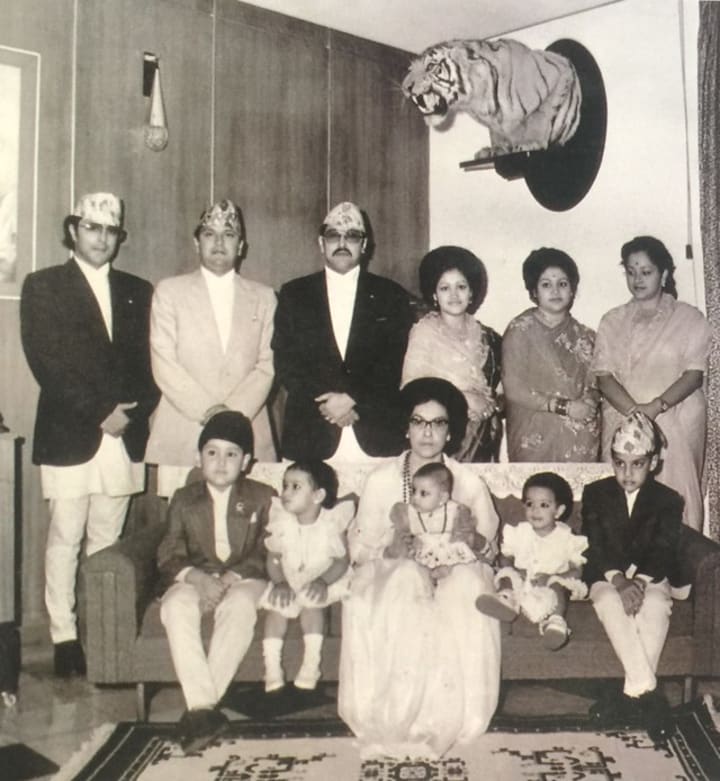
Birendra was no stranger to the consequences of political instability. His grandfather was once removed from power by the dynastic Rana government and a young Birendra was forced to flee to India with his father and grandfather. Having lived through such events, Birendra understood the importance of allowing the people to make their own choices and to find their own way. His reign brought about a period of great change for Nepal
Dipendra on the other hand was quite the opposite of his father. With a black belt in karate and significant military training, the Crown Prince cut a far more intimidating picture than his beloved father. He lived a life on two ends of a spectrum. On the one hand, he was a capable and educated young man who had travelled the world and had a throne waiting for him. On the other hand, he felt trapped in a world where he was constantly forced to defer to his elders despite being next in line to the throne. Even at the age of 29, Dipendra could not do so much as smoke a cigarette in front of his elders nor was he allowed the freedom to marry the woman he chose. Any form of rebellion was quelled by the threat of having his allowance cut off.
This second issue eventually proved to be the tipping point in the prince’s relationship with his family. While studying in England, Dipendra met Devyani Rana and it was love at first sight. Unfortunately, it was also a relationship that he knew his family would not approve of. Hailing from the same clan that once deposed Dipendra’s great grandfather and whose wealth far exceeded that of even Nepal’s royal family, Dipendra’s parents, grandmother and other relatives were extremely against the match and had tried numerous times to cut it off. Although they believed that they were acting in the best interest of their son and nation, their actions pushed Dipendra to the brink.
The day of the shooting
That fateful day on June 1 2001 started off no different than any other. It was a common tradition among the family for everybody to meet on the first and third Fridays of each month. It was a typical family gathering where invitations were not arranged and formalities were kept to a minimum as it was always the same familiar faces. Despite this, Dipendra’s second cousin, Ketaki Chester who herself was wounded in the shooting, recalls the Crown Prince personally contacting various family members to confirm their attendance on that particular Friday.
Maheshwar Singh, Dipendra’s grand-uncle was the first person to arrive at the party which had always been held in the palace’s billiards room. Maheshwar was soon joined by his brother in law, Rabi Shumsher and both men were served drinks by Dipendra himself. Neither man had any reason to suspect the horrors that were about to take place just a few short hours later. They noted that the Crown Prince was in a pleasant mood as he entertained them and had been playing billiards alone while waiting for his guests to arrive. A short time later, Dipendra excused himself from the party in order to pick up his grandmother, Queen Mother Ratna, who ironically was a member of the Rana Dynasty herself (albeit from a different branch).
Dipendra soon returns to the palace with his grandmother in tow and drops her off in an annex room where she was received by the King, Queen and a few other relatives. Dipendra then rejoins the party which by then is in full swing. Among the people that were in attendance were Dipendra’s brother Prince Nirajan, their sister Princess Shruti, their cousin Prince Paras and Shruti’s husband Kumar Gorakah. While normally known as a gracious host able to hold his drink, Dipendra seemed to have gotten himself extremely intoxicated and had to be taken to bed by his brother, cousin and brother in law just about an hour into the party. In hindsight, many of his relatives believed this to be an act in order to give Dipendra a reason to return to his room to retrieve his weapons.
The King is notified of his son’s incapacitation and leaves his mother’s annex to join the party along with the Queen. Under the assumption that a drunk Dipendra was comfortably passed out in bed, the party goes on as usual. During this time, Devyani attempted to contact Dipendra but his replies seemed incoherent. Concerned, she alerts palace security to check on him and they confirm that the Prince was all right. Dipendra himself soon calls his girlfriend and briefly reassures her that there was nothing to worry about. However, he soon dressed himself in combat fatigues and armed himself with a pistol, shotgun and an M16 assault rifle.
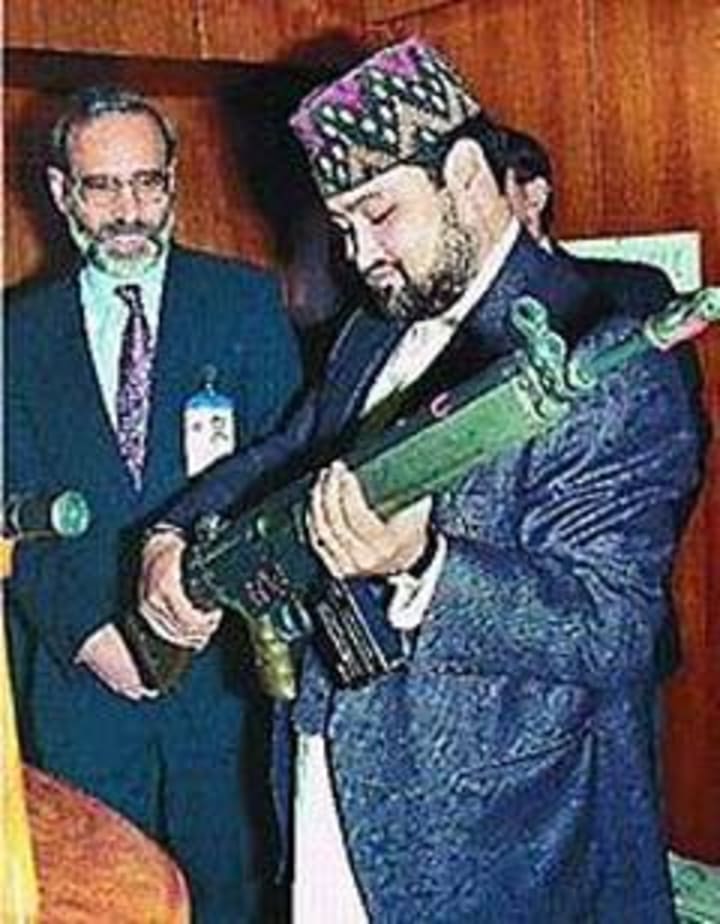
He made his way back to where the party was being held but his relatives paid little mind to him. An accomplished marksman with a known passion for guns, everybody knew that Dipendra very often practiced his shooting on the palace grounds. So, to see him in such attire and carrying weapons was not out of the ordinary. Even as he approached his father with a gun in hand, the rest of the family could only assume that he was there to show off his weapon to the King.
Dipendra soon opened fire on his father who collapsed to the floor, confused at his son’s actions. After pausing briefly, Dipendra dropped the shotgun and left the room as relatives rushed to tend to the wounded king. Even at this juncture, many believed that Dipendra had misfired his weapon and fled in shame. One of them being the King’s sister Princess Shova.
As Dipendra reentered the room, the injured King Birendra soon attempted to stand up and picked up the gun that was left behind in order to defend himself from his son. Not realising that Dipendra had brought in another gun, Princess Shova attempted to stop her brother from shooting his son in the hopes of preventing the situation from escalating. This allowed Dipendra to open fire once more and both the King and his sister fell to the floor, riddled in bullets. Princess Shova, who survived the horrifying night, has lived to regret the decision she made.
The King’s brother, Dhirendra then attempted to talk his nephew into dropping the gun. Unfortunately, he too was shot. Ketaki Chester believes that Dipendra had only intended to kill his father in the presence of his entire family in order to assert himself as King. However, in shooting his favourite uncle whom he had believed to be trying to forcefully disarm him, Dipendra was driven into a blind rage that spurred him on throughout this onslaught.
Dipendra then opened fire on his brother in law and sister. Another two of the King’s sisters and a brother in law were also killed by Dipendra. Soon after, Chester was shot alongside her sister Princess Jayanti who was killed as well. Dipendra then shot Princess Komal, the sister in law of the King and mother to Dipendra’s favourite cousin and confidante, Paras. Komal was also the wife of the King’s brother Gyanendra, a former king who later retook the throne following the massacre who was not present that night at the party. Although she suffered serious injuries, she miraculously survived the shooting as well.
By this time, Paras had gathered the younger children and elderly relatives in a far corner of the room. Maheshwar Singh recalls that both he and his brother in law, Rabi Shumsher took cover behind a sofa in this part of the room and played dead. Dipendra then turned his attention to this area but thankfully, Paras was able to talk him into sparing his life as well as those of the children and elderly. Dipendra then left the room as his mother and brother chased after him. Ketaki Chester remembers calling out to the Queen, imploring her to not go after her son. Unfortunately her attempts were in vain.
A short while later, the palace’s security forces were brought into the room after being directed there by Dr Rajiv Shahi, husband to one of the King’s nieces and the only man able to escape the room during the shooting. Paras soon takes charge of the situation in the billiards room and instructs some guards to go after Dipendra. Unfortunately, they were too late.
Dipendra’s mother and brother chased him to the palace garden, demanding an explanation for his heinous actions. After pointing his gun at the Queen, Prince Nirajan attempted to shield his mother from Dipendra’s sights and he was shot dead. Dipendra then shot his mother point black in the face, killing her instantly. He then dropped his gun, took out a pistol and shot himself in the head. Paras was informed of this and was tasked with delivering the horrifying news to his grandmother who had remained in the annex with a few relatives and had been unaware of what had transpired. The entire ordeal lasted no more than five minutes.
The injured were rushed to the hospital. Among them were King Birendra and Dipendra himself. Doctors worked frantically to save the beloved King and placed Dipendra on a mechanical ventilator. Unfortunately, the King succumbed to his injuries not long after and was among the nine people killed that day by his son. Dipendra had killed both his parents, both his siblings, three of his father’s siblings, his aunt’s husband and a cousin. He had also severely injured his brother in law, his father’s sister, the wife of his father’s brother and another cousin.
Aftermath
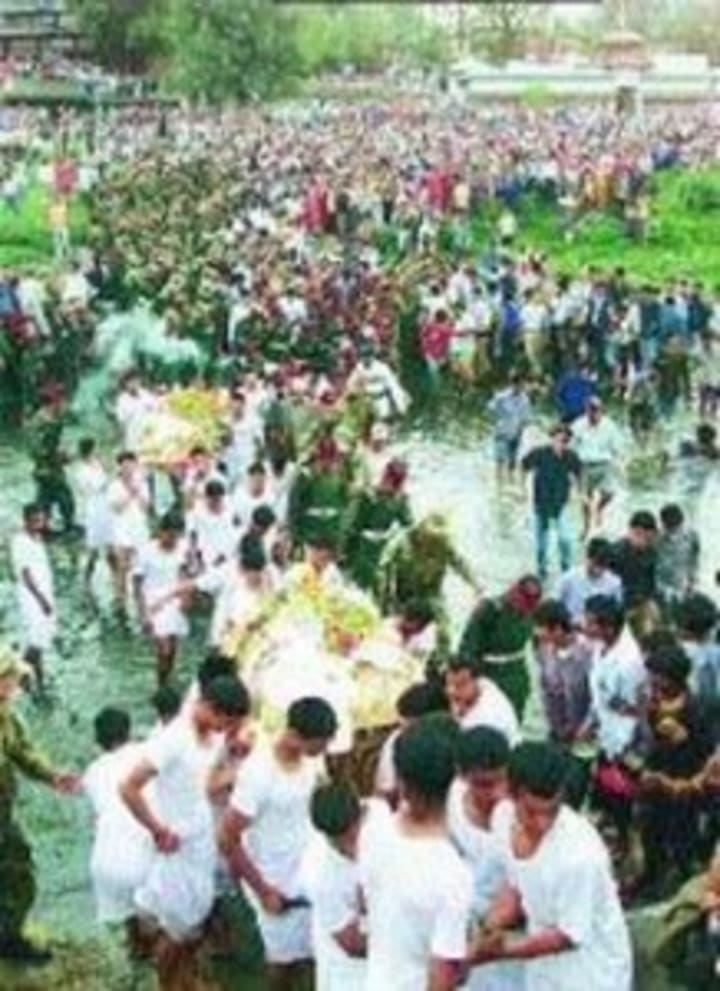
With King Birendra pronounced dead, Dipendra was crowned King while on life support. This move not only shocked the nation but was also met with disapproval by those within the royal family. Queen Ratna, now the Queen Grandmother of Nepal was so disgusted by Dipendra’s actions and by the decision to make him King that she had refused to see her grandson’s unconscious body in hospital. Dipendra did not reign for long as he died just three days later without ever regaining consciousness.

With almost the entire line of succession being wiped out in one evening, the late King Birendra’s younger brother, Gyanendra was crowned as Nepal’s king. Gyanendra had previously ruled Nepal in the 1950s while he was a child at the time when his grandfather was forced off the throne. When his grandfather, father and elder brother returned from their exile in India, he once again stepped aside and fell further down the line of succession. No longer directly in line to the throne, Gyanendra established himself as a successful businessman who had amassed a significant personal fortune for himself. An entire generation had to be wiped out for him to have returned to power.
Unlike his late brother who was more willing to give up power for the sake of democracy, Gyanendra sought to consolidate his power. Believing that the various democratically elected governments were corrupt and incompetent, Gyanendra took steps to once again bring more power to the monarchy. With the Civil War in Nepal between the government and the Maoist party escalating during his time on the throne. Gyanendra indefinitely suspended the Nepalese constitution and assumed direct control of the country in a style similar to the Kings of the past.
Besides the increasing turmoil and unrest that took place during Gyanendra’s time on the throne, he also suffered from not being able to match up to the image of his late brother. The late King Birendra was so loved by his people that he was often compared to a god. He was able to give his people the freedom they desired while still being able to keep a watchful eye over them. On top of that, Birendra had a spotless reputation and a humble disposition that made him very popular. Gyanendra on the other hand was very much an imperfect man in the eyes of his people. Not only was he not as revered as his late brother, he had his share of personal controversies that did not endear him to many of his subjects.
On top of suspending the constitution and seizing absolute power for himself, Gyanendra and his family were known for their indulgence and were seen as being out of touch with the issues of their people. His son Paras, who had at this point had become Crown Prince was known for his numerous brushes with the law for reckless driving, drugs and even allegedly for firing a gun. So unpopular was this family that their biggest detractors began making claims that Gyanendra masterminded the massacre. However, these theories are baseless especially considering how his wife was severely injured in the shooting and how his son played an instrumental role in protecting many family members.
Regardless of whether he played a role in the events of that night or not, the one thing that cannot be disputed is that the events on the night of June 1 2001 lit the spark that brought the Nepalese monarchy to an end. After Nepal’s 2006 Democracy movement forced Gyanendra to restore Parliament, he was removed from the throne just two years later after Nepal declared itself a republic. Just like that, a 240 year old monarchy was brought to an end.
Many are of the view that the monarchy was abolished not because of Gyanendra’s actions but simply because he was not his brother. Birendra was so popular because his style of leadership was so different from the kings before and after him. So much so that many believed that the Nepalese monarchy could only stay in power with him on the throne. Had it not been for his untimely death, Nepal could have very well remained a constitutional monarchy. Thus, it can be seen that Dipendra’s decision to murder his family was the catalyst that led to the downfall of the Nepalese monarchy.
About the Creator
Isa Nan
Written accounts of life, death and everything in between
The Facebook Marketplace of Horrors: Inside the groups where bones are traded like baseball cards.
It Wasn't the Dark Web When we hear about the illegal sale of human body parts, we imagine the "Dark Web"—encrypted Tor browsers, Bitcoin wallets, and shadowy Russian servers. The terrifying reality of the Jonathan Gerlach case is that he wasn't hiding in the digital shadows. He was hiding in plain sight.
By Sunshine Firecracker4 days ago in Criminal
What DHS Secretary Kristi Noem said vs. what the videos show
NBC News and PBS recapped the competinBelow is a structured, evidence-backed analysis of the Minneapolis ICE shooting and the claims made by DHS Secretary Kristi Noem—including the applicable federal laws/policies and how intent vs. recklessness factor into a potential case. I’ll keep this clear, precise, and grounded in the video evidence and governing law.
By Organic Products 6 days ago in Criminal


Comments
There are no comments for this story
Be the first to respond and start the conversation.